

This is sponsored by:
GTM AI Academy Which is on demand online content and community for individuals and teams of how to use AI to make real impact. You have options of attending live events or just accessing the hundreds of modules as a member.
AI Business Network Our new community for Business leaders from all walks of business, HR, GTM, Finance, Legal, Revenue, etc. We focus on community, live features and demos, special guest trainers and speakers.
This week we have the following:
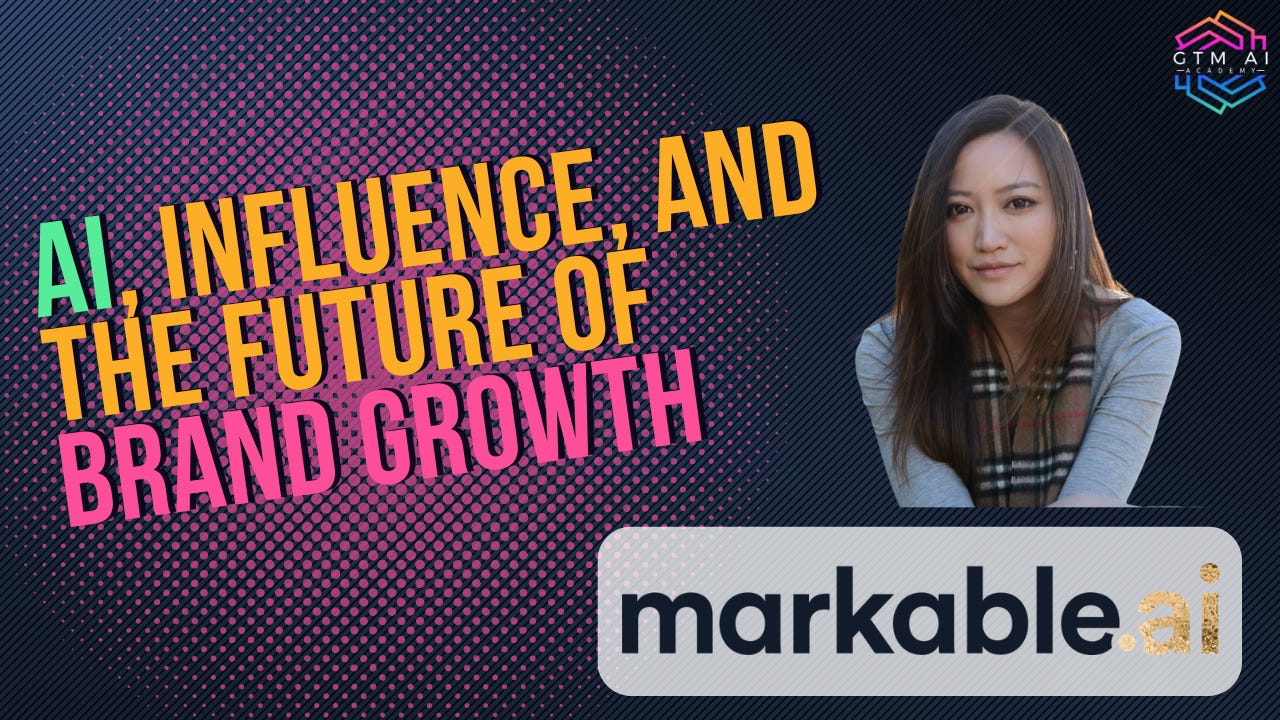
Season 2, Episode 9 with Joy Tang the CEO of Markable AI
GTM AI Tool of the week: Empler AI
And the features in the free newsletter this week are:
Multi-Agent prompting
ChatGPT 4.5 Review vs Claude 3.7 and Grok 3
AI Startups Growth is Beyond SaaS
For you who like to listen, here are our AI friends going over this weeks newsletter:
With that being said, lets get into the podcast!
You can go to Youtube, Apple, Spotify as well as a whole other host of locations to hear the podcast or see the video interview.
AI, Influence, and the Future of Brand Growth: What GTM Leaders Need to Know
Some of the best conversations happen when you least expect them. That’s exactly how I met Joy Tang the CEO of Markable AI . A random seating arrangement on a flight back from Austin turned into a deep, three-hour conversation covering everything from business and AI to personal stories and leadership. Joy isn’t just a CEO, she’s a visionary who sees the intersection of AI, brand influence, and revenue strategies with a unique clarity.
Joy shares insights on AI’s role in marketing, how brands can leverage technology to drive real impact, and why authenticity in leadership matters more than ever. She breaks down the evolution of AI-generated content, the challenges and opportunities brands face in an AI-driven landscape, and the key principles guiding her approach at Markable. Whether you’re a sales leader, marketer, or founder, her perspective on aligning AI with GTM strategy is one you don’t want to miss.
One of the most compelling parts of the conversation is Joy’s take on where AI is heading. She doesn’t just talk about what’s happening today, she maps out how brands should prepare for the next five years. Her insights challenge the way we think about content, creativity, and influence in an AI-first world.
If you’re looking to sharpen your understanding of AI’s impact on GTM, get ahead of industry shifts, or just hear from someone who’s shaping the future, this episode is for you.
Key Highlights for GTM Professionals:
1. AI-Generated Content is No Longer Optional
- Brands that don’t integrate AI into their marketing will fall behind. AI isn't replacing human creativity—it’s enhancing it.
2. Authenticity in Leadership Matters More Than Ever
- AI can optimize processes, but trust and genuine human connection remain irreplaceable in sales and branding.
3. The Future of Influence is AI-Powered
- Brands need to rethink how they leverage AI in influencer marketing and brand storytelling. Consumers will expect hyper-personalized, AI-generated experiences.
4. Sales and Marketing Need a Unified AI Strategy
- GTM teams should move beyond basic automation and use AI for deeper insights, predictive analytics, and hyper-targeted engagement.
5. The Next Five Years Will Redefine Brand Differentiation
- AI isn’t just about efficiency; it’s about crafting unique, high-value experiences at scale. Companies that embrace this will dominate their industries.
Actionable Takeaways:
1. AI is the New Creative Partner, Not a Replacement
Key Insight: Many brands still think of AI as just a tool for automation, but the real power lies in how it enhances creativity. AI can generate content, but humans provide the strategy, storytelling, and emotion that make it effective.
Actionable Steps:
Audit your content creation process – Identify where AI can help streamline tasks (e.g., idea generation, content repurposing, audience segmentation).
Test AI-driven personalization – Use AI to craft different versions of content tailored to specific customer segments.
Combine AI with human creativity – Have AI generate initial drafts of content, but refine them with human insight to maintain authenticity.
Example: Instead of manually crafting marketing emails for different personas, use an AI tool like Jasper or Copy.ai to generate personalized versions based on customer behavior, then refine them with brand voice and emotion.
2. Influence is Changing: AI-Powered Brand Storytelling is the Future
Key Insight: Traditional influencer marketing is evolving. AI-generated content, virtual influencers, and hyper-personalized storytelling will redefine how brands engage audiences. Consumers expect relevance and authenticity, even from AI-generated experiences.
Experiment with AI-generated video and voice content – Tools like Synthesia or ElevenLabs allow brands to create scalable, AI-powered videos with human-like narration.
Develop AI-driven micro-influencer campaigns – Instead of relying only on big-name influencers, use AI to identify and engage niche, high-impact brand advocates.
Leverage AI for brand sentiment analysis – Monitor how audiences are responding to AI-generated content and refine based on engagement data.
Example: A SaaS company could use AI to generate product demo videos that feel personalized for different industries, leveraging AI-powered avatars to scale content without hiring dozens of presenters.
3. AI-Driven GTM Strategies Need to Be More Than Just Automation
Key Insight: Sales and marketing teams often think of AI in terms of automation—chatbots, email workflows, and lead scoring. But AI’s biggest impact is in predictive insights and strategic decision-making.
Move beyond basic automation – Use AI for deeper insights, like predicting customer churn or analyzing deal patterns.
Deploy AI in account-based marketing (ABM) – AI can hyper-personalize outreach based on real-time engagement data.
Invest in AI-powered revenue intelligence – Platforms like Momentum.io can surface key sales trends and customer signals.
Example: Instead of just automating email sequences, use AI to analyze deal conversations, identify objections, and train reps on high-impact messaging that closes deals faster.
4. AI for Hyper-Personalization: The New Competitive Advantage
Key Insight: Generic marketing is dying. Consumers expect highly personalized experiences, and AI makes it possible at scale.
Use AI to create dynamic customer journeys – Implement AI-driven recommendation engines to serve content or offers based on real-time behavior.
Train your AI models with first-party data – The more personalized your AI’s inputs, the more relevant the outputs will be.
Test AI-generated personalized video or email campaigns – AI can generate hyper-customized content in seconds.
Example: A B2B SaaS company can use AI to tailor demo videos based on a prospect’s role, industry, or past interactions with their website—delivering a personalized experience without manual effort.
5. The Biggest Risk with AI is Not Using It
Key Insight: Joy made it clear: The brands that hesitate to integrate AI will get left behind. AI is not just a trend—it’s a fundamental shift in how GTM teams operate.
Start small, but start now – Identify one area (content, sales intelligence, customer engagement) where AI can make an immediate impact.
Train your team on AI best practices – AI literacy is becoming a competitive advantage.
Measure and iterate – Track AI-driven initiatives and optimize based on real data.
Example: A sales team that integrates AI-driven coaching (like
5 Key Quotes from Joy:
1. "AI isn’t here to replace creativity—it’s here to scale it in ways we’ve never seen before."
2. "The companies winning today aren’t just using AI; they’re integrating it into every layer of their go-to-market strategy."
3. "If you’re not thinking about AI-generated influence, you’re already behind. The way brands connect with audiences is changing fast."
4. "It’s not just about automation. It’s about creating something so valuable that customers feel like it was made just for them."
5. "The biggest risk in AI isn’t using it wrong—it’s not using it at all."

(As an FYI, we cover how to build agents, or multi-agent frameworks or agent teams in both the GTM AI Academy and the AI Business Network
In a recent Forbes Article by Dr. Lance Elliot, a world renowned AI Scientist, he goes over what exactly is Multi-Agent prompting. I wanted to connect the dots from his thoughts to GTM and how we apply it. (As a hint for our GTM AI Tool of the week, you can build these multi agents in Empler.ai as well as other platforms like Relevanceai.io)
Mastering Multi-Agent AI Prompting: A Guide for GTM Professionals
The evolution of multi-agent AI systems is fundamentally changing how Go-to-Market (GTM) teams approach automation, decision-making, and strategic execution. Dr. Lance Eliot’s article on advanced multi-agent prompting highlights how AI is moving beyond simple single-agent interactions and into complex agent collaboration models that optimize workflows.
For GTM professionals, this shift has enormous implications:
✅ Sales teams can leverage multi-agent AI for automated lead scoring, outreach, and deal intelligence.
✅ Marketing teams can create dynamic content workflows with AI-driven campaign optimizations.
✅ Customer success teams can deploy AI agents to automate onboarding, support, and retention strategies.
✅ RevOps teams can use AI for forecasting, pipeline insights, and process automation.
This in-depth guide explores how GTM leaders can effectively prompt multi-agent AI models, optimize decision-making, and scale AI-driven workflows using best practices from Eliot’s framework.
1. What is Multi-Agent AI? Why Does It Matter for GTM Teams?
🔹 The Shift from Single AI Agents to Multi-Agent Orchestration
Traditionally, AI models have operated in isolation, meaning that a single AI model (like ChatGPT, Claude, or Gemini) would handle a task from start to finish.
Multi-agent AI changes the game by allowing multiple AI agents to collaborate dynamically.
📌 Example:
Instead of one AI handling sales prospecting, multi-agent AI could coordinate several specialized agents:
✅ A Lead Research Agent that gathers firmographic and intent data.
✅ A Qualification Agent that scores leads based on historical conversion data.
✅ An Outreach Agent that personalizes email sequences based on previous interactions.
✅ A Scheduling Agent that automatically books calls based on rep availability.
🚀 Why This Matters for GTM:
Multi-agent AI allows teams to automate complex workflows that traditionally required multiple human roles.
AI orchestration improves efficiency, scalability, and accuracy in sales and marketing operations.
Manual data entry, outreach, and follow-ups can now be fully AI-driven, freeing up GTM teams for high-value activities.
2. Two Approaches to Multi-Agent Prompting: Driver vs. Passenger
Dr. Eliot outlines two core strategies for effectively prompting multi-agent AI systems:
1️⃣ Driver’s Seat Approach (Explicit Agent Selection)
You specify exactly which AI agents to invoke and define their sequence of actions.
Best for: High-control scenarios where AI decisions need tight oversight.
2️⃣ Passenger’s Seat Approach (Supervising AI Selects Agents)
You describe the outcome or task, and AI decides which agents to deploy and in what order.
Best for: Dynamic, fast-moving workflows where AI optimizes execution on the fly.
📌 GTM Use Case:
Sales Automation Example
Driver’s Seat: Manually instruct AI to gather leads → qualify them → personalize outreach → schedule meetings.
Passenger’s Seat: Instruct AI to automate lead conversion, letting it decide the optimal workflow and agents.
🚀 Why This Matters for GTM:
GTM teams can customize AI workflows based on control needs (structured vs. flexible execution).
The driver’s seat approach is ideal for critical workflows, while the passenger’s seat approach scales AI execution dynamically.
3. How to Prompt Multi-Agent AI: Step-by-Step Examples
Dr. Eliot provides a multi-agent AI framework using five specialized coding agents:
1️⃣ CodeFixer – Debugs and optimizes code.
2️⃣ CodeReviewer – Reviews code for best practices.
3️⃣ BugHunter – Identifies security vulnerabilities.
4️⃣ PerfAnalyzer – Evaluates code performance.
5️⃣ DocWriter – Generates technical documentation.
We will apply this structure to a GTM scenario by creating a multi-agent AI workflow for sales pipeline management.
🔹 Driver’s Seat Example: Manual AI Agent Selection
💡 Scenario: Automating GTM sales pipeline analysis
📌 Prompt (Driver’s Seat Approach)
**"I need a comprehensive pipeline analysis. Please run the following AI agents in this sequence:
LeadScraper – Extracts the latest leads from CRM and enriches with firmographic data.
ScoringBot – Assigns a lead score based on historical deal success rates.
FollowUpAI – Determines the next best action for each lead and drafts outreach messages.
MeetingScheduler – Books calls for sales reps based on prospect engagement.
Once these agents complete their tasks, provide a summary of lead prioritization and suggested follow-ups."**
🚀 AI Response:
✅ "Running LeadScraper, ScoringBot, FollowUpAI, and MeetingScheduler in the specified order. Lead analysis will be available in 2 minutes."
🔹 Passenger’s Seat Example: AI-Decided Agent Execution
💡 Scenario: Automating sales workflow without pre-defining agents
📌 Prompt (Passenger’s Seat Approach)
"I need to optimize our pipeline by identifying the highest-priority leads and ensuring personalized outreach. Use the necessary AI agents to complete this process, ensuring that scheduling is automated for engaged prospects."
🚀 AI Response:
✅ "Analyzing lead pipeline… Deploying LeadScraper, ScoringBot, and FollowUpAI.
✅ Prioritizing high-value leads based on engagement metrics.
✅ Automating outreach with personalized messaging and scheduling for top-tier prospects.
✅ Process complete. Summary and action recommendations are ready."
4. Best Practices for Multi-Agent AI in GTM Workflows
🔹 5 Rules for the Driver’s Seat Approach (Explicit Agent Selection)
📌 When to Use: You need full control over AI workflows
1️⃣ Clearly specify which AI agents should be used and their exact sequence.
2️⃣ Ensure that AI agents share data effectively (define input/output connections).
3️⃣ Check for overlaps between agent capabilities (e.g., multiple agents performing lead scoring).
4️⃣ Test individual agents first before deploying them in a sequence.
5️⃣ Use structured prompts to avoid AI confusion and misinterpretation.
🔹 5 Rules for the Passenger’s Seat Approach (AI-Decided Agent Execution)
📌 When to Use: You need flexibility and automation at scale
1️⃣ Describe the outcome you want, not the specific AI agents to use.
2️⃣ Allow AI to dynamically decide agent selection and workflow sequencing.
3️⃣ Ask AI to explain which agents it selected and why for transparency.
4️⃣ Provide constraints or guidelines (e.g., prioritize speed, accuracy, or engagement).
5️⃣ Iterate with AI to refine the workflow over time based on performance data.
🚀 Why This Matters for GTM:
GTM professionals can customize AI execution based on strategy (manual vs. AI-driven).
Optimizing agent sequencing improves efficiency, reducing costs and improving AI effectiveness.
Refining AI workflows over time ensures continuous process optimization.
5. Final Thoughts: Why GTM Leaders Must Master Multi-Agent AI Prompting
🔹 Key Takeaways for GTM Teams
✅ Multi-agent AI systems allow for complex, automated GTM workflows that save time and increase accuracy.
✅ Driver’s seat prompting is best for structured execution, while passenger’s seat prompting enables flexible AI automation.
✅ AI-powered workflows improve lead qualification, sales execution, and customer engagement at scale.
✅ GTM teams must iterate and refine AI workflows continuously to maximize ROI.
🔹 What GTM Professionals Should Do Next
📌 Step 1: Identify where AI agents can automate key GTM workflows (e.g., sales, marketing, RevOps).
📌 Step 2: Experiment with both driver’s seat and passenger’s seat prompting to optimize agent selection.
📌 Step 3: Track AI performance metrics (e.g., lead conversion rates, outreach response rates) and refine workflows accordingly.
📌 Step 4: Scale multi-agent AI adoption across GTM teams to increase efficiency and drive growth.
Top Platforms for Multi-Agent AI Orchestration (Including Empler AI)
If you're looking to implement multi-agent AI for GTM workflows, these platforms enable AI agent orchestration with varying levels of customization, automation, and integrations:
1️⃣ Empler AI – No-Code AI Agent Teams for GTM
✅ Build & deploy AI agent teams without coding
✅ Pre-built AI templates for sales, marketing, and customer success
✅ Best for: GTM teams automating prospecting, outreach, and workflow execution
2️⃣ OpenAI’s Operator – AI Agents for Task Execution
✅ Automates web-based tasks (browsing, form-filling, research)
✅ Uses GPT-4o and reasoning models
✅ Best for: Automating market research, data gathering, and workflow automation
3️⃣ Perplexity AI Comet – AI Agent Browser & Research Tool
✅ Autonomous web browsing and data extraction
✅ Agentic research workflows for insights & trend analysis
✅ Best for: Automating competitive research and lead intelligence
4️⃣ Anthropic’s Claude API (Claude 3.5 & Claude Code)
✅ Supports agent-based automation for coding & reasoning tasks
✅ Multi-agent execution via Claude Code for development workflows
✅ Best for: Automating technical workflows, software development, and decision-making
5️⃣ LangChain – Agentic AI Development Framework
✅ Advanced AI agent orchestration with API integrations
✅ Best for developers building multi-agent LLM applications
✅ Best for: Engineering teams building custom AI workflows and automation
6️⃣ AutoGen by Microsoft – Multi-Agent AI Framework
✅ Supports autonomous AI agents that collaborate on tasks
✅ Advanced planning and execution strategies
✅ Best for: AI-driven process automation & autonomous decision-making
🔗 Explore AutoGen
7️⃣ Hugging Face Transformers & Agents
✅ Fine-tune AI agents with open-source LLMs
✅ Supports custom agent logic for text, vision, and decision-making
✅ Best for: AI-powered enterprise automation & research
Quick Summary:
PlatformBest Use CaseEmpler AIGTM workflow automation (Sales, Marketing, RevOps)OpenAI OperatorTask automation & researchPerplexity CometAI-powered web browsing & insightsClaude APIMulti-agent reasoning & technical workflowsLangChainCustom agent developmentAutoGen (Microsoft)AI-driven autonomous executionHugging Face AgentsOpen-source AI agent customization
🚀 Best for GTM Teams? Empler AI + OpenAI Operator + Perplexity Comet 🔥
💡 Want full customization? Use LangChain or AutoGen to develop agentic AI from scratch.

GPT-4.5 for Enterprise: A High-Cost Model with Unique Strengths—What GTM Leaders Should Know
This came from the VentureBeat article by Ben Dickson originally. The release of GPT-4.5 has been met with mixed reactions—while it boasts improved accuracy, knowledge, and document processing, its cost is significantly higher than models like Claude 3.7 Sonnet and OpenAI’s own GPT-4o.
For Go-To-Market (GTM) professionals, revenue leaders, and AI-driven teams, the key question is:
✅ Does GPT-4.5 provide enough value to justify its cost?
✅ Where should GTM teams strategically deploy it?
✅ How can businesses balance performance vs. efficiency in AI model selection?
This deep dive explores the capabilities, limitations, and strategic use cases for GTM professionals evaluating GPT-4.5.
1. Key Takeaways from GPT-4.5: Strengths and Limitations
🔹 Strengths of GPT-4.5
✅ Improved factual accuracy & knowledge – Trained on 10X more compute, leading to better real-world knowledge and fewer hallucinations.
✅ Best model for document processing – 19% more accurate than GPT-4o at extracting information from unstructured data like legal and financial documents.
✅ Better at multi-step planning – Stronger at breaking down complex tasks, making it a great high-level decision-making tool.
✅ Performs well in LLM-as-a-Judge tasks – Can evaluate and refine responses generated by smaller models.
🔹 Limitations of GPT-4.5
❌ Insanely expensive – 10–30X higher cost than other leading models.
❌ Not a reasoning model yet – Performs well on knowledge-based tasks, but not superior in math, coding, or logic-heavy workflows.
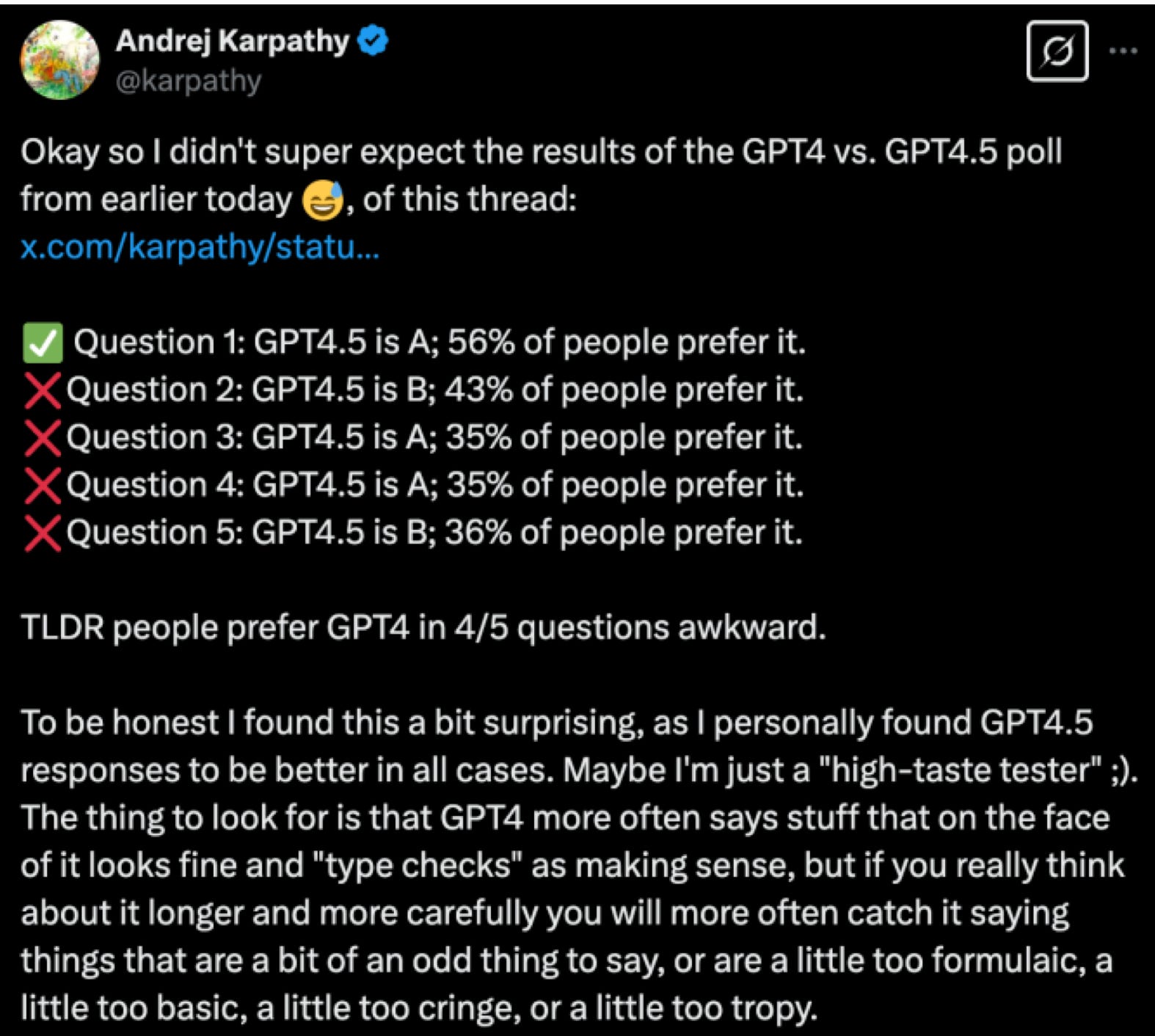
❌ Subjective writing improvements – While OpenAI claims better writing quality, early user tests found that some preferred GPT-4o’s responses instead.
🚀 What This Means for GTM Teams:
GPT-4.5 is not the go-to model for reasoning tasks—you’ll still want o3, Claude 3.7, or specialized coding models for deep problem-solving.
The model’s high cost makes it suitable only for premium enterprise use cases where accuracy and data integrity are mission-critical.
GTM teams need to balance AI cost vs. performance—GPT-4.5 is a powerful tool, but not always necessary.
2. Where Does GPT-4.5 Shine? Enterprise Use Cases
🔹 1. Enterprise-Grade Document Processing
One of the standout capabilities of GPT-4.5 is document processing and information retrieval, making it a strong choice for enterprises dealing with high-volume, complex data.
📌 Best Use Cases:
✅ Legal Teams – Extract key clauses from thousands of contracts with 19% more accuracy than GPT-4o.
✅ Financial Analysts – Answer complex financial queries from reports, filings, and earnings statements.
✅ Regulatory Compliance – Automate compliance audits by analyzing unstructured regulatory documents.
🚀 GTM Impact:
Customer success teams can use GPT-4.5 for advanced support cases requiring deep document parsing.
RevOps and finance teams can leverage it for risk analysis, contract management, and deal intelligence.
🔹 2. AI-Assisted Planning & Decision Support
Given its deeper world knowledge, GPT-4.5 can function as a high-level strategic assistant, breaking down tasks and directing execution to smaller models.
📌 Best Use Cases:
✅ Sales Strategy Planning – Automate pipeline forecasting and territory optimization based on historical win rates.
✅ Marketing Campaign Planning – Generate step-by-step multi-channel marketing strategies tailored to industry trends.
✅ Executive Briefing & Decision Support – Summarize industry reports and surface key competitive insights.
🚀 GTM Impact:
AI-driven decision-making can optimize marketing and sales execution.
GTM teams can use GPT-4.5 to improve strategic planning and leadership insights.
🔹 3. "LLM-as-a-Judge" for AI Workflow Refinement
Another major strength of GPT-4.5 is its ability to review, evaluate, and refine responses from smaller, faster AI models.
📌 Best Use Cases:
✅ AI Content Review – Smaller AI models (e.g., GPT-4o, Claude 3.7) generate marketing content, and GPT-4.5 refines it for consistency and accuracy.
✅ Code Review & QA – GPT-4o or o3 generates code, while GPT-4.5 checks for vulnerabilities and optimizations.
✅ Sales Enablement Refinement – AI-generated pitch decks and proposals can be reviewed for tone, compliance, and messaging accuracy.
🚀 GTM Impact:
AI-assisted content review ensures that messaging remains on-brand and compliant.
Multi-model AI workflows enable faster, cheaper execution without sacrificing quality.
3. How GTM Professionals Should Approach GPT-4.5 Adoption
🔹 When Should GTM Teams Use GPT-4.5?
📌 Use GPT-4.5 when:
✅ Accuracy is non-negotiable (e.g., legal, compliance, financial modeling).
✅ Enterprise-scale document processing is required.
✅ Multi-step workflows need high-level planning AI.
✅ AI model evaluation and refinement is needed.
📌 Do NOT use GPT-4.5 when:
❌ You need fast, cost-effective AI for general automation—use GPT-4o or Claude 3.7 instead.
❌ You need advanced reasoning (math, logic-heavy tasks)—use o3 or a dedicated reasoning model.
❌ You’re looking for writing quality improvements—GPT-4o is already competitive at a lower cost.
🚀 GTM Takeaway:
GPT-4.5 is best used selectively, NOT as an everyday AI model.
GTM leaders should integrate it into workflows where its strengths matter most.
Smaller, faster models should still be the default for most automation.
4. What’s Next? The Future of GPT-4.5 and AI Model Costs
🔹 The Cost Challenge: Will GPT-4.5 Become Affordable?
The biggest challenge of GPT-4.5 is its cost—but history suggests that inference costs will decline.
📌 What GTM Leaders Should Expect:
✅ GPT-4.5 will likely become cheaper over time, making it more viable for automation at scale.
✅ Future reasoning models will build on GPT-4.5’s foundation, offering even better decision-making AI.
✅ Businesses should prepare to integrate GPT-4.5 into workflows where high accuracy is critical.
🚀 GTM Strategy Recommendation:
Experiment with GPT-4.5 for key workflows where accuracy is a top priority.
Monitor cost trends to assess when GPT-4.5 becomes more viable for broader use.
Stay updated on OpenAI’s next-gen reasoning models, as these will likely be more powerful and cost-efficient.
Final Thoughts: GPT-4.5 is a Strategic AI Asset—But Not for Everyone
🔹 Key Takeaways for GTM Leaders
✅ GPT-4.5 excels at high-accuracy tasks but is too expensive for general automation.
✅ GTM teams should use it selectively for enterprise document processing, AI-assisted planning, and content refinement.
✅ Smaller, cheaper models like GPT-4o and Claude 3.7 should remain the default for most AI-driven GTM workflows.
✅ Future AI cost declines will make GPT-4.5 and its successors more practical for widespread adoption.
💡 The Bottom Line:
GPT-4.5 is not a must-have for every GTM team, but it is a powerful tool when used strategically. Knowing when and where to deploy it will separate AI-driven market leaders from those wasting budget on unnecessary AI costs. 🚀
Stripe’s Annual Letter: AI Startups Are Growing Faster Than SaaS Ever Did
In its latest annual letter, Stripe has declared what many in the industry have already suspected—AI startups are scaling at an unprecedented rate, outpacing even the fastest-growing SaaS companies of the past decade. The payment giant’s data paints a compelling picture: the top 100 AI startups in 2024 reached $5 million in annualized revenue in just 24 months, a pace that significantly outstrips the 37 months it took for the top 100 SaaS companies in 2018 to hit the same milestone.
The letter, penned by co-founders Patrick and John Collison, underscores the AI-driven shift that is rapidly reshaping business economics. Unlike traditional SaaS, which evolved over decades to become a dominant force in software, AI-native companies are scaling in ways that were previously unimaginable. Stripe’s data suggests that AI startups are achieving hockey-stick growth at rates SaaS founders could only dream of—and it’s not just because of hype, but because AI is fundamentally changing how businesses operate, integrate, and monetize software.
The examples speak for themselves. The AI-powered coding assistant Cursor has exceeded $100 million in annual revenue, while Lovable reached $17 million ARR in just three months, and Bolt hit $20 million ARR in two months. These numbers are not just impressive—they’re transformational. The ability for AI startups to scale this fast suggests that the economics of AI-driven businesses are inherently different from the traditional SaaS playbook.
AI Is Not Just an LLM Wrapper—It’s Reshaping Entire Industries
One of the most striking takeaways from Stripe’s letter is its dismissal of the notion that many AI startups are merely “LLM wrappers.” The term has often been used to describe AI startups that build on top of foundation models like OpenAI’s GPT, Google’s Gemini, or Anthropic’s Claude. Critics argue that these businesses are too dependent on third-party AI infrastructure and will struggle to build long-term moats.
Stripe, however, sees it differently.
The Collison brothers argue that industry-specific AI applications are not just wrappers—they are fundamentally changing workflows, unlocking efficiencies, and creating new economic value that wouldn’t be possible without LLMs. This shift mirrors the early SaaS evolution, where horizontal platforms like Salesforce paved the way for verticalized solutions like Toast in restaurants or Procore in construction.
Now, we are seeing a similar evolution in AI.
AI-powered healthcare tools like Abridge, Nabla, and DeepScribe are revolutionizing how patient data is recorded and analyzed, reducing administrative burden and improving care quality.
Architectural AI like SketchPro is transforming design workflows, allowing architects to generate and refine plans faster than ever before.
AI-driven legal tech is streamlining contract review and compliance, while finance AI is automating bookkeeping, fraud detection, and risk modeling.
This pattern suggests that AI isn’t just another wave of software—it’s fundamentally redefining industries. The companies that will win are not just those that integrate LLMs, but those that apply AI in ways that transform entire workflows, automate tasks previously thought impossible, and embed themselves deeply into mission-critical processes.
The Vertical SaaS Parallel: AI’s Expansion into SMBs
While AI is capturing much of the attention, Stripe remains bullish on vertical SaaS, particularly in the SMB space. The letter notes that 6.3% of small businesses powered by vertical SaaS platforms on Stripe earned $1 million in revenue in their first year—nearly 60% more than in a comparable benchmark group.
The reason for this, Stripe argues, is simple: AI-powered vertical SaaS companies create more value for their customers than traditional software ever could. By combining AI automation with deep industry expertise, these businesses enable SMBs to compete at levels that were previously only available to large enterprises.
The implication here is AI-driven SaaS may finally unlock the full economic potential of vertical markets. In the past, vertical SaaS companies struggled with higher customer acquisition costs, longer sales cycles, and limited market sizes compared to horizontal SaaS. But AI changes that equation—automating sales, reducing onboarding friction, and enabling hyper-personalized customer experiences that drive faster adoption and stronger retention.
This is a huge signal to GTM professionals. If vertical SaaS companies powered by AI can achieve better retention, GTM teams must rethink how they position, sell, and scale AI-native products.
What This Means for GTM Leaders and AI-Driven Sales & Marketing Teams
The AI boom is real, and GTM leaders cannot afford to ignore it. The playbooks that worked for traditional SaaS sales, marketing, and customer success teams need to be rethought.
1. AI-Native Companies Scale Faster—GTM Teams Must Adapt
The fact that AI startups are scaling faster than SaaS ever did means that GTM teams need to operate at an entirely new level of speed and efficiency. The traditional enterprise sales cycle—long discovery, multiple demos, and drawn-out procurement—is being replaced by AI-powered, data-driven sales motions.
2. AI-First Companies Need AI-First GTM Strategies
AI-native businesses cannot afford to run traditional playbooks. Instead, GTM teams need to:
Automate prospecting and lead qualification using AI-driven tools.
Use AI-powered chatbots and autonomous agents to handle customer support and engagement.
Deploy AI-driven personalization at scale, ensuring that every touchpoint—from marketing emails to sales calls—is hyper-targeted based on real-time insights.
3. Rethink Pricing Models and Customer Onboarding
One of the biggest differences between AI startups and traditional SaaS is how they monetize. Many AI companies are consumption-based rather than subscription-based, meaning that GTM teams must be adept at driving adoption rather than just securing long-term contracts.
For instance, an AI-driven legal tech startup might charge based on documents processed, rather than a flat monthly fee. This changes how GTM teams approach sales, onboarding, and customer success.
4. Vertical AI Solutions Will Dominate—Industry Expertise Will Be Key
Stripe’s focus on industry-specific AI applications suggests that GTM professionals must become deep industry specialists. It won’t be enough to simply sell AI as a general solution—sales teams must be trained to understand industry pain points, compliance requirements, and operational workflows.
For example, selling an AI-driven medical documentation tool will require deep knowledge of HIPAA regulations, physician workflows, and hospital IT systems—not just AI’s capabilities.
5. The GTM Motion for AI Will Be Product-Led and Community-Driven
The rapid growth of AI startups like Cursor, Lovable, and Bolt suggests that word-of-mouth, viral adoption, and strong network effects are driving success. Instead of traditional **outbound sales motions, GTM teams must leverage:
Self-serve onboarding and free trials to let users experience AI’s value firsthand.
Community-led growth, where early adopters become evangelists.
Ecosystem partnerships, integrating AI-powered solutions into existing enterprise platforms.
Final Thoughts: AI is Not Just a Trend—It’s a Fundamental Market Shift
Stripe’s annual letter provides clear evidence that AI-native companies are scaling at unprecedented speeds. The traditional SaaS playbook is not enough—GTM leaders must rethink how they approach AI-driven sales, marketing, and customer success.
AI-first companies require AI-first GTM motions—those who adapt will dominate, while those who stick to legacy sales models risk falling behind. The next decade of GTM leadership belongs to those who master AI-driven growth strategies. 🚀
GTM AI Tool of the week: Empler AI
Empler AI: The AI Agent Team Platform Built for GTM Professionals
In today's fast-paced Go-to-Market (GTM) landscape, the need for AI-driven automation and team collaboration has never been greater. GTM teams across sales, marketing, customer success, and operations need intelligent tools that automate workflows, enhance productivity, and scale outreach—without requiring deep technical expertise.
That’s where Empler AI comes in.
Empler AI is an AI-powered agent team platform designed specifically for GTM teams to create, manage, and deploy AI-driven workflows with no-code automation. With AI chat assistants, automated workflows, and scalable AI tool creation, Empler AI enables professionals to work smarter, not harder.
This in-depth review explores Empler AI’s features, how GTM teams can leverage it, and why it could be a game-changer in the AI-powered sales, marketing, and customer engagement revolution.
1. What is Empler AI? A New Era of AI-Driven GTM Execution
Empler AI is an agentic AI platform that enables teams to: ✅ Build and deploy AI-powered sales, marketing, and customer success workflows ✅ Automate repetitive GTM tasks without coding ✅ Enhance team collaboration using AI assistants and chatbots ✅ Scale AI capabilities through pre-built templates and workflow automation
With 75+ pre-built AI templates, an Auto AI Tool Builder, and seamless workflow integration, Empler AI is designed to streamline every part of the GTM motion—from lead generation to customer success.
🚀 GTM Impact:
Sales teams can automate outreach, lead qualification, and CRM updates.
Marketing teams can generate AI-driven content, campaign assets, and customer insights.
Customer success teams can deploy AI agents to improve onboarding and customer support.
RevOps professionals can automate data entry, reporting, and analytics.
Bottom Line: Empler AI is built for GTM teams that want to work more efficiently, automate workflows, and integrate AI into daily operations without needing to code.
2. Key Features of Empler AI for GTM Teams
🔹 1. Auto AI Tool Builder – Build AI Agents in Seconds
💡 What it Does:
Instantly create AI-powered tools in under 15 seconds using simple prompts.
No technical expertise required—just input your use case, and AI builds the tool.
Automates repetitive GTM tasks, such as prospecting, follow-ups, and content creation.
📌 GTM Use Cases: ✅ Sales reps can generate AI-driven outreach templates for different industries. ✅ Marketers can build AI tools to generate ad copy or landing pages. ✅ Customer success teams can automate personalized onboarding flows.
🚀 Why it Matters for GTM:
No-code AI automation lets non-technical teams leverage AI instantly.
Drastically reduces the time spent on manual tasks.
Allows for rapid experimentation and scaling of AI-driven workflows.
🔹 2. Pre-Built AI Templates – 75+ Ready-to-Use AI Workflows
💡 What it Does:
Gives teams instant access to 75+ Generative AI (GenAI) templates tailored for: ✅ Marketing automation (content creation, campaign analytics, SEO insights) ✅ Sales outreach (AI-generated email sequences, lead enrichment, follow-up automation) ✅ Customer support (AI-driven chatbots, FAQ automation, ticket triaging)
📌 GTM Use Cases: ✅ Sales leaders can use AI templates to automate outbound sequences. ✅ CMOs can generate AI-driven content faster, optimizing marketing campaigns. ✅ RevOps professionals can set up automated reporting dashboards.
🚀 Why it Matters for GTM:
Reduces time spent manually building AI workflows from scratch.
Optimized for GTM professionals, not just engineers or data scientists.
Accelerates AI adoption in sales and marketing without complex integrations.
🔹 3. AI Chat Assistants – Your AI-Powered Team Members
💡 What it Does:
Enables GTM teams to create AI chat assistants that can: ✅ Assist with customer inquiries in real time. ✅ Support internal team collaboration by handling FAQs and data lookups. ✅ Integrate with CRMs and marketing platforms to provide instant insights.
📌 GTM Use Cases: ✅ AI-powered SDR assistant handles initial prospect conversations. ✅ AI marketing assistant generates audience insights on demand. ✅ AI sales assistant suggests personalized follow-ups based on CRM data.
🚀 Why it Matters for GTM:
Automates customer and prospect interactions at scale.
Enhances team efficiency by reducing time spent on repetitive queries.
Improves customer engagement with AI-driven, context-aware responses.
🔹 4. Bulk Operations & Workflow Automation – Scale GTM Efforts
💡 What it Does:
Automates large-scale GTM workflows with Excel integration and bulk operations.
Allows teams to process thousands of records at once, reducing manual effort.
📌 GTM Use Cases: ✅ Upload bulk leads and have AI qualify them automatically. ✅ Generate and schedule content at scale for multi-channel campaigns. ✅ Automate customer success workflows for faster ticket resolution.
🚀 Why it Matters for GTM:
Scales AI-powered GTM operations without requiring a larger team.
Eliminates time-consuming manual tasks like lead processing and data entry.
Ensures consistency in customer outreach and follow-ups.
3. How GTM Teams Can Measure the ROI of Empler AI
🔹 How to Quantify AI Impact in Sales & Marketing
📌 Sales Efficiency Metrics ✅ Time saved per rep per week on prospecting ✅ Increase in Sales Qualified Leads (SQLs) from AI-driven outreach ✅ Faster deal cycles due to automated follow-ups
📌 Marketing Performance Metrics ✅ AI-generated content reducing campaign production time ✅ Higher engagement from AI-personalized campaigns ✅ Cost savings from replacing manual processes with AI automation
📌 Customer Success Metrics ✅ Reduction in response time for customer inquiries ✅ Higher retention rates from AI-driven engagement strategies ✅ Lower support ticket backlog due to AI-powered chat assistants
🚀 Why it Matters:
AI should be measured based on actual revenue impact, not just productivity gains.
GTM teams must track before-and-after data to show AI’s contribution to sales growth.
Understanding ROI helps justify AI investments and optimize AI workflows.
4. Final Thoughts: Why Empler AI is a Game-Changer for GTM Teams
🔹 Key Takeaways
✅ AI-driven automation is now essential for GTM success. ✅ Empler AI enables teams to deploy AI agents without coding, making AI adoption seamless. ✅ Sales, marketing, and customer success teams can automate and scale their workflows. ✅ AI agents can help businesses optimize lead generation, customer engagement, and revenue growth.
🔹 What GTM Leaders Should Do Next
1️⃣ Assess which GTM processes can be automated with AI. 2️⃣ Use Empler AI’s templates and Auto AI Tool Builder to deploy AI workflows. 3️⃣ Measure AI’s impact on revenue, engagement, and efficiency. 4️⃣ Continuously refine AI processes to improve lead conversion and customer retention.
🚀 Final Thought: Empler AI is not just another AI tool—it’s a full-fledged AI enablement platform for GTM professionals who want to automate, optimize, and scale their business operations using AI-powered agents.
Key Features:
Auto AI Tool Builder: Empler AI's standout feature is its Auto AI Tool Builder, which allows users to create customized AI tools in as little as 15 seconds. This functionality is particularly beneficial for teams aiming to streamline tasks without delving into complex coding processes.
Pre-Built AI Templates: The platform provides over 75 ready-to-use Generative AI (GenAI) tool templates. These templates cater to various business needs, including content generation, research, and customer relationship management (CRM), enabling teams to quickly deploy AI solutions aligned with their objectives.
AI Chat Assistants: Empler AI offers advanced AI chat assistants that facilitate project-based collaboration. Users can create AI agents equipped with integrations and tools, enhancing team communication and efficiency.
Bulk Operations: The platform supports bulk operations through Excel integrations, allowing users to perform multiple tasks simultaneously. This feature is particularly useful for managing large datasets and automating repetitive processes.
Workflow Automation: Empler AI's workflow-powered tools enable users to automate complex tasks, thereby increasing operational efficiency and reducing manual intervention.
User Feedback:
Empler AI has garnered positive reviews from its user base, achieving an overall rating of 4.4 out of 5 based on eight reviews as of November 2024. Users have highlighted the platform's convenience, versatility, and user-friendly interface. For instance, a content writer from a small business noted that Empler AI is "very convenient, improves my learning, and also helps me in my content writing by providing me with different ideas." g2.com
Another user from the higher education sector appreciated the platform's comprehensive feature set, stating, "It offers all the features that AI software can generate such as AI images, AI chat, and AI writing, and I loved the AI workplace for some features."
Pricing Structure:
Empler AI offers a tiered pricing model to accommodate various user needs:
Free Plan: Includes 1 user, 500 GPT-4 words, 2,500 GPT-3.5 words, 10 AI team credits, and 10 AI images per month.
Starter Plan ($19/month): Provides 1 user with 50,000 GPT-4 words, 200,000 GPT-3.5 words, 200 AI workflow credits, and 75 AI images per month.
Pro Plan ($49/month): Offers unlimited use for 1 user, including 500 AI workflow credits and 125 AI images per month.
Start-Up Plan ($99/month): Caters to 5 users with unlimited use, 1,000 AI workflow credits, and 250 AI images per month.
Growth Plan ($249/month): Designed for 15 users, offering unlimited use, 2,500 AI workflow credits, and 625 AI images per month.
Scale-Up Plan ($999/month): Suitable for 60 users, providing unlimited use, 10,000 AI workflow credits, and 1,500 AI images per month.
This flexible pricing structure ensures that both individuals and teams can select plans that best fit their requirements and budget. Originality.ai
Pros and Cons:
Pros:
User-Friendly Interface: Empler AI's intuitive design allows users without technical expertise to create and manage AI tools effectively.
Comprehensive Feature Set: The platform's extensive range of tools and templates caters to diverse business needs, from content creation to data analysis.
Scalability: With its tiered pricing and robust features, Empler AI can accommodate both small businesses and large enterprises.
Cons:
Pricing for Regular Users: Some users have expressed concerns about the pricing structure, suggesting it may be high for regular users.
Overwhelming Features: The vast array of features may be overwhelming for some organizations, making it challenging to utilize all relevant functionalities effectively. g2.com
Overall, an amazing tool, I have loved working with the team and seeing what is possible. I will be doing a more in depth case study showing what its capable of.
Let me know what you think, look forward to more!