

This is sponsored by the AI Business Network and GTM AI Academy
For the full breakdown of all these articles, you can read for free at the www.gtmaipodcast.com GTM AI Podcast
This week we have the following:
Season 2, Episode 13 with Jack Siney 🧢 CEO of FrontRace
GTM AI Tool of the week: Proxy.ai
And the features in the free newsletter this week are:
Hard Truth about AI in GTM
GTM AI Report from the GTM AI Academy
Cybernetic Teammate Research Study
AWS and Limitless Labor
Claude FINALLY updates to access internet
With that being said, lets get into the podcast!
You can go to Youtube, Apple, Spotify as well as a whole other host of locations to hear the podcast or see the video interview.
AI Metrics that win Deals and Unlock Sales Performance
Had a great chat with the CEO of FrontRace, Jack Siney 🧢 who went into detail with me on his own journey, why he thinks most people look at the wrong AI tech and metrics, and how to correct it quickly.
Understanding FrontRace: Solving the Data Overload
FrontRace isn't out to add just another tool to your already crammed tech stack. Instead, it unifies your existing data into one cohesive view, stripping away the chaos of dispersed platforms. “We aggregate everything you have today… and lets you see it in one view,” Jack explains. The power of this consolidation means you can pinpoint inefficiencies and potentials with precision.
The Problem with Data: Drowning and Discovering
The challenge, as Jack sees it, isn’t the lack of data but the overwhelming abundance of it. He believes many managers are inadvertently drowning in data, unsure where the real value lies. “I have all this data, what do I do with that?” Jack observes, highlighting a common predicament. To tackle this, FrontRace offers AI-powered insights that cut through the noise, presenting gold nuggets of wisdom that might otherwise remain buried.
The Shift: Forget Faster Horses, Think Flight
AI isn’t just another horse; it’s a completely different form of transportation. This shift in paradigm means abandoning old processes and embracing entirely new methodologies. Jack and I agreed on this transformative vision. “Instead of companies being open to… let me look at everything over, they’re trying to automate AI into a process they had 3, 4, 2 years ago,” Jack remarks. The implication is clear: evolve or risk obsolescence.
The Gold Nuggets: Finding Patterns in the Haze
Every manager likes to think they know their team's workflow inside and out. But Jack argues otherwise. In his experience, the reality is often a shock. “When we serve up the first data set to a customer… it’s never even close to what the manager thinks they’re doing,” Jack asserts. From finding out when teams are most productive to discovering which unheralded sales tactics yield the best outcomes, these insights can redefine organizational success.
Looking Forward: The Blue Ocean Awaits
As we forge ahead into this new AI-driven landscape, the conversation with Jack reminded me of the importance of readiness to pivot and adapt. While the potential is vast, so is the uncertainty. “The reality is, five years from now… the rest will either consolidate or peter away,” Jack predicts about AI companies. This era is about embracing the unknown and being open to change.
Final Thoughts
Jack’s closing thought summarizes the current state and the exciting yet daunting future ahead: “2030… the sales market will be so different than 2020. It’s not even funny. It’s gonna be crazy.” It's a brave new world out there, and with leaders like Jack, we're not just predicting the future; we're helping shape it.

GTM AI Tech of the week: Proxy AI
https://proxy.convergence.ai/
Proxy, the flagship product from Convergence AI, isn’t just another automation tool—it represents a
📌 What Is Proxy?
Proxy is an AI agent that acts like a "browser-native teammate"—able to
🧠 Key Features That Matter to GTM Professionals
1. Agent-Driven Workflow Automation
Proxy can automate workflows like:
Uploading prospect lists into CRMs
Submitting ad briefs into platforms like Google Ads or LinkedIn
Updating deal records in Salesforce
Navigating support portals to escalate tickets
Impact
2. No-Code Template Hub
Proxy offers a library of
Marketing Ops: Automate competitive research across websites for positioning updates
Sales: Auto-populate sales tools like Outreach or Apollo using lead form templates
Enablement: Create repeatable how-to workflows for onboarding reps or setting up tool integrations
Impact
3. Learning & Adaptation via LMLMs
Proxy agents don’t need to be rebuilt every time the UI of a website changes—they
4. Web-Native Execution Without APIs
Most GTM automation requires APIs or integrations. Proxy doesn’t. It interacts directly with the
Logging into a customer portal
Grabbing metrics from a competitor’s site
Comparing demo options across vendors
Posting or analyzing content on social platforms
Impact
🚀 Real-World Impacts by GTM Function
🔸 Sales
Auto-gather competitive insights before calls
Auto-fill follow-up emails or call summaries into CRM
Update forecast fields in Salesforce from spreadsheets ROI: Saves AE/SDR time, reduces admin work, and improves CRM hygiene.
🔸 Marketing
Submit and A/B test campaign variations across multiple platforms
Scrape event pages or community forums for GTM research
Monitor pricing pages for changes to competitor positioning ROI: Rapid response to market signals, faster campaign ops.
🔸 RevOps
Reconcile data from billing systems and CRM without an API
Auto-populate deal desk forms or approval workflows
Monitor and triage lead routing errors via web tools ROI: Better data quality, process automation across platforms.
🔸 Enablement
Record how-to flows with Proxy and turn them into live, re-runnable sequences
Auto-assist reps with tool navigation or onboarding processes
Monitor LMS or training platforms for engagement ROI: Onboards reps faster, reinforces workflows with minimal overhead.
🔸 GTM Leadership
Prototype GTM automations or test new tools with real browser interaction
Quickly audit website experiences across regions or devices
Benchmark competitors on pricing, messaging, or UX ROI: Increases speed to insight, improves visibility across competitive landscape.
⚠️ Considerations
Training time is minimal, but Proxy works best when GTM users define clear workflows and expectations.
Accuracy is strong (82% on the WebVoyager benchmark), but high-stakes workflows should still be reviewed before full deployment.
Security & compliance: GTM leaders should ensure Proxy operates within company guardrails and doesn’t access restricted systems without appropriate controls.
💡 Final Takeaway: Proxy Is GTM’s New Tactical Teammate
Proxy transforms web tasks that bog down reps and ops pros into fast, repeatable, AI-run processes. It gives non-technical GTM teams a low-lift, high-leverage way to automate across tools, reduce manual labor, and react to market signals in near real time.
Whether you're running campaigns, qualifying leads, or building enablement flows, Proxy doesn’t just help—it does. And in a time when execution speed defines competitive edge, Proxy offers a glimpse into the future of AI-empowered GTM teams.
In “The Hard Truth About What AI Will Do to GTM,” Mark Stouse delivers a clear-eyed, evidence-based, and unapologetically urgent thesis: AI is in the process of permanently breaking traditional B2B go-to-market (GTM) strategies, and most GTM professionals aren’t ready.
Rather than offering a superficial take on AI’s productivity benefits, Stouse’s article confronts the existential threat AI poses to outbound, persuasion-based marketing and sales. His position is backed by real signals from enterprise buyer behavior, tooling advancements, and internal enterprise AI adoption patterns.
This isn’t about automation — it’s about the power shift from vendors to buyers that AI enables, and what that means for every GTM function.
The Core Shift: From Persuasion to Proof
At the center of Stouse’s thesis is a paradigm collapse: traditional GTM is persuasion-based — get someone’s attention, persuade them you're the answer, and guide them through a vendor-led buying process.
But AI flips this dynamic. Buyers are already using AI to:
Bypass gated content through language models and summarization tools.
Analyze vendors, products, and pricing without ever contacting sales.
Avoid persuasion tactics by relying on AI-powered peer data, customer sentiment, and benchmarks.
Stouse warns: “Vendor marketing has gone from leading the dance in many ways to being led by the buyer.” The future is not persuasion. It’s proof — value demonstrated upfront, verifiable, and structured to align with buyer-driven, AI-mediated workflows.
What’s Dying: GTM Functions Facing Extinction by 2028
Stouse outlines a sobering set of predictions:
In Marketing:
Demand generation as we know it will collapse — no more MQL waterfalls or “lead nurturing.”
SEO and content arbitrage will be irrelevant as AI LLMs summarize and synthesize content directly.
B2B influencer marketing will lose trust and signal as AI detects bias and peer-sourced insights dominate.
Outbound performance marketing will be defeated by AI-driven content filters and blockers.
In Sales:
SDRs/BDRs will be replaced by AI-driven procurement bots doing vendor pre-screening.
Discovery and early demos will shift to self-guided AI trials and simulations.
Consultative selling will be supplanted by AI-led competitive modeling and ROI frameworks.
In Customer Success:
Manual onboarding and Tier 1-2 support will be handled by AI learning systems and self-diagnosing assistants.
Basic CSM-led interactions will fade as AI provides hyper-personalized guidance and troubleshooting.
What’s Thriving: The New GTM Core
Stouse is not nihilistic. Instead, he highlights the new center of gravity for GTM:
Causal AI and GTM Impact Analytics: GTM teams must prove ROI with cause-and-effect, not correlation. Performance must be measurable, attributable, and defensible — the kind of rigor boards and CFOs will demand.
Market Intelligence and AI-Augmented Strategy: Organizations need professionals who understand how AI-driven buyers think and make decisions, and who can design GTM strategy to align with that logic.
Peer-Led Selling and Community: Peer knowledge sharing, verified user feedback, and buyer-led evaluation communities will dominate the influence stack.
High-Trust Brand Reputation: AI will surface vendors based on trusted, verified, accurate information — not clever campaigns.
Fiduciary GTM Models: Vendors will be pressured to offer performance-based pricing and service-level commitments to match buyer expectations.
Implications for GTM Leaders
For VPs of Marketing, Heads of Sales, RevOps directors, Enablement leaders, and CCOs, this article serves as both a wake-up call and a blueprint. Here's what GTM leaders must internalize:
1. Your ICP Has AI Tools.
Buyers no longer wait for education — they prompt an agent or LLM to do the research. Your role is to structure your assets, positioning, pricing, and customer proof to show up credibly in that workflow. That means radically de-risking the decision for buyers before you ever talk to them.
2. AI Will Force a Collapse of Tech-Heavy, Headcount-Heavy GTM Orgs.
Expect:
Up to 90% reduction in traditional sales roles, especially SDR/BDRs.
55%+ reduction in marketing teams, particularly roles tied to outbound, SEO, or MQL-based content.
50% reduction in customer success teams, with AI handling low-level training and support.
Rise of the Chief Commercial Officer who unifies GTM under revenue, trust, and proof-based metrics.
3. Proof-Based GTM = New Measurement + New Talent.
You’ll need to invest in:
Causal analytics: Can your team prove that campaign X led to deal Y and margin Z?
Reputation architecture: Is your product experience so good it generates shareable, trusted signals?
Trust engineering: Are you giving AI the information it needs to trust and recommend you?
How to Prepare
Audit your GTM for persuasion bias: If your funnel, outreach, or messaging relies on convincing a buyer rather than enabling their discovery and trust, it’s a risk.
Invest in peer activation: Build and nurture communities, user reviews, and co-creation programs that feed AI with credible buyer signals.
Build a causal GTM motion: Shift your team from “marketing and sales activities” to business outcomes modeling.
Deploy internal AI copilots: Start using AI internally to reduce manual GTM effort, analyze buyer signals, and prototype pricing or positioning changes.
Revise roles, not just tools: It’s not enough to give your sales team ChatGPT. You may need to rethink the job description entirely.
Final Thought
Mark Stouse’s article isn’t a hot take. It’s a forecast built on observable trends in AI usage, buyer psychology, and commercial infrastructure. His ultimate conclusion is clear: the AI buyer is in control now. And organizations that still structure their GTM teams to persuade rather than prove will find themselves increasingly irrelevant by 2028.
This isn’t the end of go-to-market — it’s the beginning of GTM 3.0: autonomous, trust-optimized, and outcome-verified.
The GTM leaders who adapt will thrive. Those who cling to the playbooks of the past will disappear.
GTM AI Report
Surprising Patterns in AI Adoption for Go-To-Market Teams Get it free and deep dive.
In this analysis of over 200 survey responses from sales, marketing, enablement, and GTM leaders, we uncover patterns that challenge conventional wisdom about AI adoption. The findings reveal that success with AI doesn't necessarily correlate with budget size or organizational scale.
Key Findings At A Glance
The Small Company Advantage: Organizations with 1-50 employees demonstrate higher AI adoption rates (2.14 tools per user) and better success rates (72%) than many larger enterprises. Nimbleness appears to be outperforming scale.
The Tool Quantity Paradox: Teams using 2-3 AI tools strategically outperform those using 5+. Our analysis shows diminishing returns and even performance degradation once teams exceed 3 tools.
The Confidence-Concerns Shift: As users gain experience, their concerns shift dramatically from technical issues to strategic considerations:
Beginners: 85% technical concerns, 25% strategic concerns
Experts: 35% technical concerns, 85% strategic concerns
The Team Function Impact: Sales teams have the highest tool adoption (2.47 tools/user) but GTM Leaders demonstrate the highest sophistication (1.13 score) despite using fewer tools, suggesting quality over quantity is prevailing.
What Actually Works?
Cross-analyzing team function, company size, and confidence levels reveals clear patterns of success:
Integration Over Innovation: Teams focused on integrating AI into existing workflows (72%) outperform those focused on exploring cutting-edge features (45%).
Process Beats Tools: Organizations that standardize AI processes (68% success rate) outperform those with more tools but less process structure (48%).
Goldilocks Zone: Mid-market companies (51-200 employees) with 2-3 AI tools and moderate budgets ($500-1000/employee) show optimal performance metrics across industries.
Effectiveness Drivers: Team alignment has 2.3x more impact on AI success than budget allocation and 1.8x more than specific tool selection.
Industry-Specific Insights
Technology: Leads in strategic focus (85%) but faces integration challenges.
Healthcare: Highest privacy concerns (95%) driving more cautious but compliance-oriented adoption.
Smaller Sectors: Education and finance show emerging patterns similar to early technology adopters from 18 months ago.
Practical Applications
Survey respondents overwhelmingly requested practical, actionable guidance:
76% prioritize "practical applications and tools"
85% want workflow automation solutions
65% need clearer use-case libraries
In response, companies that provide clear, role-specific frameworks for implementation are seeing adoption rates 3.5x higher than those offering only general AI education.
The Bottom Line
Success with AI in Go-To-Market functions isn't driven by budget size or having the latest tools. The differentiator is intelligent integration into existing workflows, standardization of processes, and cross-team knowledge sharing.
Organizations should focus their AI strategy on creating standardized but adaptable frameworks, providing role-specific implementation guides, and facilitating cross-team collaboration. The data clearly shows that simplicity, focus, and integration are outperforming complexity and tool proliferation.
For most teams, getting really good at a few things with AI will deliver substantially better results than trying to do everything.
This report is based on survey data from over 200 GTM professionals across multiple industries, company sizes, and team functions. For the full analysis including industry-specific breakdowns, detailed visualizations, and predictive models, please contact us for the complete GTM AI Report.
The Cybernetic Teammate: Redesigning GTM Work in the Age of AI Collaboration
In one of the most rigorous and consequential studies to date on the impact of AI in professional environments, a joint team from Harvard, Wharton, and Procter & Gamble unveiled a new vision of AI—not as a productivity booster, but as a teammate. Their field experiment, titled The Cybernetic Teammate, suggests we are standing on the edge of a fundamental shift in how organizations work, collaborate, and organize teams. For Go-to-Market (GTM) professionals—marketers, sales teams, enablement leaders, RevOps and commercial executives—this is not just theory. It’s the roadmap to how your entire GTM function will be structured, staffed, and executed over the next five years.
The Experiment That Changed Everything
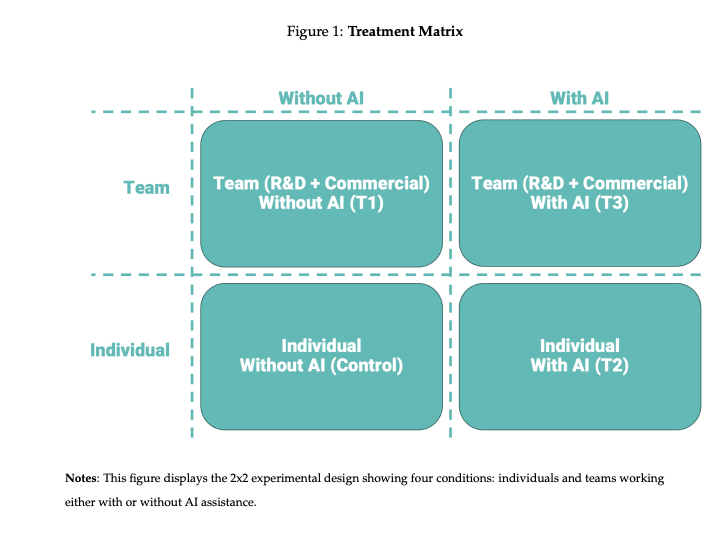
The study assigned 776 P&G professionals to real-world product development tasks. Some worked solo, others in teams, some with AI assistance (powered by GPT-4), some without. What the researchers found was stunning: individuals using AI performed just as well as teams of two humans without AI. In other words, AI effectively replaced the collaborative benefit of having another professional in the room. Not just in task execution, but in cross-functional thinking and emotional engagement.
For decades, the justification for GTM teamwork has rested on three pillars: performance, expertise sharing, and emotional connection. Teams are supposed to work better than individuals because they combine diverse perspectives, bring domain-specific knowledge to the table, and foster a sense of motivation and camaraderie. But this study suggests that GenAI may now serve all three functions—with one major implication: collaboration itself may no longer require multiple humans.
For GTM leaders, the message is clear. AI isn’t just a tool that speeds up tasks. It’s reshaping how marketing plans are made, how campaigns are ideated, how enablement materials are created, and even how sellers approach product positioning. The lone marketer or seller equipped with AI is no longer alone. They’re operating with a cybernetic partner that thinks with them, expands their domain coverage, and emotionally buffers their cognitive load.
Rethinking the GTM Operating Model
The traditional GTM structure—marketing, sales, customer success, RevOps—has long operated on assumptions that human interaction is the best path to innovation and performance. Campaigns were brainstormed in war rooms. Sales plays were refined through enablement sessions. Customer insights were shared across teams through collaboration tools. But the AI-augmented worker disrupts this rhythm.
Consider a marketer responsible for launching a new vertical campaign. Pre-AI, they would meet with product, align with sales, workshop copy with creative, and build assets over weeks. With GenAI, they can simulate stakeholder objections, generate copy in multiple tones and personas, pull competitive messaging, and get performance predictions—all in one session. Not only is the work faster, it's broader in scope and often more balanced. The AI teammate acts like a strategist, a content marketer, a sales engineer, and a product manager rolled into one.
This isn’t automation—it’s augmentation. And it challenges the idea that innovation comes from team diversity alone. The study found that AI flattened functional differences: R&D professionals generated more commercially viable ideas, and Commercial pros proposed more technically sound solutions. That’s not just better output—it’s cross-functional thinking made ambient.
The AI teammate is also emotionally intelligent. The study found participants reported greater enthusiasm, less frustration, and more energy when working with AI—even compared to working in teams. This may sound subtle, but it has serious implications for burnout, creativity, and motivation in fast-paced GTM environments. If AI can make a seller feel less isolated, or a marketer more confident, it becomes more than just a performance multiplier. It becomes a cultural asset.
The Shifting Role of Human Collaboration
One might assume that the rise of AI teammates would replace the need for collaboration altogether. But that’s not what the data shows. While individuals with AI matched teams without it, the combination of teams plus AI produced the highest share of top 10% ideas. In other words, AI elevates both individuals and teams, but the most exceptional performance happens when humans and AI work together in complementary roles.
For GTM teams, this means a new operating norm: high-impact work will be done in AI-augmented duos or trios, not in large cross-functional teams or assembly-line workflows. RevOps should be redesigning reporting flows to reflect this. Enablement leaders should shift toward AI-augmented training scenarios. Marketing orgs should give individuals ownership over entire campaign pillars, trusting that their AI assistants will simulate the functions of peers.
Yet, this transformation won’t be purely intuitive. The study also found that while AI improved objective performance, it didn’t always boost self-confidence. Participants using AI were less likely to believe their output was top-tier—even when it was. This mismatch between perception and reality is a challenge. It suggests that organizations need to educate teams not just on how to use AI, but how to trust their own AI-augmented judgment. This becomes a critical training area for enablement.
Implications for Hiring and Organizational Design
Perhaps the most uncomfortable takeaway is what this means for headcount. If one AI-enabled person can match the output of a two-person team, what does that mean for hiring plans, resource allocation, and productivity expectations? Should GTM leaders prioritize hiring multi-modal thinkers who can prompt, synthesize, and validate across domains—with AI as their co-pilot?
The study points to a likely future where the unit of high-performance GTM is no longer the team, but the AI-augmented individual. Sales, marketing, and product enablement teams won’t shrink overnight, but their shape will change. You may not need a full campaign team; you’ll need a strategist who can co-create with AI. You may not need a cross-functional content council; you’ll need someone who can simulate that diversity in their AI workspace. And RevOps will need to build systems to track, measure, and improve hybrid human-AI output, not just human productivity.
The Cybernetic Future is Now
This isn’t theory anymore. The P&G study shows in real numbers what many GTM leaders have suspected: GenAI is not just improving workflows—it’s redefining what it means to work together.
Whether it’s the collapse of functional silos, the emotional resonance of AI interactions, or the replication of teamwork performance by AI-enhanced individuals, the message is consistent: AI is no longer a back-office tool or a productivity add-on. It’s a teammate. A creative partner. A collaborator that doesn’t just amplify your work—but makes you better.
The smart GTM organizations in 2025 will stop treating AI as a tech stack feature and start integrating it into the human architecture of their teams. Not just as a co-pilot for tasks, but as a collaborator in strategy, execution, and team design itself.
This is the beginning of a new era of GTM—one not defined by headcount, but by capability. Not by functions, but by outcomes. And not by who you hire—but by how well your humans and their AI teammates think together.
AWS, Salesforce, and Oracle Say AI Agents Will Redefine Work. GTM Leaders Must Pay Attention.
If the last two years were defined by the rise of generative AI for content and co-pilot use cases, 2025 is shaping up to be the year of agentic AI—where AI no longer simply responds to prompts, but proactively acts on behalf of users, executing workflows and orchestrating across systems. In a recent discussion at the HumanX conference, top executives from AWS, Salesforce, and Oracle made a strong case that this new phase of AI will upend how organizations operate—from how customer service is handled to how systems are integrated, and ultimately, to what work itself looks like.
For GTM professionals—those in marketing, sales, RevOps, enablement, and customer experience—this shift is not theoretical. The way your company engages buyers, supports customers, and coordinates internal operations is about to be rewritten.
From Co-Pilot to Teammate: The Evolution of AI Agents
AWS’s Swami Sivasubramanian described the transition from traditional generative AI to agentic AI as a fundamental leap. Earlier AI capabilities were assistive—they generated content, synthesized data, and provided summaries. Agentic AI goes further: it can reason, plan, and execute.
“AI agents can research, pay bills, manage enterprise applications and even decompose high-level objectives into executable steps,” he explained. This isn’t just about automating tasks; it’s about AI acting autonomously, coordinating with other systems and even other agents—without human intervention.
Real-world case studies are already emerging. Genentech cut five years off drug research timelines using agents. Moody’s reduced credit risk reporting from a week to under an hour. Internally, AWS deployed agents that saved Amazon 4,500 developer years and over $250 million.
These are not marginal efficiency gains. They’re seismic.
Salesforce: Welcome to the Era of ‘Limitless Labor’
Salesforce EVP Adam Evans added further color to this transformation, describing agentic AI as creating a new labor paradigm—“limitless labor”—in which companies no longer scale by hiring humans, but by deploying agents. More than 5,000 customers have already signed up for Agentforce, Salesforce’s own agent platform, in its first full quarter of sales.
These AI agents span three types:
External agents interacting with customers via chat, email, and voice.
Internal agents supporting employees across systems like Slack and CRM.
Background agents running processes like lead qualification, document analysis, or performance optimization.
In Salesforce’s own usage, Evans reported that agents resolved 97% of customer inquiries—without human intervention. This fundamentally changes the model of customer support, and by extension, the structure of GTM teams.
Wiley Publishing reported a 40% increase in customer satisfaction after rolling out agent-driven support. Pfizer is deploying similar agents in life sciences workflows.
And perhaps most importantly, Salesforce is preparing for a world where businesses want pricing models to reflect AI usage, not human seats. Flexible pricing for agent use is already replacing traditional license-based pricing.
Oracle: Agentic AI as the New Interface
Miranda Nash of Oracle painted an even more transformative picture: agentic AI as the primary user interface across enterprise systems. “Let’s stop adapting ourselves to computers and make them adapt to us,” she said.
Rather than navigating Oracle’s complex software menus, employees will soon be able to “just ask Oracle”—a conversational interface backed by multi-agent workflows in the background.
Oracle has embedded these agents across HR (for hiring), finance (for accounts payable optimization), and supply chain (for logistics automation), essentially transforming functional operations into AI-managed systems.
And like AWS and Salesforce, Oracle leaders were quick to emphasize that the shift won’t necessarily eliminate jobs—but will change them. Repetitive roles will be automated, while humans will move into higher-value work. Customer support agents will become customer success strategists. Sales ops will become RevOps architects.
What GTM Teams Need to Do Now
For GTM professionals, this isn’t a distant future—it’s already happening. Here’s what leaders and practitioners across marketing, sales, and revenue need to begin adapting to immediately:
1. Rethink roles, not just tools.
If 97% of customer queries are handled by agents, what is the new role of support reps? If SDRs are bypassed by buyer-side agents doing research and shortlisting, how does pipeline get built? GTM leaders must audit their org charts with AI agents in mind, not just as tools, but as workforce capacity.
2. Start building agent orchestration skills.
Tools like Agentforce, LangChain, OpenAI’s Assistants API, and Vertex AI Agent Builder aren’t just for engineers. GTM teams must start building agent workflows for onboarding, follow-up, nurturing, pricing configuration, content assembly, and more. These agents will soon live inside Salesforce, HubSpot, Notion, and Slack.
3. Prepare for buyer-controlled journeys.
Buyers are building their own agents too. These buyer-side bots research vendors, simulate ROI, compare contract terms, and even draft purchase requests—before your sales team ever gets a meeting. Your enablement content, pricing, and integrations must be ready for AI-first discovery.
4. Shift your GTM metrics from persuasion to proof.
In this agentic world, storytelling alone won’t win. You’ll need data, simulations, third-party validation, and benchmarked impact metrics embedded directly into your product demos, websites, and proposals. Agents will parse and compare your claims against competitors in real-time.
5. Break down GTM silos.
Agents don’t care whether data is in marketing, sales, CS, or ops. They work across stacks. GTM leaders must structure systems and teams accordingly—removing data walls and unifying revenue intelligence under a single agent-accessible platform.
The Fully AI World Is Already Underway
Swami Sivasubramanian put it bluntly: “This evolution is not a roadmap for the future. In fact, most of it is already happening today.” Agentic AI is no longer a prototype or pilot—it’s running at Amazon, Salesforce, Oracle, Genentech, Moody’s, Pfizer, and thousands of others.
The only question is whether your GTM team is preparing to collaborate with AI agents—or waiting to be displaced by them.
The “fully AI world” will belong to those who reimagine GTM from the ground up—integrating AI into not just tasks, but roles, workflows, pricing models, hiring strategies, and customer journeys.
Not adapting is not an option. As Nash said: “The only option now is to get in the cloud, get to agents, and meet the future of this world of work.” GTM leaders who listen will find themselves not just surviving the shift—but leading it.
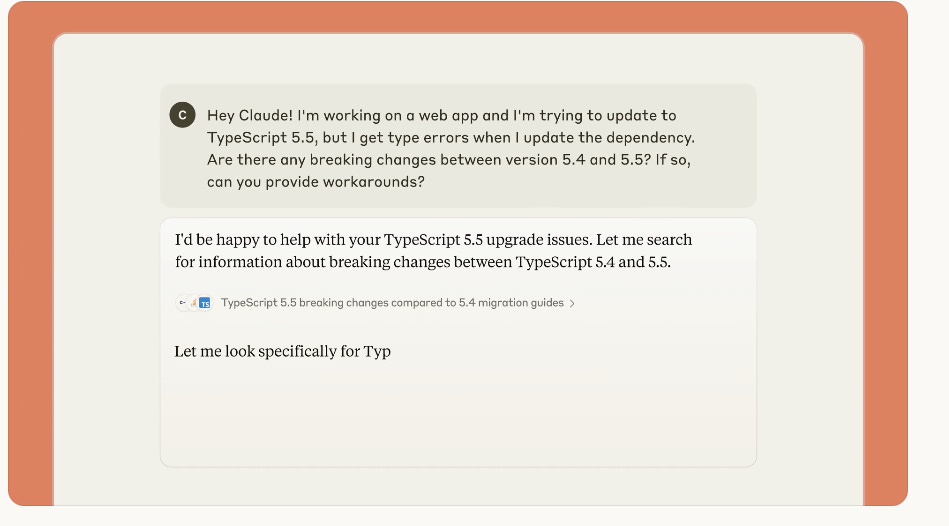
Claude FINALLY release Internet access and search.
That is it… thats the post ;) For those of us who love Claude and been waiting years (literally) for this moment, we rejoice!
Getting started
Web search is available now in feature preview for all paid Claude users in the United States. Support for users on our free plan and more countries is coming soon. To get started, toggle on web search in your profile settings and start a conversation with Claude 3.7 Sonnet. When applicable, Claude will search the web to inform its response.