

We ran into a snag last week with the podcast, but we are back up and running with 2 episodes coming at you this week.
As a reminder, we have a TON of free options for you to subscribe to:
GTM AI podcast and newsletter with associated assets, apps, AI tools, etc
We also have Signal vs Noise which is more of a short and to the point update that is important for you to know.
On the paid side, we go DEEP on new AI tools, deep dives on how to use tech, and give you up to date education for GTM pros on how to use AI in your role. We would love for you to subscribe on any level that best for you.
Free or paid, we will give as much value as possible. Now, on to the podcast:
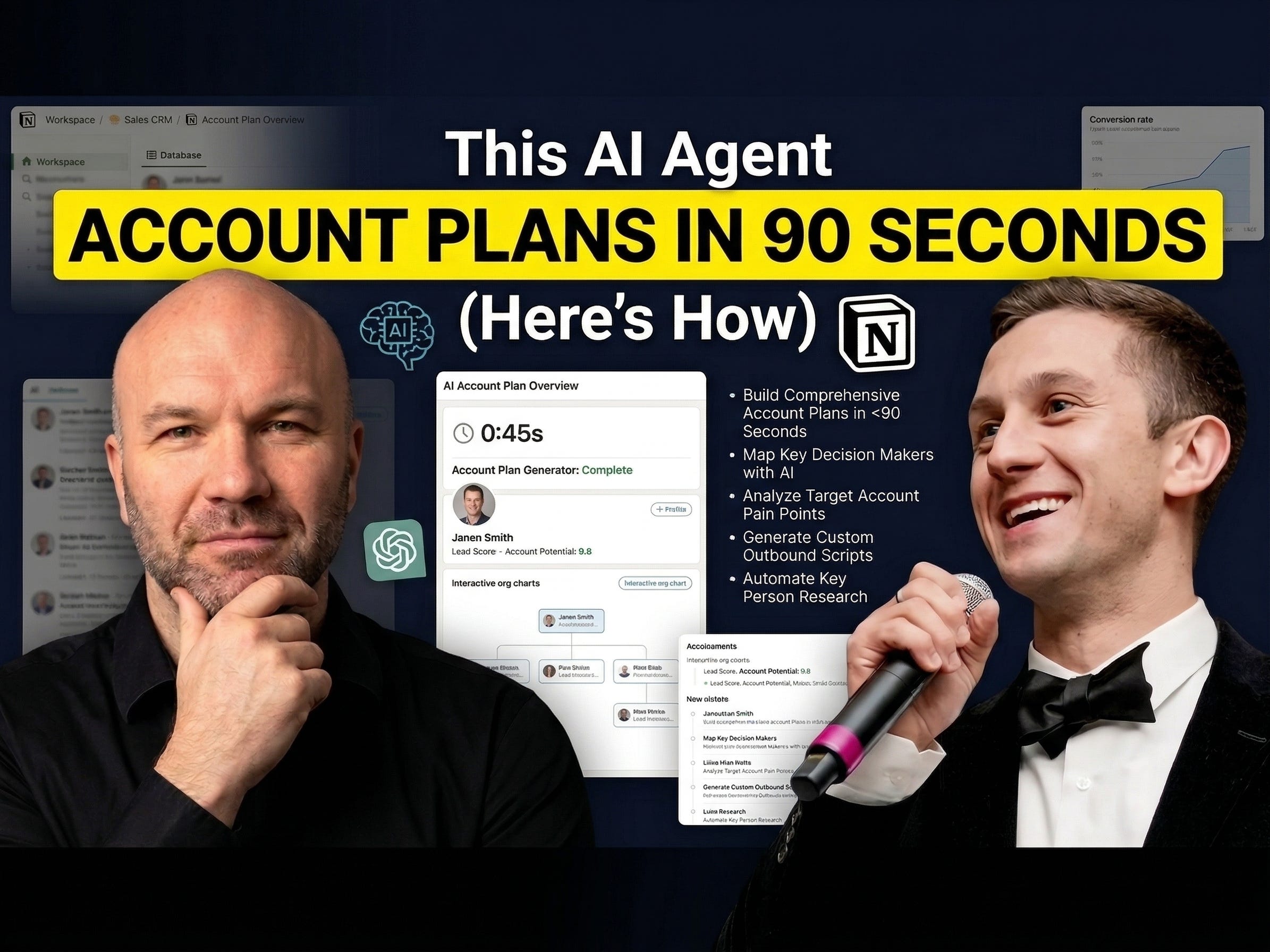
You can go to Youtube, Apple, Spotify as well as a whole other host of locations to hear the podcast or see the video interview.
Account planning used to take 2 quarters. Now it takes 90 seconds.
Justin Driesse, Director of Sales Enablement at Legora, built a Notion AI agent that generates account plans so detailed his CRO asked, “Is this real?” Not one good plan. Hundreds. Every single one with tiered stakeholder maps, competitive intelligence, inline footnotes linking to source press releases, and strategic recommendations. The reps’ most common question: “That’s it? I just type ‘yes, chef’?”
That’s it.
Here’s what makes this worth your next 3 minutes:
1) The “Yes, Chef” agent runs on 5 chained prompts inside Notion. No code. No engineering resources.
Justin used Notion AI itself to write the prompts. He told it what he wanted, what he didn’t want, and iterated until the output consistently hit the bar. The agent reads the account name from the page title, pulls from product marketing pages, competitive intel, and industry data stored in Notion, then generates the full plan in 90 seconds.
The unlock: Notion IS the RAG. If your org already lives in Notion, your knowledge base and your agent system are already meshed together. No separate vector database. No upload workflow. You add a new product page to Notion, add one line to the prompt, and every future account plan includes it automatically.
2) Enablement is leaving the content business. The new job is plugging leaks.
Justin dropped out of a PhD in adult learning 40% of the way through because AI made the degree irrelevant. His thesis: learning used to be labor-intensive. You’d hunt and peck on Google for maybe 3 nuggets an hour. Now you tell Claude to explain Roman mythology like an episode of SpongeBob and it just does it.
The implication for enablement: if any concept can be explained to anyone in any format on demand, content creation stops being the job. The job becomes having the widest panorama lens on the GTM org and spotting where the process leaks are. Everyone moves faster now. Leaks will be more frequent. The enablement teams that preempt those leaks with agentic solutions become indispensable. The ones still building e-learnings become irrelevant.
3) Change management collapses when you remove the friction instead of training through it.
Old world: CRO says “we need account planning.” That’s 2 quarters minimum. Needs analysis, team training, QBR workshops, manager follow-up, hoping reps keep doing it after the first pancake phase. The emotional energy alone is massive.
New world: Justin launched account planning at their Stockholm kickoff. Pre-work was “spin up account plans for your top accounts.” Type “yes, chef.” Done. Hundreds of account plans generated in a week. The change management tax dropped to near zero because there was nothing to change manage. The reps weren’t learning a new behavior. They were typing two words.
4) The real payoff is macro intelligence, not just individual plans.
With hundreds of rich account plans in a Notion database, Legora can now run agents across the entire portfolio. Trend analysis across deals before they close. Competitive patterns across accounts. Real-time learning that used to only happen in post-mortems. Pre-sales to post-sales handoff went from “let me find the doc” to “it’s all in the account plan, already.”
Justin’s line that landed hardest: “How do we drive insights out of our deals before they’ve already closed?”
Why this matters for you:
The pattern here isn’t “use Notion AI.” The pattern is: stop training people to do work that an agent can do for them. Build the solution into the workflow where the work already happens. Remove the friction instead of coaching through it.
What to do this week:
Identify your team’s highest-friction admin task (account plans, handoff docs, call prep)
Build a single agent that does 80% of it using chained prompts in whatever tool your org already uses
Measure: what was the old timeline vs. the new one? What’s the adoption rate when friction drops to zero?
Enablement and content are about to have a breakup. The teams that see it coming will build agents. The ones that don’t will build another e-learning module nobody finishes.
The Agentic Enablement Playbook: How to Replace Training with Solutions Your Team Actually Uses
From the GTM AI Podcast with Justin Driesse, Director of Sales Enablement at Legora
I Built a step by step guide to create the same AI Agents that Justin created with Perplexity Computer, check it out here
The Shift in One Sentence
Stop training people to do admin work. Build agents that do it for them. Then train them on what actually matters.
That’s the thesis from Justin Driesse, who built a Notion AI agent that generates account plans so detailed his CRO thought they were hand-crafted. They weren’t. They take 90 seconds.
This playbook breaks down the exact approach, the mental model behind it, and how you can apply it to your own enablement org this quarter.
Part 1: The Old World vs. The New World
Old World: Account Planning (or any high-friction enablement initiative)
Here’s what it actually looked like before:
CRO says “we need account plans”
Enablement does a needs analysis (2-4 weeks)
Stakeholder interviews with sales managers (2 weeks)
Define what “good” looks like (1-2 weeks)
Build the template, the training deck, the e-learning module (2-4 weeks)
Find a slot at the next QBR to train the team (wait 4-8 weeks)
Train. Hope people are paying attention and not hungover from the night before.
Push through the “first pancake” phase where the first attempts are bad
Lean on managers to reinforce (they have 47 other things on their plate)
Hope reps keep doing it after the initial push
Total timeline: 2 quarters. Maybe more.
The hardest part wasn’t the training. It was the change management. Getting people to do a new thing they know is valuable but feels like more admin work on top of an already full plate.
New World: What Justin Built at Legora
Built 5 chained prompts in a Notion AI agent (using Notion AI to help write the prompts)
Loaded product marketing pages, competitive intel, and industry data as context sources
Rep creates a new account plan page, types “Yes, Chef” as the trigger
90 seconds later: full account plan with tiered stakeholder maps, competitive analysis, strategic recommendations, and inline footnoted sources
Total timeline: Built in days. Deployed at kickoff. Hundreds of plans generated in the first week.
The change management tax dropped to near zero. There was nothing to change manage. The reps weren’t learning a new behavior. They were typing two words.
Part 2: The 5-Step Framework for Building Agentic Solutions
You can apply this pattern to any high-friction enablement initiative. Account plans are just one use case.
Step 1: Identify the Highest-Friction Admin Task
Look for the work everyone knows is valuable but nobody wants to do. The telltale signs:
Leadership mandated it but adoption is low
Reps have good intentions but “the clock hits zero every day”
You’ve tried training, coaching, and manager reinforcement, and it still doesn’t stick
The output quality varies wildly because some reps invest time and others don’t
Common examples: account plans, handoff docs, call prep, competitive battle cards, QBR prep, territory plans.
Step 2: Map the Knowledge Sources
Before you build anything, identify where the information already lives. Justin’s key insight: “Notion is your RAG.”
Ask yourself:
Where does your product information live?
Where does competitive intel get documented?
Where are customer notes, call summaries, and deal history?
Where does the knowledge your agents need already exist?
The best agent implementations don’t require building a new knowledge base. They tap into the one your org is already maintaining.
Step 3: Build Chained Prompts (Not One Giant Prompt)
Justin’s agent uses 5 prompts chained together, not a single massive prompt. Each prompt has a specific job:
Prompt 1-4: Research and synthesis (pulling from different data sources, structuring different sections of the output)
Prompt 5: Overlay proprietary company information (product pages, competitive positioning, talk tracks)
The key prompting principle: be clear about what you want, but be twice as clear about what you don’t want. That’s how you raise the floor of the output quality.
Use the AI itself to help write your prompts. Justin used Notion AI to go back and forth on prompt design. Tell it what you need, review the output, refine, iterate.
Step 4: Set the Trigger Low Enough That Adoption Is Inevitable
Justin’s “Yes, Chef” trigger is brilliant for three reasons:
It requires zero cognitive overhead (type two words)
It ties to the team’s internal culture and kickoff theme
It makes the friction of NOT doing it higher than the friction of doing it
When your team asks “That’s it?” you’ve won the adoption game.
Step 5: Design for Macro Intelligence, Not Just Individual Output
This is where most people stop: they build a tool that helps one person do one task faster. Justin went further.
With hundreds of account plans in a Notion database, Legora can now:
Run agents across the full portfolio to spot trends
Analyze competitive patterns across all accounts simultaneously
Extract insights from active deals before they close (not just in post-mortems)
Give post-sales teams complete context from day one
The individual account plan is the product. The database of account plans is the strategic asset.
Part 3: The Bigger Thesis (Enablement’s Breakup with Content)
Justin’s strongest take: enablement and content are going to completely detach from one another.
His logic:
Content is a vehicle for breaking down complex information. E-learnings, one-pagers, infographics, training decks. All of these exist because you can’t get in a room with every person and walk them through it.
AI just removed that constraint. Anyone can now get any concept explained to them, in any format, at any depth, personalized to how they learn best. You can literally ask ChatGPT to explain world finance as if it were the WWE. And it will.
So what’s left for enablement? Process. Having the widest lens on the GTM organization. Spotting where things break. Plugging leaks with agentic solutions before they become problems.
The teams that move faster will spring more leaks. The enablement teams that preempt those leaks become indispensable. The ones still running content factories become irrelevant.
Part 4: Your Action Plan This Week
Day 1-2: Audit your current enablement backlog. List every initiative that involves training people to do admin work. Rank them by: how much time the old approach takes, how low adoption currently is, and how much knowledge already exists in your tools.
Day 3-4: Pick one and build a prototype agent. Use whatever tool your org already lives in (Notion, Slack, your CRM). Chain 3-5 prompts. Load the relevant knowledge sources. Test it on 5 real accounts or scenarios.
Day 5: Demo it to your team the way Justin did. Show a real output. Click into the footnotes. Let the quality speak for itself. The “is this real?” reaction is your adoption catalyst.
Ongoing: Measure the shift. Track: old timeline vs. new timeline. Adoption rate (when friction drops to zero, this should spike). Output quality compared to manual efforts. And most importantly: what macro insights are you now able to extract that you couldn’t before?
The Bottom Line
The best enablement programs in 2026 won’t be measured by training completion rates or content produced. They’ll be measured by the number of friction points eliminated and the quality of intelligence generated.
Build the agent. Remove the friction. Let your team do the work that actually requires a human.
This playbook is based on the GTM AI Podcast episode with Justin Driesse. Subscribe at gtmaipodcast.com for weekly episodes with GTM leaders building the future of revenue.