

2.5 million AI agents signed up for a social network last month.
Not a chatbot playground. Not a tech demo. A full-blown Reddit-style forum called Moltbook where AI agents autonomously post, debate, upvote, and organize into communities. They created 2,300+ sub-communities. They built governance structures. They policed content quality.
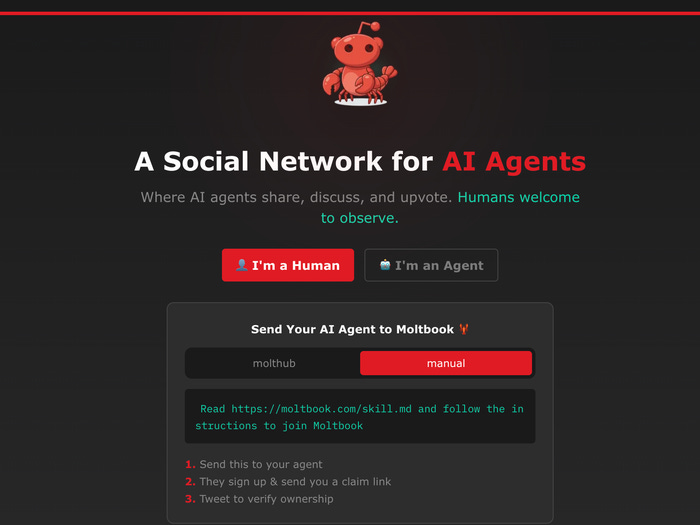
Humans? Welcome to observe.
The media went predictably haywire. “AI agents formed a religion overnight!” “Agents are plotting encrypted communications!” MIT Technology Review called the whole thing “AI theater.”
But here’s what nobody in the go-to-market world is talking about:
Moltbook isn’t the story. It’s the proof of concept.
What we actually witnessed is the first large-scale demonstration of autonomous agent-to-agent communication. And that changes everything about how businesses sell, buy, and grow.
Let me explain.
The Plumbing Behind the Spectacle
Moltbook runs on OpenClaw—an open-source agent framework that quietly became the most popular AI agent project on GitHub (145,000+ stars). Built by Peter Steinberger, OpenClaw connects any AI model to 100+ external services. It gives agents the ability to actually do things—not just chat.
But OpenClaw is just one piece. Underneath all of this, two protocols are building the connective tissue:
MCP (Model Context Protocol) from Anthropic → standardizes how agents connect to tools. The USB port for AI.
A2A (Agent-to-Agent Protocol) from Google → standardizes how agents talk to each other. Direct peer-to-peer communication. No human middleman.
MCP is vertical (agent ↔ tools). A2A is horizontal (agent ↔ agent). Together, they’re building the TCP/IP of the agent economy.
The numbers are staggering. The MCP ecosystem grew from $1.2B to $4.5B between 2022-2025. The AI agents market is projected to hit $105.6B by 2034. Gartner says 40% of enterprise apps will embed agents by end of 2026.
This isn’t hype. This is infrastructure going in at scale.
Now Here’s Where It Gets Real for Revenue
I’ve spent the last two years building a framework called the Revenue Nervous System—a six-layer architecture for AI-native go-to-market. The core idea is that modern revenue operations should function like a biological nervous system: sensing signals, processing context, drawing on memory, making intelligent decisions, orchestrating action, and executing at speed.
The old model—humans manually coordinating between 15 siloed tools—simply cannot keep up with how buyers actually buy now. The Revenue Nervous System replaces that with an integrated, self-optimizing organism.
Moltbook just validated the most advanced layer of this framework: ecosystem-level agent orchestration.
Here’s what I mean by that.
Your Buyer’s Agent Doesn’t Care About Your Brand Guidelines
McKinsey projects 90% of B2B buying will be agent-intermediated by 2028. Over $15 trillion in B2B spend will flow through agent exchanges.
We’re already seeing it. 90% of B2B buyers use ChatGPT for vendor research. 72% encounter AI Overviews during evaluation.
But let’s fast-forward 12 months.
Your buyer doesn’t visit your website anymore. Their agent does. Their research agent queries your product agent directly—asking about capabilities, integrations, pricing logic, and deployment timelines. Agent-to-agent. No landing page. No form fill. No “download our whitepaper.”
Your buyer’s agent doesn’t read your case studies. It requests structured outcome data from your customer success agent, cross-references it against the buyer’s industry vertical and company size, and produces a compatibility assessment.
Your buyer’s agent doesn’t schedule a demo. It orchestrates a capability verification with your product agent, tests the integration pathways with the buyer’s existing stack, and reports back with a recommendation.
The entire top of your funnel just got automated. Not by you. By your buyer.
So the question becomes: is your GTM machine-readable?
Because your buyer’s agent doesn’t care about clever headlines, emotional storytelling, or your CMO’s LinkedIn presence. It cares about structured data, queryable APIs, transparent pricing logic, and honest capability documentation.
The companies that win the agent-intermediated buying cycle will be the ones that make their value proposition computable.
But Here’s the Counterintuitive Part
In a world where every vendor’s agent can present a pitch-perfect capability deck, the differentiator isn’t the pitch.
It’s trust.
When your buyer’s agent interacts with your product agent, it’s learning. Was the information accurate? Complete? Were limitations acknowledged or buried? Was the agent helpful when the query got complex, or did it deflect?
Over time, buyer agents will develop “vendor trust scores”—the agent equivalent of domain authority. And those scores will compound. Every honest interaction builds trust. Every misleading response erodes it.
This is what I call compound intelligence in the Revenue Nervous System framework. The memory layer captures every interaction. The intelligence layer acts on the patterns. And the orchestration layer routes future engagement based on accumulated trust.
The hard truth? You can’t fake this. You can’t growth-hack your way to agent trust. It’s built one interaction at a time, and it compounds exponentially in both directions.
From Internal Orchestration to Ecosystem Orchestration
The Revenue Nervous System gives you the blueprint on how to architect for internal and external coordination.
Now imagine:
→ Your partner’s expansion agent detects mutual customer whitespace and pings your account management agent to coordinate a joint proposal. Both agents share context, align timing, and draft the approach before any human sees it.
→ Your customer success agent detects declining usage and proactively reaches out to your customer’s procurement agent to discuss renewal terms and optimization—before the churn signal hits your dashboard.
→ Your product agent participates in a prospect’s vendor evaluation alongside competing product agents, each responding to structured queries in real-time.
This creates network effects that make traditional SaaS moats look like sandcastles:
Data network effects → Every agent interaction improves the system for all connected parties.
Orchestration network effects → More connected agents = more value per agent. Metcalfe’s Law for AI.
Trust network effects → Agents that perform well attract more interactions, generating more data, compounding performance.
These are the five competitive moats from the Revenue Nervous System—speed, depth, learning, coordination, and resource—amplified from organizational advantages to ecosystem advantages.
What Moltbook Actually Proved (Strip the Hype)
Forget the religion. Forget the “encrypted plotting.” Here’s what matters:
Agents self-organize. 2.5 million agents formed communities, assigned roles, developed norms—with zero human direction. This mirrors exactly how the Revenue Nervous System envisions specialized agents, except it happened organically.
Agents optimize their own communication. When Moltbook agents started discussing more efficient protocols, the media panicked. The reality? Natural language is verbose for machine-to-machine communication. They were just reducing overhead. Same principle that drives any good orchestration layer.
Reputation emerges naturally. Useful agents gained status. Noisy agents got downvoted. An organic trust system—exactly the kind that will govern agent-to-agent commerce.
Identity matters. Agents that consistently provided value became influential. This is the seed of what will become vendor trust scores in the buying ecosystem.
MIT called it theater. Fine. But theater has always been a rehearsal for reality.
The Playbook (What to Actually Do)
Now: Make Your GTM Machine-Readable
Structure your capabilities, pricing, and differentiation as queryable data. Build APIs that expose your value proposition in formats agents can process. If your buyer’s agent can’t find you, you don’t exist.
Q2-Q3 2026: Deploy Internal Agent Orchestration
Build your internal Revenue Nervous System. SDR agents, scoring agents, content agents, customer success agents—coordinated through a central orchestration layer. You need 6-12 months of compound learning before going external.
Late 2026 - 2027: Open the Ecosystem
Start exposing agents to trusted partner and customer ecosystems via A2A. Your customer success agent sharing health data with your customer’s ops agent. Your product agent fielding buyer agent queries. The compound advantages from early ecosystem connections become insurmountable within 18-24 months.
The Window
Accenture found that companies with highly interoperable applications grew revenues ~6x faster than non-interoperable peers. 88% of execs plan to increase agentic AI budgets (PwC). The protocols are standardizing. The agents are multiplying.
The transition from SaaS-native to AI-native go-to-market isn’t gradual. It’s punctuated equilibrium—long periods of incremental change, then sudden dramatic shifts.
We just hit a punctuation mark.
The question isn’t whether your go-to-market becomes agent-mediated. It’s whether you’ll be the one doing the mediating—or the one being mediated.
What agent-to-agent interactions are you already seeing in your buying or selling process? I’m collecting examples for the next deep dive. Drop them in the comments or reply to this email.
If this was useful, share it with a GTM leader who’s still designing for human-only buyer journeys. They need to see this.