

We are almost to the end of the year and so excited about what is coming in 2026. I hope that this last year, we have been helpful in your journey with AI and GTM. Would love your feedback, share this post, or send me a message, I would genuinely love to hear from you.
Today we deep dive into a ton of good research, we have an amazing guest on the podcast, and actionable take aways.
And per usual, have a NotebookLM that is loaded with all the content you can use and play with.
Lets get into it!
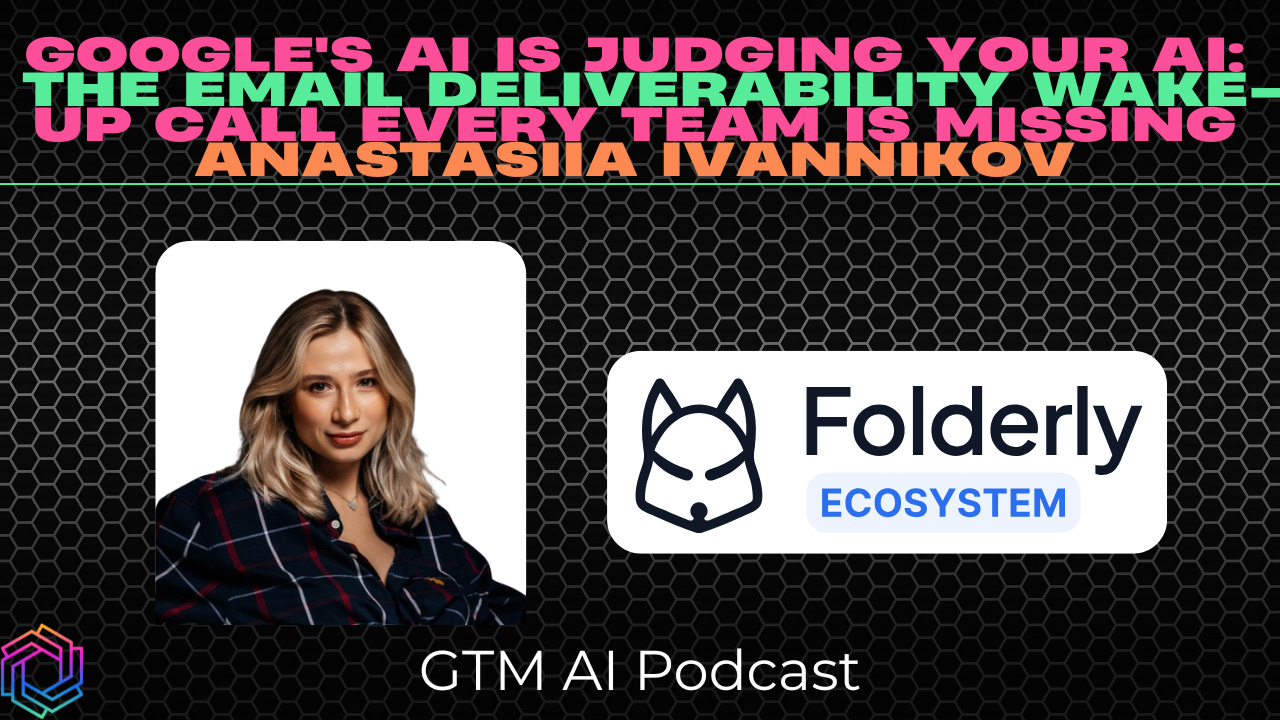
You can go to Youtube, Apple, Spotify as well as a whole other host of locations to hear the podcast or see the video interview.
“Google’s AI Is Judging Your AI: The Email Deliverability Wake-Up Call Every Sales Team Is Missing”
I sat down with Anastasiia Ivannikov, CEO of Folderly, and she dropped something that stopped me mid-conversation: Google switched to AI-based spam detection this past spring. Not rule-based filtering. Not keyword scanning. Actual AI deciding whether your AI-written email sounds human enough to deserve an inbox.
Think about that for a second. It’s AI judging AI on humanness. And most sales teams have no idea this shift even happened.
Here’s what’s at stake: every third email lands in spam. Which means 40-50% of your pipeline never gets a chance to respond because they literally never saw your outreach.
Anastasiia’s been in sales since she was 14. She ran outbound at Macpaw (unicorn status) before taking the CEO seat at Folderly.
We geeked out on email specifics like spintax variations, sending velocity patterns, why your sequencing tool’s default settings are probably torching your domain reputation.
She called out something I see constantly: teams using “AI brain instead of AI as a tool.” ChatGPT telling you every idea is wonderful. Single-LLM dependency creating blind spots in strategy. The South Park episode roasting exactly this behavior (if you haven’t seen it, fix that).
We also got into the math that should scare every GTM leader: conversion used to take 5 touches. Now it’s 17. And if half your touches are landing in spam, you’re not running a funnel—you’re running a sieve.
Key Quotes
On the new reality:
“It’s AI judging AI, whether it’s a human. That’s hilarious... but then the major thing is not to sound robotic from all perspectives possible.”
On using AI correctly:
“I hate seeing sales teams use AI brain instead of AI as a tool. Use AI to challenge yourself—ask questions to understand your ICP deeper, your value prop better. The brain still has to belong to the human.”
On avoiding AI bias:
“If you’re using only one LLM, you’re getting biased. ChatGPT is programmed to be very friendly, to accept every single idea... use a couple of LLMs to not become biased and not go ahead with the worst idea ever.”
On what Google’s looking for now:
“Your outreach needs to act as a human—meaning you need to use different copy for your outreach. That’s how Google sees your emails differently.”
Top 3 Things to Do Now
1. Implement Spintax in Every Outreach Sequence
Google’s AI is scanning for identical copy patterns. If you’re sending the same email to 500 people, you’re getting flagged. This changed in May 2024 and most teams haven’t caught up.
Action: Build 3-5 variations for every sentence element—greetings, value statements, CTAs. “Hey Anna” vs “Hi Anna” vs “Good morning” creates different email signatures to Google’s detection system. This isn’t A/B testing for optimization. This is survival mechanics for inbox placement.
Tool consideration: Most sequencing platforms have spintax capability buried in settings. If yours doesn’t, that’s a gap you need to address at the infrastructure level.
2. Humanize Your Sending Behavior
Your AI SDR or sequencing tool is probably sending too fast. Humans don’t fire off emails every 60 seconds. Google knows this. Their AI knows this.
Action: Space emails 4-5 minutes apart minimum. Randomize timing windows. Match the rhythm of how an actual human works through their inbox—bursts of activity followed by gaps, not mechanical precision.
The deeper point: Behavioral signals are now weighted as heavily as content signals. You can have perfect copy and still get flagged because your sending pattern screams automation.
3. Use Multiple LLMs as Thinking Partners (Not Just Executors)
This is the one that Anastasiia and I aligned on hard. ChatGPT will validate your terrible ideas because it’s optimized for engagement, not accuracy. That’s dangerous when you’re building strategy.
Action: Run your ICP hypotheses, messaging angles, and competitive positioning through Claude, Gemini, AND ChatGPT. Look for where they disagree. That’s where your blind spots live. Use AI to stress-test your thinking, not confirm your biases.
Why this matters for email specifically: Your copy quality starts with your strategic clarity. If you’re using AI to write emails without first using AI to sharpen your understanding of who you’re writing to and why they should care, you’re automating mediocrity at scale.
Ending
Email isn’t dead. Anastasiia’s heard that prediction every year she’s been in sales. What’s dead is the lazy approach—same template to 500 people, default sequencing settings, no attention to the infrastructure layer.
The teams winning right now understand something most are missing: deliverability is a strategy problem disguised as a technical problem. You can nail the DNS records, warm up the domains, do everything right at the infrastructure level—and still fail if your sending behavior and copy patterns scream “bot.”
17 touches to convert. Half potentially landing in spam. That’s the math every GTM leader needs to internalize.
Fix the infrastructure. Vary the copy. Slow the sends. Keep your brain in control.
And maybe stop letting ChatGPT tell you all your ideas are brilliant.
Connect with Anastasiia on LinkedIn | Folderly.com
$8T in AI infrastructure vs. 0-1% chance of AGI: What 6 new studies reveal about who actually wins
ARTICLE LINKS
AI Investment Crisis:
AI Implementation Research:
Prompt Engineering:
HIGH-LEVEL SUMMARY
We’re witnessing the greatest contradiction in tech history: $8 trillion being deployed into AI infrastructure while 95% of AI initiatives deliver zero ROI. This newsletter connects six major studies released in the past month to reveal why this paradox exists—and more importantly, what you can do about it right now.
The data tells a brutally clear story: The problem isn’t the technology. It’s us. How we’re buying it, deploying it, training on it, and fundamentally misunderstanding what makes AI work in practice versus theory. From IBM’s CEO warning about unsustainable infrastructure costs to MIT research showing enterprise AI pilots are statistical failures, to Wharton proving that “expert personas” in prompts are theater, we’re watching an industry-wide reckoning unfold in real-time.
For revenue leaders, this matters because your competitors are making the same mistakes. The winners in 2025 won’t be those with the biggest AI budgets—they’ll be those who understand these four patterns and act on them.
THEME 1: THE INFRASTRUCTURE MIRAGE - When More Compute Doesn’t Mean More Value
The Numbers That Should Terrify Every CIO:
IBM CEO Arvind Krishna dropped a bomb on The Decoder podcast: filling one 1-gigawatt data center costs $80 billion at current prices. Companies are planning 20-30 gigawatts. Do the math: $1.5-2.4 trillion in capital expenditures. And here’s the kicker—those AI chips depreciate in 5 years, creating a continuous reinvestment treadmill.
Industry-wide commitments are approaching 100 gigawatts, totaling roughly $8 trillion in capex. To service just the interest on that debt requires $800 billion in annual profit. Krishna assigns current LLM technology only a “0 to 1%” chance of achieving AGI without fundamental breakthroughs.
Meanwhile, the market is already reacting. Oracle’s stock dropped 13% on rumors of OpenAI data center delays (which they denied). Broadcom fell 11% after earnings showed lower margins on custom AI processors. UBS reports that financing agreements for AI data centers soared from $15 billion in 2024 to $125 billion in 2025—an 8x increase in one year. The Bank of England is now warning that escalating debt in AI infrastructure could amplify financial stability risks.
What This Means for You:
Your vendors are in an arms race they can’t win through infrastructure alone. OpenAI announced $1.4 trillion in long-term infrastructure agreements. Alphabet raised its 2025 capex to $91-93 billion. Amazon increased its forecast to $125 billion. These aren’t investments in making AI better at your specific business problems—they’re bets on computational scale as a competitive moat.
The pattern is clear: the industry is building massive capability looking for profitable applications, not solving identified business problems with right-sized solutions.
The Contradiction:
While AI labs pour trillions into infrastructure, MIT’s research (surveying 153 senior leaders at 52 organizations managing $30-40 billion in AI investments) found that 95% of AI initiatives generate zero return. Boston Consulting Group’s global survey shows only 26% of companies see tangible ROI from AI.
This isn’t a technology problem. It’s a deployment problem. The compute exists. The models work. But the gap between technological capability and business outcome remains enormous.
THEME 2: THE ADOPTION PARADOX - Why Your Teams Resist AI Even When It Works
The Behavioral Science Bomb:
Research from Harvard Business Review and multiple behavioral science labs reveals something uncomfortable: AI adoption is not a technology challenge. It’s a behavioral change challenge. And we’re treating it backwards.
The problems are hardwired into human psychology:
Algorithm Aversion: People abandon AI after seeing it make one mistake, even when it outperforms humans over time. This bias is statistically significant and consistent across contexts.
The Transparency Trap: People overestimate their understanding of human decision-making, making them dismiss AI by comparison. In medical studies, patients believed they understood a human doctor’s reasoning better than an AI’s—even though medical AI often outperforms human providers.
Loss Aversion in Workflow: Clinical decision-support tools embedded in electronic health records provided demonstrable benefits but were under-utilized because alerts disrupted work routines. The perceived workflow “losses” loomed larger than opportunities to improve patient care.
The Skills Gap That Won’t Close:
Expert.ai’s director Quentin Reul identifies the core issue: enterprises overestimate what generative AI can deliver out of the box. Foundational models are probabilistic—they excel at generating content but stumble when organizations expect precise analytical outputs.
The earliest stumbling block is often basic AI literacy. Employees must understand the difference between symbolic AI, machine learning, generative systems, and predictive analytics as practical distinctions that shape viable use cases. Without this literacy, organizations misjudge capabilities and set themselves up for disappointment.
Here’s the pattern: 71% of CIOs see themselves responsible for accelerating AI-driven innovation, but only 32% believe they’re responsible for driving organizational transformation. The technosolutionist mindset persists even among the people who should know better.
The Hidden Data Point:
John Santaferraro (Ferraro Consulting) nails it: “Most users never make it past the very basic use: to do old processes faster.” This is why ROI remains elusive. Organizations aren’t redesigning processes—they’re automating existing inefficiencies faster.
THEME 3: THE INTEGRATOR GOLD RUSH - A New Vendor Triangle You Didn’t Ask For
The Accenture-Anthropic Signal:
Accenture’s decision to train 30,000 employees on Claude and Claude Code isn’t just a partnership announcement—it’s a market signal. A new category is emerging: AI integrators. These firms position themselves as the essential translators between AI labs’ capabilities and enterprise realities.
The new vendor triangle:
AI Labs: Push boundaries of model capabilities (OpenAI, Anthropic, Google)
Cloud Providers: Supply infrastructure for training, hosting, inference (AWS, Azure, GCP)
Integrators: Translate capabilities into operational outcomes (Accenture, Deloitte, McKinsey)
Why This Matters:
Few organizations can cultivate AI capability internally at scale. Accenture retraining tens of thousands of consultants illustrates the upskilling required. CIOs lean heavily on integrators to supply capabilities from model evaluation to application development to workflow redesign.
But here’s the trap: if an integrator has preferred model ecosystems or strategic alliances, you may be nudged toward a specific architectural path. Santaferraro warns this is especially risky “early in the AI project, when organizations are trying to identify the best use cases, get the right technology in place, launch new projects [and] get first projects into production.”
These early decisions determine your trajectory for years.
The Dependency Risk:
You’re potentially trading one form of vendor lock-in for another. Instead of being locked into a cloud provider, you’re locked into an integrator’s methodology, partnerships, and architectural preferences. The advice: use early consulting engagements as skill-building moments, not outsourcing functions. Work closely enough to ensure your team learns the ropes and can operate independently for follow-on projects.
THEME 4: THE COLLABORATION CEILING - When “Expert Personas” and Multi-Agent Dreams Fail
The Prompt Engineering Myth Explodes:
Wharton’s Generative AI Labs just published research that should fundamentally change how you think about prompting. They tested whether assigning expert personas to LLMs (”you are a physics expert,” “you are a world-class mathematician”) improves factual accuracy on graduate-level questions.
The results: Across six models (GPT-4o, o3-mini, o4-mini, Gemini 2.0 Flash, Gemini 2.5 Flash), expert personas showed no consistent benefit. In fact, “low-knowledge personas” (layperson, young child, toddler) often reduced accuracy. The only exception: Gemini 2.0 Flash showed modest improvements with expert personas—but this appears model-specific, not a general principle.
This directly contradicts official documentation from major AI vendors. Google’s Vertex AI guide recommends “Assign a role” as a best practice. Anthropic’s samples include “You are an expert AI tax analyst.” OpenAI’s materials suggest “You are a world-class Python developer.”
The Research Design Was Rigorous:
They used GPQA Diamond (198 PhD-level questions) and MMLU-Pro (300 difficult questions with 10 answer choices). They collected 25 independent responses per question for each model-prompt condition—4,950 runs per model for GPQA, 7,500 for MMLU-Pro. The statistical power was there. The personas just don’t work for factual accuracy.
The Alternative Approach:
Jennifer Chang Wathall proposes treating prompt development like rhetoric, not engineering. Her I.D.E.A.S. framework (Inquire, Design, Engage, Adapt, Synthesize) emphasizes iterative refinement through conversation, not one-shot “expert” instructions.
Phase 1: Inquire (explore and question), Design (organize structure), Engage (style and tone) Phase 2: Adapt and Synthesize (refine based on outputs)
This aligns with how AI actually works—probabilistic, conversational, requiring iteration—not deterministic systems you configure once with the right “persona.”
The Multi-Agent Mirage:
Separate research from Google and MIT reveals another uncomfortable truth: more AI agents isn’t always better. They identified a performance ceiling: once a single agent achieves approximately 45% accuracy on a task, adding more agents yields diminishing or negative returns due to coordination overhead (beta coefficient of -0.408, p<0.001).
Financial analysis tasks with independent components saw 80.9% improvement with multi-agent coordination. But Minecraft planning tasks (sequential dependencies) saw 39-70% performance degradation with multi-agent setups. When each step alters the state required for subsequent steps, multi-agent systems struggle as context fragments.
The Human-AI Synergy Factor:
The most fascinating finding comes from Northeastern University research on human-AI collaboration. They analyzed 667 humans working with and without AI on multiple-choice questions, using Item Response Theory to separate individual ability from collaborative ability.
The breakthrough: collaboration ability is distinct from individual problem-solving ability. Users better able to infer and adapt to others’ perspectives (Theory of Mind) achieved superior collaborative performance with AI—but not when working alone.
This suggests that getting value from AI isn’t about prompt engineering tricks or expert personas. It’s about social-cognitive skills: understanding when to delegate, how to formulate requests, deciding whether to accept AI responses, providing refinements, requesting clarification.
THE PLAYBOOK: What You Should Do Monday Morning
1. STOP BUYING INFRASTRUCTURE, START BUYING OUTCOMES
The Action:
Freeze any AI infrastructure expansion until you can demonstrate ROI on existing pilots
Audit your current AI vendor contracts: separate infrastructure costs from outcome delivery
Restructure AI vendor relationships around outcome-based pricing when possible
The Reasoning: The $8 trillion infrastructure arms race benefits vendors, not customers. Your advantage isn’t more compute—it’s better deployment of existing capability.
Tactical Question to Ask: “If we tripled our AI infrastructure budget tomorrow, which specific business outcomes would improve, by how much, and how would we measure it?” If your team can’t answer this crisply, you’re building infrastructure looking for problems.
2. TREAT AI ADOPTION AS BEHAVIORAL CHANGE, NOT TECH DEPLOYMENT
The Action:
Assign ownership of AI initiatives to someone with change management expertise, not just technical capability
Measure AI adoption through behavioral metrics (frequency of use, types of tasks delegated, user trust levels) not just technical metrics (uptime, latency, accuracy)
Build internal AI literacy programs focused on practical distinctions (when to use symbolic AI vs. ML vs. generative systems) not technical depth
The Reasoning: 95% of AI initiatives fail because organizations treat adoption as a technology purchase instead of a behavioral change problem. The studies are unambiguous: resistance comes from algorithm aversion, loss aversion in workflows, and overconfidence in human judgment.
Tactical Framework:
Design Stage:
Invite diverse end-users to pilot and beta-test before full rollout
Intentionally add small friction points where you want scrutiny (counterintuitive but validated)
Have behavioral experts work with technical designers to translate user insights
Adoption Stage:
Frame AI as an augmenter, not a replacer (reduces loss aversion)
Make AI mistakes relatable—position it as a learning partner, not an infallible authority
Provide transparency about how AI makes decisions (explainable AI reduces anxiety)
Management Stage:
Acknowledge your own biases as a leader (overconfidence in AI understanding, escalation of commitment to failing projects)
Establish clear metrics beyond technical performance: employee trust, perceived fairness, adoption rates
Create feedback loops—if an AI initiative isn’t delivering after 90 days, kill it or pivot hard
3. GUARD AGAINST INTEGRATOR DEPENDENCY
The Action:
Use consultants for first 1-2 projects, but require knowledge transfer as a contract deliverable
Build internal “AI product owner” capability: people who understand your business deeply AND can translate needs into AI applications
Maintain architectural independence: document every decision about model selection, infrastructure, and tooling with clear rationale
The Reasoning: The rise of AI integrators creates a new form of vendor lock-in. Early architectural decisions made under integrator influence can lock you into ecosystems that may not serve your long-term interests.
Tactical Checklist:
[ ] Does this integrator have strategic partnerships that might bias recommendations?
[ ] Are we building internal capability alongside the external engagement?
[ ] Do we understand our architecture well enough to change integrators if needed?
[ ] Are we the ones driving use case prioritization, or is the integrator?
The Hard Truth: If you can’t explain your AI architecture and strategic rationale without the consultant in the room, you don’t own your AI strategy—they do.
4. ABANDON PROMPT ENGINEERING THEATER, EMBRACE CONVERSATIONAL ITERATION
The Action:
Stop training people on “expert persona” prompting techniques—the research shows they don’t work for factual accuracy
Train people on iterative prompt development: start broad, refine based on outputs, adapt through conversation
Adopt the I.D.E.A.S. framework (Inquire, Design, Engage, then Adapt, Synthesize) or similar conversation-based approach
The Reasoning: Your team is wasting time on prompt engineering techniques that research proves don’t improve outcomes. The Wharton study tested this rigorously across multiple models—personas aren’t the answer.
New Mental Model: Think of AI interaction like hiring a smart but literal junior employee:
You don’t succeed by giving them an elaborate persona (”you are a world-class analyst”)
You succeed by giving clear tasks, checking outputs, and iterating toward what you need
The skill is in the conversation, not the initial instruction
Practical Change: Replace: “You are an expert sales analyst. Analyze this data and provide insights.” With: “Analyze this sales data focusing on Q4 trends.” → Review output → “Now break down the enterprise segment specifically.” → Review → “Compare this to our performance in Q3.”
The second approach requires more back-and-forth but produces better results because you’re steering based on actual outputs, not hoping a persona prompt hits the mark.
5. FOCUS ON COLLABORATION SKILLS, NOT TECHNICAL SKILLS
The Action:
Hire and promote for “Theory of Mind” capability—people who can infer others’ perspectives and adapt communication
Build AI training around when to delegate, how to formulate requests, and how to evaluate responses—not technical architecture
Create feedback mechanisms where employees share what worked in human-AI collaboration
The Reasoning: The Northeastern study proves collaboration ability with AI is distinct from individual problem-solving ability. Users with stronger Theory of Mind achieve superior results with AI—but only when working together, not solo.
This Means:
Your best prompt engineer might not be your most technically sophisticated employee
The skills that make someone good at working with AI overlap with skills that make them good at working with people
Social-cognitive abilities (perspective-taking, communication adaptation) transfer to human-AI collaboration
Hiring Implication: When you’re building AI-native teams, don’t just hire for technical depth. Hire people who excel at:
Articulating ambiguous problems clearly
Adapting communication based on who they’re talking to
Iterating toward solutions through dialogue
Knowing when they don’t understand something and asking clarifying questions
These are the people who will extract value from AI tools.
6. KILL THE MULTI-AGENT DREAM (FOR NOW)
The Action:
If you’re considering multi-agent systems, first validate that your task actually decomposes into independent parallel components
For any task with sequential dependencies (where step N affects step N+1), stick with single-agent systems
Measure whether your single agent is above 45% accuracy before even considering multi-agent expansion
The Reasoning: Google/MIT research shows multi-agent systems hit a performance ceiling around 45% single-agent accuracy. Beyond that, coordination overhead eats your gains.
The Quick Test: Can this task be split into completely independent pieces that don’t affect each other?
YES: Financial analysis where one agent handles sales trends, another costs, another market data → Multi-agent might help
NO: Sequential planning where inventory changes affect later steps → Multi-agent will hurt
Most real business processes have sequential dependencies. Don’t add complexity that degrades performance.
7. MEASURE WHAT ACTUALLY MATTERS
The Action: Establish a quarterly AI audit that measures:
User Behavior:
What percentage of employees use AI tools at least weekly?
What tasks are they delegating vs. avoiding?
Where do they report trust vs. skepticism?
Business Outcomes:
Which processes show measurable time reduction?
Which show quality improvement?
What’s the actual dollar ROI, not the projected ROI?
Organizational Capability:
Can we execute AI projects without external consultants?
Do we understand our architecture well enough to switch vendors if needed?
Are we building proprietary advantage or just matching market baseline?
The Reasoning: MIT’s research shows 95% of AI initiatives fail because organizations measure the wrong things. They track technical performance (uptime, latency) instead of business outcomes (revenue impact, time savings, quality improvement).
OUTRO: THE REAL QUESTION
The data from six major studies released this month tells one coherent story: We’re in the middle of the biggest capital deployment in tech history ($8 trillion), and we’re doing it wrong.
Not wrong because the technology doesn’t work—it does. Wrong because we’re treating AI adoption as a technology problem when it’s actually a human problem. A behavioral problem. A collaboration problem.
The winners in 2025 won’t be companies with the biggest AI budgets or the most sophisticated infrastructure. They’ll be companies that:
Stopped confusing spending with progress and focused on measurable outcomes
Treated AI adoption as organizational change and deployed behavioral science
Built internal capability instead of outsourcing strategy to integrators
Learned that prompting is conversation, not configuration and dropped the persona theater
Recognized collaboration skills matter more than technical skills for AI value creation
The $8 trillion question isn’t “Can we afford to invest in AI?”
It’s “Can we afford to invest in AI the way everyone else is doing it?”
Based on the data, the answer is no.
Your move.