

Welcome to another week my friends of the GTM AI Podcast!
As a reminder, we would love to make sure you subscribe below, you can get every weeks podcast and assets for free after subscribing.
If you need or want help deep diving into AI tech, guides, walk throughs and live meetups, we would love to have you join as a paid member, but no pressure!
The second one is below and is the Build vs Buy framework inspired by todays podcast.
Our guest is Marchelle Mooney, VP of Sales at Mangomint
Lets get into it!
You can go to Youtube, Apple, Spotify as well as a whole other host of locations to hear the podcast or see the video interview.
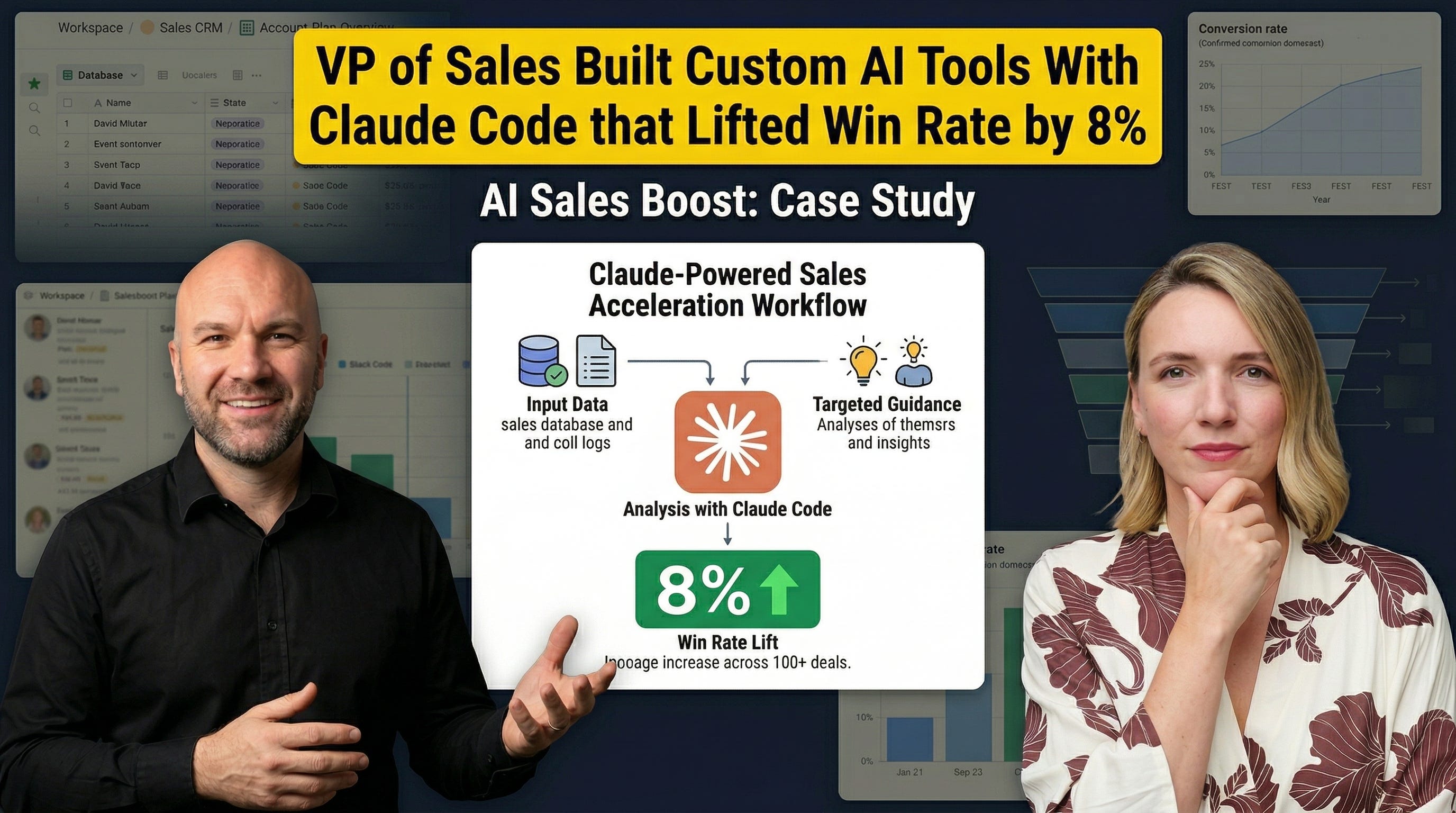
A former hairstylist built a custom LMS, automated post-call workflows, and analyzed 212 cold call transcripts in 3.5 minutes. No Python. No engineering degree. Just Claude Code and the refusal to wait for someone else to solve the problem.
Marchelle Rooney is the VP of Sales at Mangomint, a $25M ARR vertical SaaS company serving salons and spas. Her team runs a 2-day sales cycle (down from 5), closes 20-30 new logos per month per AE, and just posted an 8% win rate increase in under a year. Her stack: Momentum for call intelligence and deal signals, Nooks for dialing and outbound sequencing, Avara for AI role-play simulation, Notion for SOPs and knowledge, and Claude Code as the glue that connects everything the vendors don’t. The tools she showed on this week’s GTM AI Academy podcast aren’t theoretical. They’re in production. Built by non-technical operators who decided “everything is figureoutable.”
Here’s what stood out:
1) Her Director of Onboarding (a former hairstylist) built a full LMS in Claude Code.
Mangomint looked at buying an LMS. Then they realized their product changes too fast for a traditional tool to keep up. Marissa, who came from behind the chair, built a custom product training platform connected to Notion via MCP. It tracks progress by module, submits certifications to managers, and breaks learning into weekly complexity tiers. Their engineering team asked: “Wait, did you actually code any of this?” She didn’t. She told Claude what she needed.
The strategic shift: When your product moves fast, the people closest to the customer should own the training tooling. Not a vendor. Not IT. The operator.
2) They analyzed 212 BDR transcripts in 3.5 minutes to rebuild their cold call playbook.
Marchelle couldn’t export call data from Nooks (their BDR dialer and outbound sequencer). Old approach: copy-paste until your head falls off. New approach: she used Claude’s browser extension to scrape all 212 transcripts into a JSON, then fed them into Claude Code for analysis. Out came:
Top objections (and which ones were actually overcome)
Pattern interrupts that booked demos vs. ones that didn’t
Battle card gaps where reps were getting caught flat-footed
Regrettable vs. non-regrettable lost conversations
This is the same playbook they used with AEs 6 months earlier, where a frontline manager named Noah pulled transcripts, found the patterns, rebuilt the golden script, layered it into Avara (AI role-play simulator), and required passing scores to stay in the round robin. The result: 8% win rate increase from 29% to 37%.
3) A junior data analyst solved an import problem in one week that a senior engineer said was impossible.
The senior engineer had deep API experience and knew all the ways this import had failed before. The junior analyst didn’t know what couldn’t be done. She just asked Claude Code to help her figure it out. One week later, the problem was solved. Marchelle called it “the blessing of not knowing too much.”
This is the build vs. buy unlock: your revenue team prototypes with AI, the best solutions bubble up, and then engineering hardens what actually moves revenue. The people closest to the customer become the product feedback loop.
4) They built a post-call automation layer on top of Momentum that handles what Momentum doesn’t.
Momentum captures call signals and pushes tasks to Salesforce and Slack. But Marissa’s onboarding team needed more nuance: specific hardware orders based on what was discussed, action items beyond CRM field updates, and multi-step implementation workflows. So she built a Claude Code tool that takes a Momentum transcript, extracts every action item, and generates one-click hardware shipping orders from the conversation details (address, stand color, card reader type). The gap between what your call intelligence tool captures and what your team actually needs to execute? That’s the bridge AI builds.
5) “Micromanage the data, not the people” is her operating system.
Marchelle’s managers know: if she starts jumping back into the details on something, that’s the signal to go build a solution. She doesn’t tell them what to build. She watches the data, finds the friction, and her team reads the pattern. It’s management by visible obsession with the metric, not the task. When her team sees her harping on one thing, they know: that’s the thing to go solve.
Why this matters:
The companies winning right now aren’t waiting for vendor integrations or perfect API coverage. They’re giving non-technical operators Claude Code and a mandate: find the friction, build the MVP, prove the revenue impact. Then decide if engineering needs to harden it.
What to do this week:
Have every frontline manager record their full day, then feed it to Claude and ask what can be automated (credit: Jordan Crawford)
Identify the one data export or analysis you’ve been putting off because the tool doesn’t support it. Use Claude’s browser extension to get the data out
Stop hiring for problems you haven’t tried to solve with AI first. Build the case, then make the hire
The people closest to the revenue are the ones who should be building. Not because they’re technical. Because they know what actually matters.
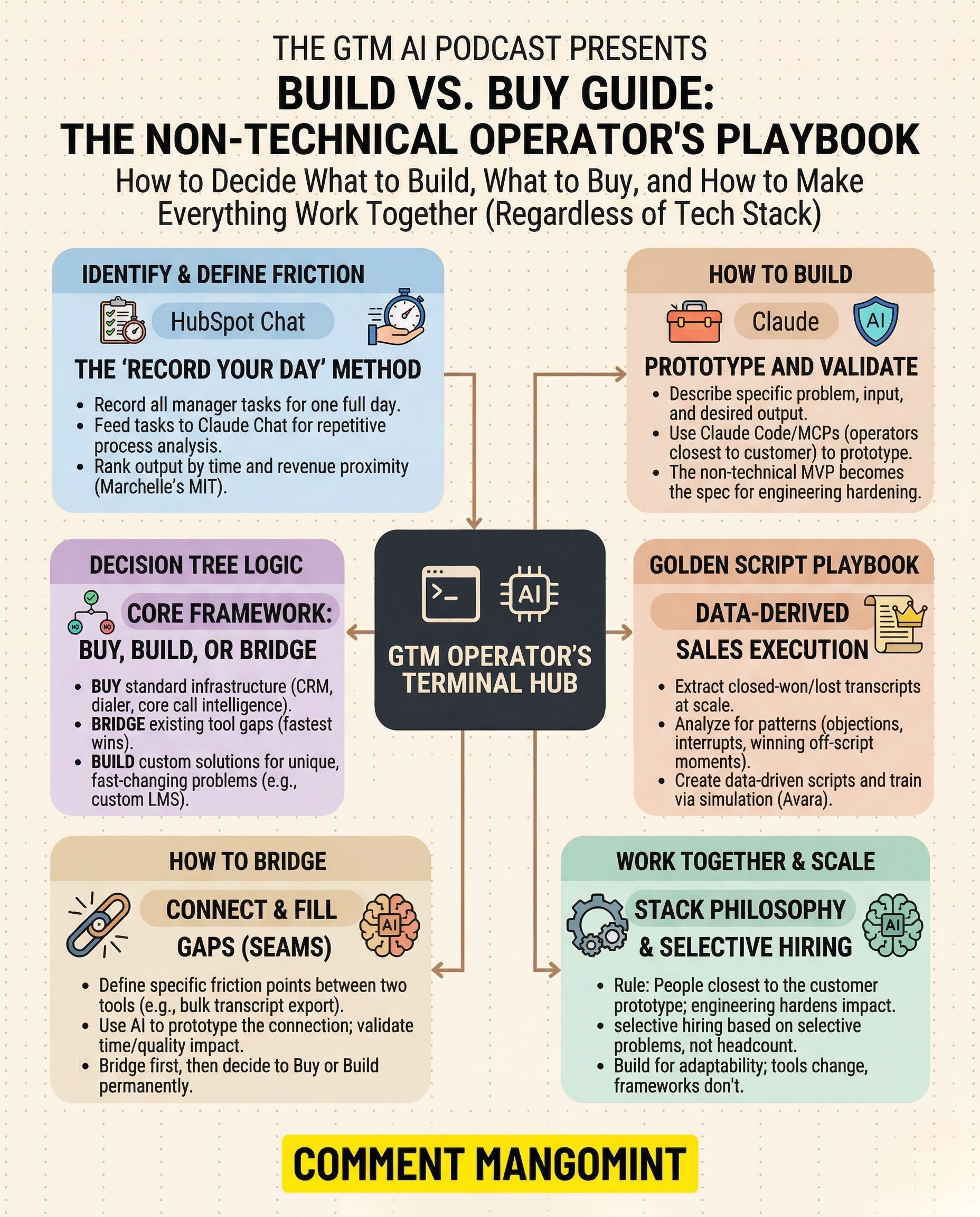
BUILD VS. BUY GUIDE: THE NON-TECHNICAL OPERATOR’S PLAYBOOK
How to Decide What to Build, What to Buy, and How to Make Everything Work Together (Regardless of Tech Stack)
WHY THIS GUIDE EXISTS
A VP of Sales with zero technical background just built tools that made her engineering team ask: “Wait, did you actually code this?”
She didn’t. Her team talked to Claude Code. They built a custom LMS connected to Notion, analyzed 212 cold call transcripts from Nooks in 3.5 minutes, automated post-call workflows that extend what Momentum captures, and created a golden script system trained through Avara (AI role-play simulator) that drove an 8% win rate increase.
This guide isn’t about Marchelle’s specific tools. It’s the decision framework and execution playbook behind what she did, so you can do the same thing with whatever stack you run. Gong or Momentum. Outreach or Nooks. Confluence or Notion. Salesforce or HubSpot. The framework is stack-agnostic. The principle is universal: the people closest to the customer should be the ones building solutions, and AI just made that possible without writing a single line of code.
THE CORE FRAMEWORK: BUILD, BUY, OR BRIDGE
Every revenue team hits the same wall: your tools don’t do exactly what you need. You have three options, and most teams only consider two of them.
BUY: Purchase a point solution that solves the problem out of the box. This is the right call for stable, infrastructure-level needs (CRM, dialer, email platform, core call intelligence). You don’t build your own Salesforce. You don’t build your own dialer. Buy the foundation.
BUILD: Create a custom solution using AI tools like Claude Code. This is the right call when the problem is unique to your business, changes frequently, or sits in a gap no vendor covers. Marchelle’s team built a custom LMS because Mangomint’s product changes too fast for any off-the-shelf LMS to keep pace. That’s a build.
BRIDGE: Use AI to connect existing tools and fill gaps between them. This is the most underused option, and it’s where the fastest wins live. You’re not replacing tools. You’re filling the seams. Marchelle used Claude Code to bridge Nooks (which doesn’t have bulk transcript export) to her analysis workflow. She bridged Momentum transcripts to automated hardware ordering. She bridged Notion content to a tracking and certification layer.
The mistake most teams make: they default to Buy or they wait. They wait for the vendor to ship the feature. They wait for engineering to have bandwidth. They wait for budget approval. Meanwhile, the problem compounds, reps run outdated playbooks, and deals slip.
The new playbook: Bridge first, validate the impact, then decide whether to Buy or Build permanently.
STEP 1: IDENTIFY THE FRICTION (THE “RECORD YOUR DAY” METHOD)
Before you decide what to build or buy, you need to know where the real problems are. Not where you think they are. Where the time actually goes.
The exercise (credit: Jordan Crawford of Cannonball):
Every frontline manager records everything they do for one full day. Every task. Every copy-paste. Every manual lookup. Every “I wish this tool did X.” Every toggle between tabs. Every time they say “I’ll just do it manually.”
Feed that list into Claude (chat, not code) and ask: “Which of these tasks are repetitive, don’t require deep judgment, and could be automated or accelerated?”
Rank the output by two criteria: (a) time consumed per week, and (b) proximity to revenue impact.
The filter question Marchelle uses: If I do this one thing, does it impact the downstream metrics that drive revenue?
Her team at Mangomint calls this the MIT (Most Important Thing). Every manager identifies one thing per week. Not five priorities. One. The thing where solving it unlocks everything downstream.
What this looks like in practice across different roles:
For a Sales Manager: “I spend 3 hours per week manually reviewing call recordings to check script adherence.” That’s a bridge. Your call intelligence tool (Momentum, Gong, Chorus) captures the calls. Claude Code can analyze transcript patterns against your golden script and flag deviations automatically.
For a RevOps Leader: “I can’t get the data out of Tool A in the format Tool B needs.” That’s a bridge. Claude’s browser extension or Claude Code can extract, transform, and load data between tools that don’t natively integrate.
For a BDR Manager: “My reps cherry-pick from the prospect list based on gut feeling instead of the scoring model.” That’s a build. You need a tool that surfaces why each prospect is scored the way it is, so the rep trusts the data instead of second-guessing it.
For an Enablement Lead: “Our training content is outdated within two weeks of publishing because the product moves so fast.” That’s a build. You need training infrastructure that pulls directly from your live knowledge base, not a static LMS.
For a CS Manager: “I manually check 15 dashboards to build my weekly at-risk account list.” That’s a bridge. Claude Code can pull from your existing data sources and build the consolidated view you actually need.
STEP 2: RUN THE BUILD-BUY-BRIDGE DECISION TREE
For each friction point you identified, run it through this:
QUESTION 1: Does a tool already exist that solves this well?
Yes, and it integrates cleanly with our stack → EVALUATE BUYING
Yes, but integration is limited, incomplete, or the tool does 80% of what we need → BRIDGE (see Step 3)
No, this is unique to our business or workflow → BUILD (see Step 4)
QUESTION 2: How fast does this problem change?
The requirements shift monthly or faster (scripts, playbooks, competitive intel, product training) → BUILD or BRIDGE. Vendors update quarterly at best. Your competitors aren’t waiting.
The requirements are stable (CRM, dialer, email infrastructure, core analytics) → BUY. Don’t reinvent infrastructure. That’s ego, not strategy.
QUESTION 3: Who understands the problem best?
The people closest to the customer (AEs, BDRs, CSMs, onboarding, frontline managers) → BUILD or BRIDGE. They should prototype it because they know the nuance no product spec will capture.
A technical team with no customer context → BUY a tool that abstracts the complexity away from them.
QUESTION 4: What’s the cost of waiting?
If the vendor ships the feature in 6 months, what do you lose in the meantime? Marchelle’s team didn’t wait for Nooks to build a transcript export. She scraped 212 transcripts in 3.5 minutes with Claude’s browser extension. Six months of waiting would have meant six months running outdated battle cards and an old golden script while competitors adapted.
QUESTION 5: Can a non-technical person prototype this in under a week?
Yes → BRIDGE or BUILD it now. Validate with real data. Then decide if it needs engineering investment.
No, it requires deep infrastructure work (database migrations, security layers, production-grade API integrations) → BUY or put it on the engineering roadmap with the prototype as the spec.
Decision Tree Summary:
FRICTION IDENTIFIED
    │
    ├── Stable, infrastructure-level need? → BUY
    │
    ├── Gap between two existing tools? → BRIDGE
    │       (Claude Code / browser extension fills the seam)
    │
    ├── Unique to your business + changes fast? → BUILD
    │       (Operator prototypes with Claude Code)
    │
    └── Not sure? → BRIDGE first (fastest to validate)
            Then decide: Buy, Build permanently, or let it ride as-is
STEP 3: HOW TO BRIDGE (CONNECT WHAT YOU ALREADY HAVE)
Bridging is the fastest path to value. You keep your existing tools. You keep your existing workflows. You just fill the gaps between them with AI.
Real examples from Mangomint’s stack:
Gap: Nooks (BDR dialer + sequencer) doesn’t support bulk transcript export for analysis. Bridge: Claude’s browser extension scraped 212 transcripts into a JSON file in 3.5 minutes. Claude Code then analyzed them for objection patterns, successful pattern interrupts, and battle card gaps. Impact: New BDR golden script and updated live battle cards, derived from actual call data instead of manager opinion.
Gap: Momentum (call intelligence) captures signals and pushes tasks, but the onboarding team needs more nuanced post-call actions than field updates and task creation. Bridge: Custom Claude Code tool takes a Momentum transcript, extracts every action item, identifies hardware needs discussed on the call (stand color, card reader type), and generates one-click shipping orders using the customer’s address from the transcript. Impact: Post-call execution went from “read the notes and figure it out” to “one-click and it’s done.”
Gap: Notion holds all SOPs and training content, but tracking who learned what, testing comprehension, and reporting progress to managers was a mess. Bridge: Claude Code + Notion MCP built a custom LMS that pulls content directly from Notion, breaks it into weekly modules of increasing complexity, includes certification quizzes, and submits progress to the frontline manager. Impact: No more stale LMS content. No more “did they actually learn it?” ambiguity. Training updates the moment Notion updates.
How to find bridge opportunities in YOUR stack (regardless of tools):
Think about the places where you manually move information between two systems. That’s the bridge.
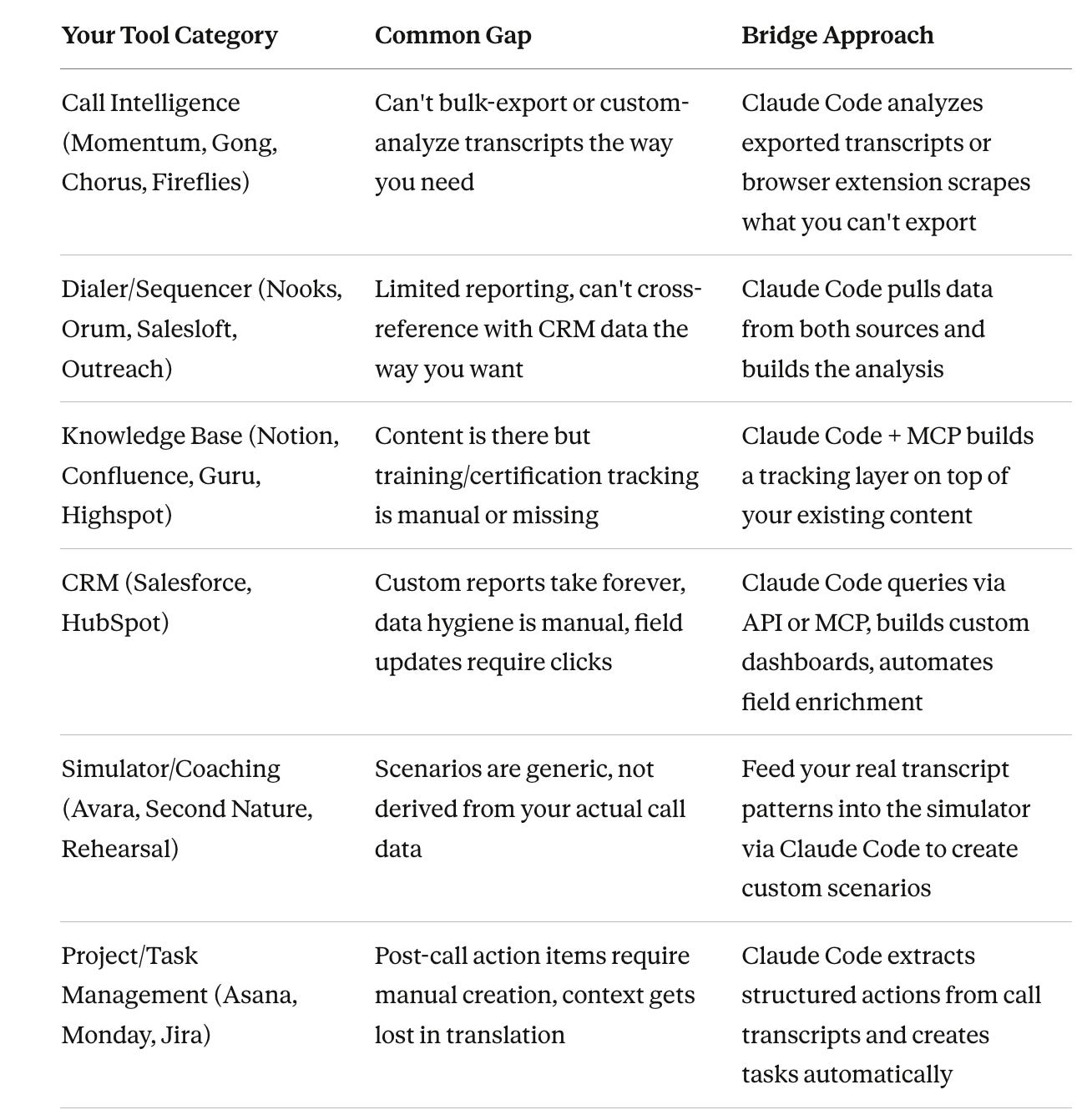
The three-step bridge pattern:
Identify the gap between two tools (where manual work or lost context lives)
Use Claude Code or Claude Chat to prototype the connection
Validate: Does it save time? Does it improve data quality? Does it accelerate the workflow?
If yes, keep running it. If the volume or complexity grows, decide whether engineering should harden it into a permanent integration.
STEP 4: HOW TO BUILD (THE NON-TECHNICAL OPERATOR’S PATH)
You do not need to know how to code. You need to know three things:
What problem you’re solving (be specific: “I need to analyze 200+ cold call transcripts to find which objections we overcome vs. which ones we lose to”)
What the input is (transcripts, CSVs, Notion databases, CRM data, exported spreadsheets)
What the output should look like (a ranked list, a dashboard, a training module, an automated workflow, a Slack alert)
The tools, in order of complexity:
Level 1: Claude Chat (zero technical skill)
Ask questions, get analysis, brainstorm approaches, process text
Best for: one-off analysis, content creation, strategy thinking, cleaning up data you’ve pasted in
Example: Paste 5 call transcripts and ask “What are the top 3 objections and how were they handled?”
Level 2: Claude Chat + Browser Extension / Cowork (minimal technical skill)
Claude can interact with web apps you’re logged into, read pages, click buttons, extract data
Best for: scraping data from tools that don’t have export, filling forms, navigating UIs at scale
Example: This is exactly how Marchelle pulled 212 transcripts from Nooks. The tool doesn’t export. Claude’s browser extension went in and pulled them one by one. 3.5 minutes.
Level 3: Claude Code (moderate comfort with a terminal)
Build actual applications, analyze data at scale, create tools with UIs
Best for: custom apps (like the LMS), bulk data analysis, workflow automation, anything that needs to process more data than you can paste into chat
You don’t write code. You describe what you want. Claude writes and runs the code. You review and iterate.
Example: “I have a JSON file with 212 call transcripts. Analyze each one for: objections raised, whether they were overcome, pattern interrupts used, and competitor mentions. Give me a summary with rankings.”
Level 4: Claude Code + MCPs (connecting to your live systems)
MCP (Model Context Protocol) lets Claude Code connect directly to tools like Notion, Slack, Google Drive, databases, and more
Best for: building tools that read from and write to your existing systems in real time
Example: The Mangomint LMS pulls content from Notion via MCP, so when SOPs update in Notion, the training modules update automatically. No re-upload. No version mismatch.
Level 5: Claude Code + MCPs + Browser Automation (the full stack)
Combine all of the above: code-level analysis, live system connections, and browser-based interaction with tools that don’t have APIs
Best for: end-to-end workflows that span multiple tools, some with APIs and some without
Example: Scrape transcripts from the browser (Level 2), analyze them in Claude Code (Level 3), push the resulting golden script updates to Notion via MCP (Level 4), and trigger a Slack notification to the team.
The mindset shift Marchelle described: “There’s definitely a moment where I have to switch my brain from trying to muscle through things to letting the intelligence push me along. Letting go of the idea that I have to do it all manually doesn’t mean I’m not doing something right.”
What you need to succeed (the real prerequisites):
Relentlessness. Marchelle said it directly: “There’s zero technical skill needed aside from the fact that you have to be relentless.” Things will break. You’ll restart 3 times. That’s normal.
Clarity on the problem. If you can’t explain what you need in plain English, Claude can’t help you. The better your description of the problem, the better the output.
Willingness to iterate. Your first attempt won’t be perfect. Neither was Marchelle’s. She rebuilt analyses, switched between chat and code, restarted when things broke. That’s the process.
A bias for “good enough” over “perfect.” The MVP that runs today beats the perfect tool that ships in 6 months.
STEP 5: THE GOLDEN SCRIPT PLAYBOOK (DATA-DERIVED SALES EXECUTION)
This deserves its own section because it’s the project that drove Mangomint’s 8% win rate increase, and it’s replicable by any team with call recordings.
The problem: Sales scripts are usually built on opinion, institutional memory, and “what the top rep does.” That’s a start, but it’s not scalable and it drifts as the market changes.
The Mangomint approach:
Phase 1: Extract the data. Noah (frontline AE manager) pulled transcripts from closed-won and closed-lost deals. Initially done manually with ChatGPT. Later, Marchelle replicated this at scale with Claude Code, pulling 212 BDR transcripts from Nooks in 3.5 minutes.
Phase 2: Analyze for patterns. Fed transcripts into Claude Code and asked for:
What objections came up most frequently?
Which objections were successfully overcome, and what language was used?
What pattern interrupts led to booked demos vs. dead air?
Where did reps go off-script and still win? (This is gold. It reveals what the playbook is missing.)
Where did reps go off-script and lose? (This reveals training gaps.)
What battle card gaps exist? (Competitor mentions where reps had no prepared response.)
Phase 3: Build the golden script. Took the winning patterns, synthesized them into a structured script, and documented it in Notion. The script isn’t a word-for-word read. It’s a framework: opening pattern interrupt, discovery structure, objection responses, and closing sequence, all derived from what actually works in real calls.
Phase 4: Train with simulation, not slides. Loaded the golden script scenarios into Avara (AI role-play simulator). Every AE and BDR must pass the simulation with a qualifying score before they enter the demo rotation. This builds muscle memory, not just knowledge. Knowing the objection response is different from delivering it smoothly under pressure.
Phase 5: Monitor adherence and evolve. Momentum captures call signals in real time. Marchelle’s frontline managers use those signals to identify when reps go off-script. But here’s the nuance: off-script isn’t always bad. When a rep goes off-script and wins the deal, that’s a signal to update the script. When they go off-script and lose, that’s a coaching moment. The script is a living document, not a stone tablet.
Phase 6: Repeat for every motion. They did this for AEs first. Now they’re running the same playbook for BDRs. Different motion, different objections, different pattern interrupts. Same framework.
STEP 6: THE BUBBLE-UP PROTOCOL (HOW MVPs BECOME REAL PRODUCTS)
This is the part most teams skip. Building the MVP is step one. What happens next determines whether it creates lasting value or dies in a forgotten browser tab.
Marchelle’s model:
Non-technical operator builds the MVP with Claude Code. They know the problem. They know the customer. They know the workflow. They don’t need to know Python.
They test it in production with real workflows, real data, real reps. Not a sandbox. Not a demo. Production.
Results are measured against the metric that matters (win rate, ramp time, conversion, time saved, deal velocity).
If it works, engineering reviews it to harden, scale, optimize, or integrate into the core product. The MVP becomes the spec. No more writing 10-page PRDs that describe a problem the engineer has never experienced.
If it doesn’t work, it cost nothing but time and the team learned something about the problem that informs the next attempt.
The “blessing of not knowing too much”:
The junior analyst at Mangomint solved a data import problem in one week that a senior engineer said was impossible. The senior engineer had years of experience with painful API integrations and knew all the ways it had failed before. The junior analyst had none of that baggage. She asked Claude Code to help her figure it out. One week later: solved.
This isn’t an argument against expertise. It’s an argument against expertise-as-blockers. The junior person’s prototype proved the problem was solvable. Engineering then had a working model to refine, not a theoretical debate about whether it could be done.
The rule: The people closest to the customer prototype. Engineering hardens what proves revenue impact. Not the other way around.
Why this changes hiring:
Mangomint doesn’t start the year with a headcount plan. They use what Marchelle calls “selective hiring.” The logic: it takes so long to ramp a technical hire to understand the nuance of their customer (salon and spa owners with specific workflows) that the existing team, armed with Claude Code, can solve most problems faster. Then, when a hire is needed, the job description is specific because the prototype already exists. You’re not hiring someone to “figure out the problem.” You’re hiring someone to scale the solution.
STEP 7: HOW TO MAKE EVERYTHING WORK TOGETHER (THE STACK PHILOSOPHY)
Regardless of what tools you use, these principles apply:
Principle 1: Don’t wait for integrations. If two tools don’t talk to each other, build the bridge yourself. Marchelle’s team wanted Nooks integrated with Momentum. It isn’t. Rather than waiting for a vendor roadmap, she used Claude Code to fill the gap. Waiting is a choice to lose months of value. The bridge you build today might be temporary. That’s fine. Temporary solutions that work beat permanent solutions that don’t exist yet.
Principle 2: Your training and enablement must move as fast as your product. If your product ships features monthly, an LMS with quarterly content updates is already behind. Mangomint’s Director of Onboarding built a training system that connects directly to Notion via MCP. When the knowledge base updates, the training updates. When new product features ship, the certification modules reflect them. This is why they built instead of bought. No off-the-shelf LMS could keep pace with their product velocity.
Principle 3: Every script, playbook, and battle card should be data-derived, not opinion-derived. Pull transcripts. Analyze patterns. Find what your top closers actually say vs. what the playbook says they should say. Then update the playbook. Marchelle’s golden script project didn’t start with “what do we think works?” It started with “what does the data say works?” The 8% win rate increase came from aligning the script to reality, not theory.
Principle 4: Measure the muscle memory, not just the knowledge. Mangomint uses Avara (AI role-play simulator) to practice scripts before going live. Knowing the objection response is not the same as executing it under pressure with a skeptical prospect on the phone. Build practice infrastructure into every rollout. Require passing scores. Make simulation a gate, not an optional exercise.
Principle 5: Micromanage the data, not the people. This is Marchelle’s operating philosophy. Watch the metrics. When something is off, drill in until you find the solvable thing. Your team will learn to read your focus areas and build solutions around them. When her managers see Marchelle harping on a specific metric or problem, they know: that’s the thing to go build a solution for. It’s management by signal, not micromanagement by task.
Principle 6: Let the non-technical people surprise the technical people. When Marchelle’s team showed their Claude Code builds to the engineering team, the engineers asked: “Did you actually code this?” They didn’t. The value of this moment isn’t the tool. It’s the organizational signal: the revenue team can now prototype solutions that previously required an engineering ticket and a 6-week wait. That changes the speed of the entire company.
Principle 7: The best tools in 6 months will be different from today. Build for adaptability. Marchelle said it plainly: “Probably 4 months ago, we could not have done this.” The MCP integration with Notion, the browser extension capabilities, the enterprise plan features, all of it evolved. Build your processes around the framework (find friction → prototype → validate → harden), not around any single tool. The tools will change. The framework won’t.
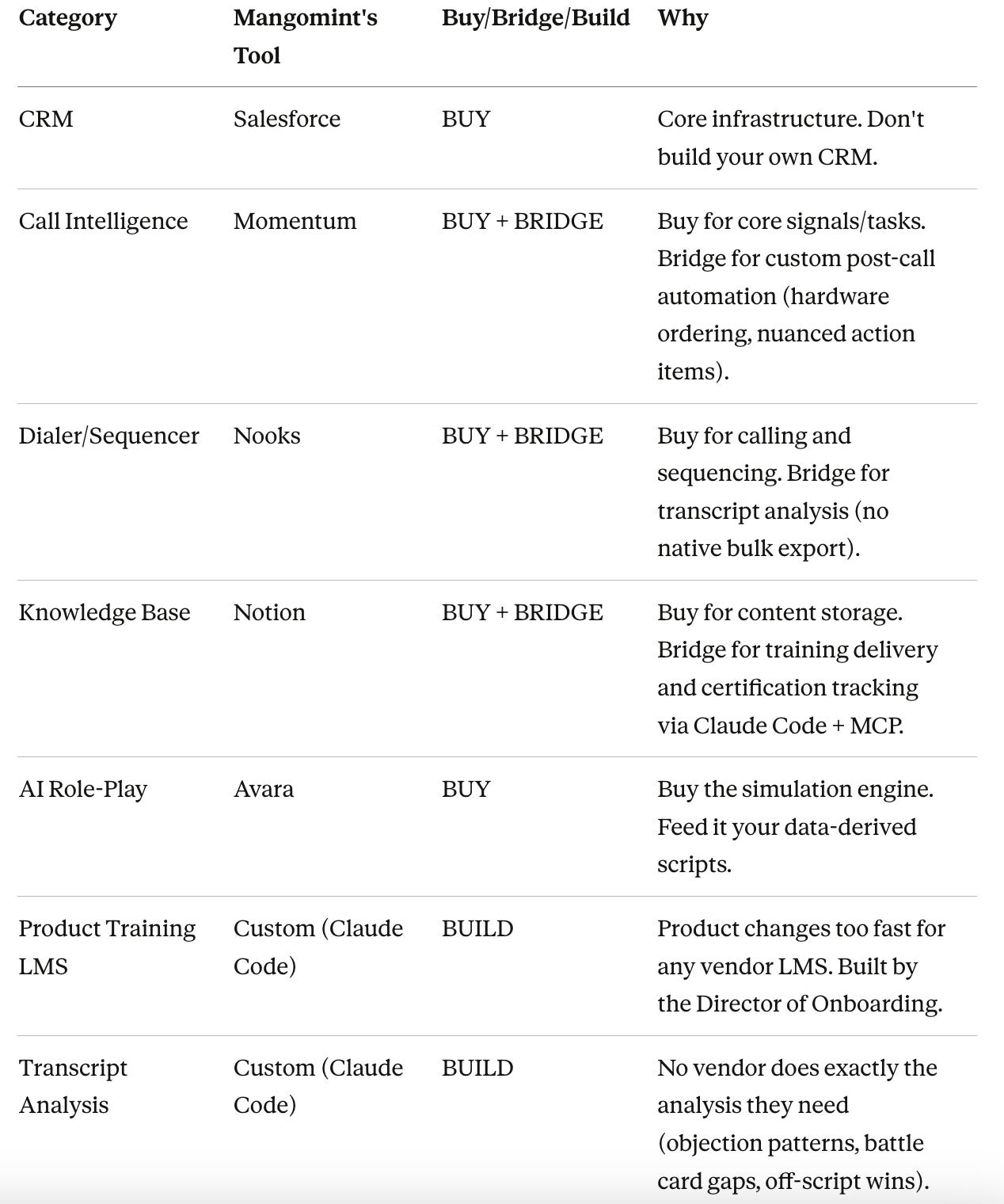
THE TOOL STACK MAP: WHAT TO BUY, WHAT TO BRIDGE, WHAT TO BUILD
Here’s how Mangomint thinks about their stack. Adapt the categories to your own tools.
QUICK-START CHECKLIST
This week:
Have every frontline manager record their full workday and feed it to Claude
Identify the #1 manual task that sits between two tools (that’s your first bridge)
Try Claude’s browser extension on one data extraction you’ve been putting off
List every place in your workflow where you manually move information from Tool A to Tool B
This month:
Run the Build-Buy-Bridge decision tree on your top 3 friction points
Build one MVP tool with Claude Code that solves a real friction point
Pull your last 50-100 call transcripts and run them through Claude Code for pattern analysis
Measure the before/after on the metric the MVP was designed to move
Share the result with your engineering team. Watch their reaction.
This quarter:
Establish the bubble-up protocol: operator prototypes → validate → engineering hardens
Move from opinion-based playbooks to data-derived golden scripts (full golden script playbook)
Build practice infrastructure (Avara, Second Nature, or any AI simulator) into every script rollout
Map your full stack using the Buy/Bridge/Build framework
Create a recurring cadence: re-analyze transcripts monthly. Scripts evolve. So should yours.
The mandate Marchelle gives her team: Find the things that are annoying, repetitive, and don’t require deep nuance. Then go build a solution. If you even come up with the MVP that shows your head of engineering the signal, you’ve created more value than waiting 6 months for a feature request.
FINAL THOUGHT
Marchelle’s team didn’t ask permission to build. They didn’t wait for a budget cycle. They didn’t submit a Jira ticket. They opened Claude Code and started talking to it about their problems.
The tools you use don’t matter as much as the willingness to fill the gaps between them. Every stack has seams. The teams that win are the ones that bridge those seams instead of waiting for someone else to do it.
Everything is figureoutable. Start there.