

Good day to everyone, yet another day and PACKED with a ton of content.
Today is sponsored by the www.aibusinessnetwork.ai and www.gtmaiacademy.com
Here to help you understand how AI makes real business impact for teams and individuals.
Today we will cover:
Season 2, Episode 8 with the Thynk.ai Team with John Long and Dane Oborn is revolutionizing sales with AI Agents that they built.
GTM AI Tool of the week Telescope
And we dive into:
Model upgrades and announcements from Perplexity, Claude, and Mistral
New Generation of Doctors and what does that mean for GTM?
Ideal Mix of Human and AI
Let’s get into the podcast:
You can go to Youtube, Apple, Spotify as well as a whole other host of locations to hear the podcast or see the video interview.
The Year of the AI Agent: How Thynk.ai is Revolutionizing Sales
In my latest GTM AI Podcast episode, I reconnected with John Long and Dane Oborn, longtime friends and co-founders of Thynk.AI Their journey from sales professionals to AI innovators is remarkable - after experiencing the frustrations of inefficient sales processes firsthand, they've built a solution that's changing the game.
Thynk.ai has developed autonomous AI agents that handle the entire pre-sales process from prospecting to discovery, solving a problem every GTM leader understands: ensuring every sales conversation is productive. What struck me most was seeing how their experience in the trenches of sales informed their tech development, creating a solution that addresses real pain points rather than theoretical problems.
Top 5 Highlights for GTM Teams
[00:40:04] From frustration to innovation: Thynk.ai emerged because John and Dane couldn't find existing tools that managed the complete pre-sales workflow—they needed something that called, texted, qualified, and prepared prospects before human sales involvement
[00:49:43] True AI agents vs. assistants: Unlike interactive AI assistants that require constant human guidance, their agents work autonomously toward defined objectives, fundamentally changing how we think about sales development roles
[01:02:27] The "hands-off" moment: Business owners experience a paradigm shift watching AI agents independently engage with leads in real-time, handling complex conversations without human intervention
[01:19:31] AI's workforce transformation: Rather than simply cutting jobs, the most strategic companies are leveraging AI to amplify their human talent while expanding their total addressable market
[01:25:31] Strategic AI implementation framework: John's "three buckets" approach helps GTM leaders distinguish between superficial AI tools, meaningful operational enhancements, and revolutionary custom solutions
Building Intelligence: The Core of Thynk AI
When I invited John and Dane to dig into the mechanics of their AI agents, he explained, "Dan and I both have a background in sales… and through that process, we were constantly frustrated with unqualified leads." This mutual frustration led them to explore AI's potential to streamline the pre-sales process, ensuring sales reps engage with prospects ready for meaningful conversations.
"Imagine if there was a way for AI to help with that pre-sales motion," John continued. "Wouldn't it be cool?" This vision materialized into Thynk AI's agent technology, capable of performing tasks like prospecting, calling, texting, and even holding discovery calls autonomously.
The Impact of AI: A Dual Perspective
Turning the spotlight to potential workforce implications, John acknowledged, "It's a sobering reality to recognize that we are in the middle of a new tech revolution." While acknowledging the delicate balance between adopting AI and managing existing teams, he emphasized the dynamic nature of AI in creating new opportunities.
Notably, a recent report by the World Economic Forum suggested AI could result in a net increase of 90 million jobs by 2030, reinforcing John's optimism. "For those listening to this podcast, learning about AI is exciting," he encouraged. The potential for AI to not only sustain but expand job markets underscores the need for proactive engagement with this evolving technology.
Key Insights for Revenue Leaders
The autonomous agent advantage: "An agent can work on its own. That's like bringing on an employee that's going through a process, trying to accomplish an objective and do it for you where you're not having to hold its hand the entire time." - Dane Oborn
The psychological transition: "Business leaders sit back and see a new lead come in. They're like, 'Oh, shouldn't I be doing something?' And yet the agent is texting, calling, holding conversations, answering questions, scheduling meetings—handling customers better than they had ever been handled before, and as a business owner, I'm not having to do anything." - John Long
AI implementation strategy: "Most businesses are going to see the biggest bang for their buck by finding tools in bucket number two [meaningful operational tools] to employ and see major increases virtually overnight as a result." - John Long
The AI productivity multiplier: "It's the difference between thriving and surging forward and being able to take the same resources that you're using today and get a 10X output. That's exciting for business leaders, and that's progress in a very good, healthy way." - John Long
The timing advantage: "2025 is expected to be the year of the AI agent. What I would tell business owners is it's the year where everybody is going to start adopting this on a more wide scale. There are tools out there that can help you—explore them, learn about them, invest in them in your company." - Dane Oborn
Really good conversation that stretches the mind of what is possible. Well worth the 30 min to tap into how they think, what that means for business, and pushing yourself to a new level of performance.
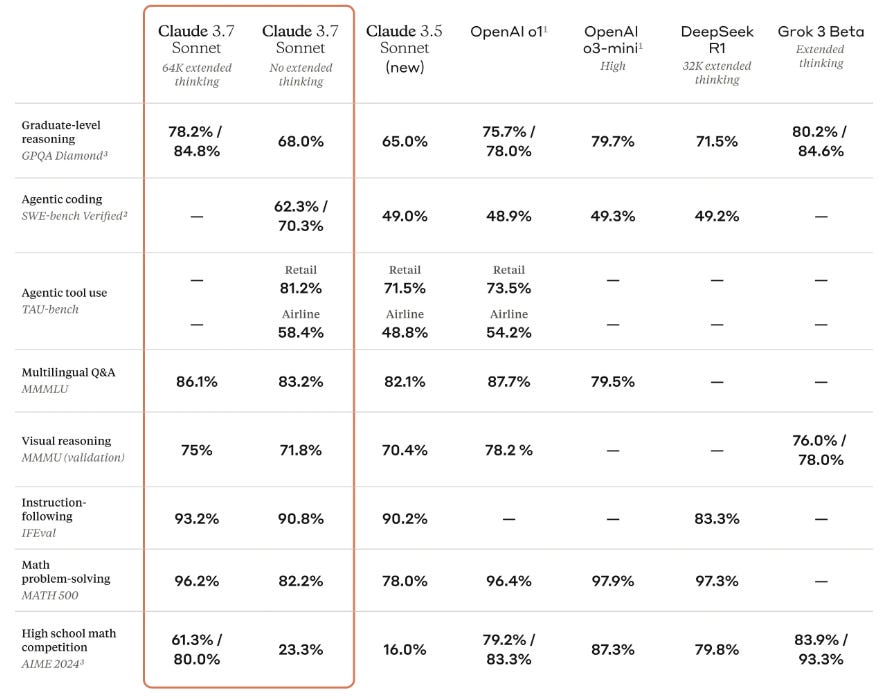
Anthropic's recent unveiling of Claude 3.7 Sonnet marks a significant advancement in artificial intelligence, introducing the first hybrid reasoning model designed to seamlessly integrate rapid responses with in-depth analytical capabilities. This innovation is poised to transform how Go-To-Market (GTM) teams and professionals approach complex problem-solving, coding, and strategic planning.
Key Features of Claude 3.7 Sonnet:
Hybrid Reasoning Capability:
Standard Mode: Delivers near-instantaneous responses suitable for straightforward queries, enhancing efficiency in daily operations.
Extended Thinking Mode: Engages in comprehensive, step-by-step reasoning for complex tasks, improving performance in areas such as mathematics, physics, and coding. Users can toggle this mode based on the depth of analysis required.
Enhanced Coding Proficiency:
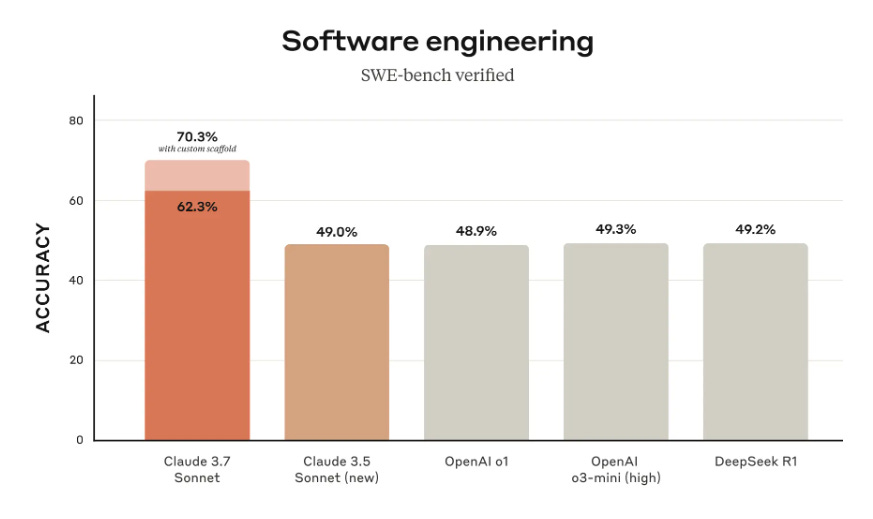
Demonstrates significant improvements in coding and front-end web development, enabling the generation of production-ready code with reduced errors. Early testers have noted its exceptional precision in complex agent workflows and full-stack updates.
Claude Code Integration:
Introduces Claude Code, a command-line tool available as a limited research preview, allowing developers to delegate substantial engineering tasks directly from their terminal. This facilitates a more interactive and efficient coding experience.
Scalability and Accessibility:
Supports up to 128K output tokens in beta, over 15 times longer than previous versions, which is particularly valuable for rich code generation and planning.
Available across all Anthropic plans—including Free, Pro, Team, and Enterprise—as well as through the Anthropic API, Amazon Bedrock, and Google Cloud’s Vertex AI, ensuring broad accessibility for various organizational needs.
Implications for GTM Teams and Professionals:
The introduction of Claude 3.7 Sonnet offers several strategic advantages:
Accelerated Decision-Making: The hybrid reasoning model allows GTM teams to obtain quick insights for routine inquiries while enabling deep analytical processing for complex strategic decisions, thereby enhancing agility and responsiveness.
Optimized Resource Allocation: By automating intricate coding tasks and reducing the time required for problem-solving, teams can reallocate resources to focus on innovation and market expansion.
Improved Collaboration: The integration of Claude Code fosters seamless collaboration between technical and non-technical team members, as the AI can bridge gaps in understanding and execution, leading to more cohesive project development.
Cost Efficiency: Maintaining the same pricing as its predecessors—$3 per million input tokens and $15 per million output tokens—Claude 3.7 Sonnet offers an economical solution for advanced AI capabilities, making it accessible to a wide range of businesses.
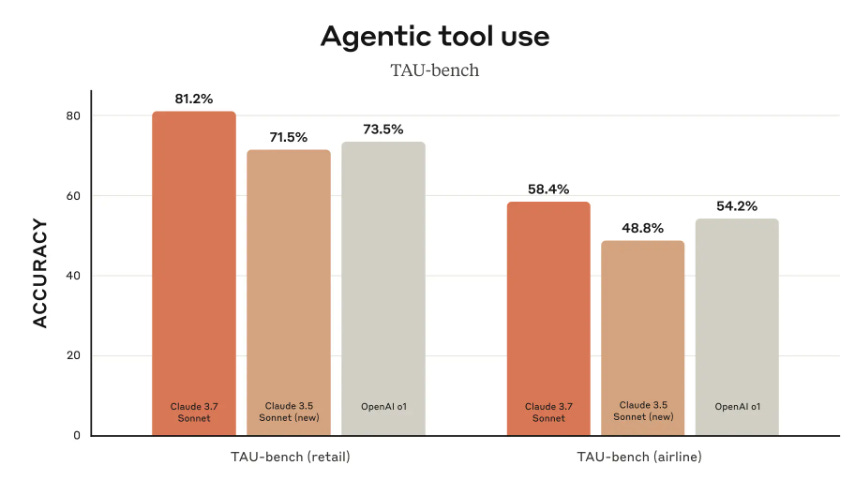
In summary, Claude 3.7 Sonnet represents a pivotal development in AI technology, providing GTM teams and professionals with a versatile tool that enhances both speed and depth in their operations. Its hybrid reasoning capabilities, coupled with advanced coding support, position it as an invaluable asset in navigating the complexities of modern markets.
Perplexity AI's announcement of Comet, (you can go there to join the wait list) an AI-powered web browser, signifies a pivotal shift in how users may interact with the internet. This development aims to integrate advanced artificial intelligence directly into the browsing experience, potentially transforming traditional web navigation and information retrieval.
Understanding Comet:
Comet is designed as an "agentic browser," a term suggesting that it will incorporate AI agents capable of performing tasks autonomously on behalf of the user. While specific features have not been fully disclosed, the integration of AI into the browser's core functionality is expected to enhance user experience by providing more intuitive and efficient interactions. Potential capabilities include real-time threat detection, intelligent tab management, and personalized content delivery.
Significance of Comet:
The introduction of Comet is significant for several reasons:
Enhanced User Experience: By embedding AI directly into the browser, Comet could offer more personalized and context-aware browsing, reducing the time users spend searching for information and increasing overall efficiency.
Competitive Dynamics: Entering a market dominated by established browsers like Google Chrome, Safari, and Microsoft Edge, Comet represents a bold move that could disrupt existing hierarchies and foster innovation.
Integration of AI Agents: The concept of an agentic browser implies that Comet may perform complex tasks autonomously, such as booking appointments or managing emails, thereby redefining the scope of browser capabilities.
Potential Impact:
The launch of Comet could have far-reaching implications:
For Users: A more seamless and interactive browsing experience, with AI handling routine tasks and providing tailored content.
For Developers: Opportunities to create AI-driven applications and extensions that leverage Comet's advanced capabilities.
For the Browser Market: Increased competition may lead to accelerated innovation, with other browsers integrating similar AI functionalities to keep pace.
Implications for Security and Browsing:
The advent of AI-powered browsers like Comet introduces new considerations:
Security Enhancements: AI can proactively identify and mitigate online threats, offering users a safer browsing environment.
Privacy Concerns: The deep integration of AI necessitates robust data protection measures to prevent unauthorized access and ensure user trust.
Redefined Browsing Paradigms: With AI agents capable of autonomous actions, the traditional model of user-driven navigation may evolve into a more collaborative interaction between users and their browsers.
In summary, Perplexity AI's Comet browser represents a significant advancement in integrating artificial intelligence into everyday internet use. Its development could redefine user expectations and set new standards for browser functionalities, emphasizing the growing importance of AI in enhancing digital experiences.

Mistral AI, a prominent player in the artificial intelligence landscape, has recently introduced several significant updates that underscore its commitment to innovation and user-centric solutions. These developments encompass advancements in language models, strategic partnerships, and the expansion of AI accessibility across various platforms.
Advancements in Language Models:
Mistral Small 3: In January 2025, Mistral AI unveiled Mistral Small 3, a 24-billion-parameter language model that achieves over 81% accuracy on the Massive Multitask Language Understanding (MMLU) benchmark. Notably, it processes 150 tokens per second, offering a balance between performance and efficiency. Released under the Apache 2.0 license, this model empowers businesses to modify and deploy it freely, facilitating a wide range of applications.
Mistral Saba: Demonstrating a focus on regional language support, Mistral AI introduced Mistral Saba, a model tailored for specific linguistic and cultural contexts. This initiative highlights the company's dedication to inclusivity and the provision of AI solutions that resonate with diverse user bases.
Strategic Partnerships and Collaborations:
Agence France-Presse (AFP): In a landmark agreement, Mistral AI partnered with AFP to integrate over 2,000 daily news articles into its chatbot, Le Chat. This collaboration ensures that users receive responses grounded in verified, up-to-date information, enhancing the chatbot's reliability and factual accuracy.
Stellantis: Mistral AI has strengthened its partnership with automotive giant Stellantis to develop an advanced in-car assistant. This AI-powered system aims to provide real-time, conversational support for drivers, enhancing the in-vehicle experience and setting new standards for automotive AI applications.
Expansion of AI Accessibility:
Le Chat Enhancements: Mistral AI's AI assistant, Le Chat, has undergone significant updates, including the addition of web search capabilities with citations. This feature enables users to access real-time information directly within their interactions, bridging the gap between conversational AI and dynamic data retrieval.
Mobile Application Launch: Recognizing the importance of accessibility, Mistral AI has launched mobile applications for Le Chat on both iOS and Android platforms. This move ensures that users can engage with advanced AI assistance seamlessly across devices, promoting a more integrated and user-friendly experience.
Implications for Go-To-Market (GTM) Teams and Professionals:
These developments by Mistral AI carry profound implications for GTM teams and professionals:
Enhanced Product Offerings: The introduction of versatile language models like Mistral Small 3 allows GTM teams to incorporate cutting-edge AI capabilities into their products, thereby meeting diverse customer needs and staying competitive in the market.
Strengthened Market Positioning: Strategic partnerships, such as those with AFP and Stellantis, not only expand Mistral AI's reach into new sectors but also enhance its credibility. GTM professionals can leverage these collaborations to position their offerings as reliable and innovative solutions.
Improved Customer Engagement: The continuous enhancement of Le Chat, including its mobile accessibility and real-time information integration, provides GTM teams with powerful tools to engage customers more effectively, offering personalized and contextually relevant interactions.
In summary, Mistral AI's recent updates reflect a strategic blend of technological advancement, collaborative synergy, and a commitment to broadening AI accessibility. These initiatives not only reinforce Mistral AI's position as a leader in the AI industry but also equip GTM teams and professionals with the resources to drive innovation and deliver exceptional value to their customers.

AI-Powered Medical Training: How NYU Langone’s AI Innovation Signals the Next Evolution of Learning and Decision-Making in GTM Leadership
NYU Langone Health is leading a transformational shift in medical education by deploying AI-powered learning systems to equip the next generation of doctors with real-time case insights, personalized learning paths, and AI-assisted decision-making. By integrating agentic Retrieval-Augmented Generation (RAG) and open-weight large language models (LLMs), Langone is pioneering a new "precision medical education" model that adapts dynamically to students' needs.
For Go-To-Market (GTM) leaders, professionals, and sales & marketing teams, this breakthrough holds far-reaching implications beyond healthcare. It provides a blueprint for AI-driven workforce enablement, continuous learning, and the future of data-assisted decision-making.
Here’s an in-depth review of NYU Langone’s AI approach, why it matters, and what GTM professionals can learn from it.
1. How NYU Langone’s AI-Driven Training Model Works
🔹 Personalized AI Research Companion for Medical Training
NYU Langone’s custom-trained AI model runs on Llama-3.1-8B-instruct, an open-weight large language model.
The AI processes electronic health records (EHRs) every night, analyzing patient cases and matching them with the latest research, diagnosis guidelines, and medical insights.
By morning rounds, medical students receive personalized AI-generated emails containing:
✅ Summarized patient cases from the previous day.
✅ Relevant medical research and trials from PubMed.
✅ Self-study questions and AI-curated recommendations to reinforce learning.
🔹 A Frictionless Learning & Decision-Support System
AI-powered insights arrive exactly when doctors need them—before rounds—ensuring they stay updated without wasting hours manually researching.
The model bridges gaps in knowledge, catching missed insights, best practices, and overlooked details.
Physicians reported that when the AI-powered emails stopped for a few days, they immediately noticed the gap in decision-making support.
🚀 GTM Takeaway:
✅ GTM leaders must build AI-powered enablement workflows that deliver real-time, contextualized insights to sales, marketing, and product teams.
✅ Enterprise teams need AI copilots that serve as personalized research assistants, delivering insights at the moment of need.
2. Why This AI Model Matters for Medical Training and Beyond
🔹 Moving From "One-Size-Fits-All" to Adaptive, AI-Driven Learning
Traditional medical education follows a fixed curriculum, whether a student plans to become a neurosurgeon or a psychiatrist.
AI enables precision learning, personalizing training for each individual student based on their specialization, case history, and knowledge gaps.
💡 GTM Parallel:
Most sales and marketing training still follows a generic approach, despite different reps needing tailored enablement based on deal size, industry, and stage in their career.
AI can customize GTM training the way NYU Langone is customizing medical education, making sales coaching, customer success training, and marketing strategy far more precise and effective.
🚀 GTM Takeaway:
✅ AI-driven enablement should replace static sales playbooks, delivering personalized coaching based on real deal data, customer interactions, and rep performance trends.
✅ Enterprise L&D teams should adopt AI-assisted learning for role-specific training, just as NYU Langone is personalizing medical education.
3. How AI Copilots Are Reshaping Decision-Making
🔹 Augmenting, Not Replacing, Human Judgment
Doctors have historically been expected to keep up with every new medical study—a near-impossible task given the millions of medical papers published annually.
AI doesn't replace human expertise—instead, it acts as a co-pilot, ensuring doctors get real-time knowledge to support their decision-making.
💡 GTM Parallel:
GTM leaders must accept that AI will outperform humans in data retrieval, pattern recognition, and research aggregation.
Instead of resisting AI, business leaders must build AI-assisted decision-making processes that enhance their teams' expertise.
🚀 GTM Takeaway:
✅ Sales and marketing leaders must rethink their decision frameworks to incorporate AI-assisted insights.
✅ AI copilots should be used to suggest strategies, surface insights, and flag risks in GTM decision-making—just as NYU Langone is using AI for diagnostic support.
4. Implications for GTM Leaders: AI-Powered Enablement and Continuous Learning
🔹 How GTM Teams Should Apply NYU Langone’s AI Model
1️⃣ AI-Driven Sales and Marketing Enablement
Just as NYU Langone delivers AI-researched patient case studies every morning, AI-powered GTM enablement could:
✅ Deliver real-time deal coaching to sales reps.
✅ Surface competitor insights for marketing teams.
✅ Generate dynamic training materials based on rep performance.
2️⃣ AI for Adaptive Market Intelligence
NYU Langone’s AI actively scans millions of research papers to find the most relevant insights for medical professionals.
GTM teams need AI-driven market intelligence that continuously scans:
✅ Competitor strategies and shifts in the market.
✅ Emerging customer pain points and trends.
✅ Regulatory changes affecting sales and marketing.
3️⃣ AI-Powered Decision Support for Leaders
Just as NYU Langone’s AI highlights next steps for doctors, AI-driven business copilots should:
✅ Flag at-risk deals before they stall.
✅ Recommend pricing adjustments based on real-time market shifts.
✅ Provide data-backed marketing campaign optimizations.
🚀 GTM Takeaway:
✅ Business leaders need AI copilots that deliver real-time, data-driven insights to enhance decision-making—just as NYU Langone is doing in medicine.
✅ AI should be embedded into leadership workflows to recommend actions and uncover blind spots.
5. The Future of AI-Powered Learning and Decision-Making in GTM
🔹 Key Lessons from NYU Langone’s AI Approach
1️⃣ AI is not replacing expertise—it’s making experts more effective.
2️⃣ Static training programs will be replaced by adaptive, AI-driven learning.
3️⃣ GTM leaders must build AI-assisted decision-making frameworks to remain competitive.
🔹 What GTM Professionals Should Do Next
📌 Implement AI-powered coaching tools that deliver real-time recommendations to sales teams.
📌 Develop AI-driven competitive intelligence systems that track real-time industry changes.
📌 Adopt AI copilots for GTM leadership decision-making, ensuring leaders have real-time data-driven insights.
🚀 Final Thought:
NYU Langone’s AI-assisted medical training is not just a breakthrough for healthcare—it’s a blueprint for AI-powered continuous learning and decision-making in every industry.
💡 For GTM professionals and business leaders, the key question is: How fast can you integrate AI copilots into your workflows to stay ahead?
The Human-AI Collaboration Paradox: What This Study Means for GTM Professionals and AI-Driven Strategy
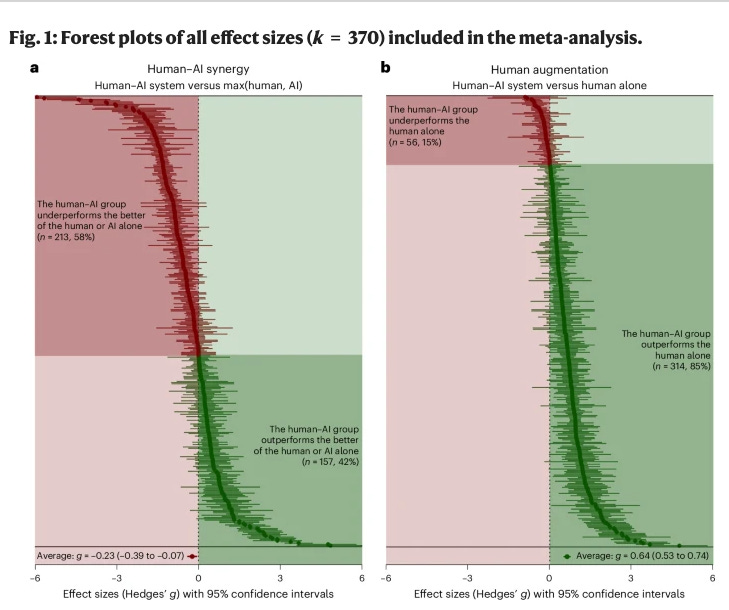
A new study published in Nature Human Behaviour provides a comprehensive analysis of how humans and AI perform together versus separately, offering crucial insights into when AI enhances human performance and when it does not. The findings present a critical roadmap for Go-To-Market (GTM) professionals, leaders, and AI-driven teams who seek to integrate AI more effectively into business workflows, sales strategies, and customer engagement.
The study systematically analyzed 106 experimental studies with 370 effect sizes, revealing key insights:
✅ Human-AI collaboration improves human performance (augmentation) but
❌ Human-AI collaboration often performs worse than AI alone (no synergy)
This paradox—where AI helps humans but humans don't always improve AI performance—has profound implications for business leaders, sales teams, marketing professionals, and decision-makers navigating AI adoption.
1. Key Findings from the Study: When AI and Humans Work Best Together
🔹 When Human-AI Collaboration Works Well (Augmentation)
The study found strong evidence that AI enhances human decision-making, making individuals more effective at certain tasks.
Human augmentation was most noticeable in:
✅ Creative and content-related tasks (e.g., brainstorming, writing, design)
✅ Complex analysis with structured human input
✅ Situations where humans retained decision-making authority over AI recommendations
📌 Example for GTM Teams:
AI-powered marketing content creation improves human efficiency in writing, ad copy, and design.
AI-enhanced sales prospecting surfaces better leads for sales reps to pursue.
AI-driven customer support automation speeds up issue resolution while letting human agents handle complex edge cases.
🚀 Takeaway for GTM Teams:
✅ Use AI to assist with creativity, analysis, and scaling decision-making rather than attempting to replace human intuition completely.
🔹 When Human-AI Collaboration Fails (No Synergy)
The study found that when AI outperformed humans alone, collaboration often led to performance losses.
Key failures occurred in:
❌ Decision-making tasks where AI was clearly better (e.g., fraud detection, algorithmic trading, forecasting)
❌ Overreliance on AI (automation bias), leading to human errors in judgment
❌ Underuse of AI insights due to distrust (automation skepticism)
📌 Example for GTM Teams:
AI-generated lead scoring models often outperform human judgment in predicting high-converting prospects. However, sales reps may override AI insights based on gut feeling, leading to worse decisions.
AI-driven pricing and demand forecasting can be more accurate than human estimates, but businesses may resist data-driven decisions due to cognitive bias.
AI-powered customer service chatbots handle routine inquiries better than human agents, yet companies continue routing customers to humans out of habit.
🚀 Takeaway for GTM Teams:
✅ Use AI where it clearly outperforms humans (e.g., lead scoring, forecasting, automation).
✅ Ensure humans only intervene where their expertise adds measurable value.
2. Implications for GTM Professionals: How to Integrate AI More Effectively
🔹 When to Use AI as a Co-Pilot, Not Just a Tool
AI works best as a co-pilot when:
✅ It assists with research and data processing (e.g., AI surfacing real-time competitive insights).
✅ It automates routine tasks but keeps humans in control (e.g., AI-driven outreach with human sales reps handling negotiations).
✅ It augments creative or strategic decision-making rather than attempting to replace it.
📌 GTM Example:
AI-generated marketing copy should always go through human review and refinement before launch.
AI-powered lead scoring should be paired with human judgment in edge cases, rather than blindly followed or ignored.
AI-powered sales forecasting should be used to guide decision-making, but not replace strategic planning.
🚀 Takeaway:
✅ GTM teams must train employees to work alongside AI, rather than relying too much on it or dismissing its insights.
🔹 The Future of AI in Decision-Making: Humans Must Adapt to AI, Not Vice Versa
The study suggests that as AI continues to improve, humans will need to adapt their workflows rather than expecting AI to fit old ways of working.
Companies must develop new hybrid work processes that:
✅ Identify tasks where AI performs best and let AI take the lead.
✅ Redesign decision-making structures to integrate AI effectively.
✅ Ensure that AI remains explainable and transparent for human oversight.
📌 Example for GTM Teams:
Customer support AI chatbots should be trained on real customer conversations to improve accuracy.
Sales reps should be trained to interpret AI insights correctly, rather than dismissing them or relying on them blindly.
AI-driven ad targeting and personalization should be tested iteratively with human oversight to avoid bias and optimize results.
🚀 Takeaway:
✅ Organizations must redesign workflows around AI, rather than just layering AI on top of existing processes.
3. Practical Applications: How GTM Leaders Should Think About AI Integration
🔹 AI in Sales and Marketing: Smarter, Not Just Faster
AI should not just automate tasks but actively enhance decision-making for GTM teams.
AI can improve customer segmentation, lead qualification, and personalization, but it requires careful human oversight.
📌 Best Practices for AI in Sales & Marketing:
✅ Use AI to automate low-value tasks (e.g., scheduling, CRM updates) but keep human reps focused on high-value interactions.
✅ Leverage AI for data-driven insights, but ensure decision-makers understand AI recommendations before acting on them.
✅ Integrate AI into cross-functional GTM strategies to unify sales, marketing, and customer success efforts.
🔹 AI in Customer Engagement: The Hybrid Future
Customers expect personalized experiences, but pure automation doesn’t work in every scenario.
The best AI-driven customer experiences involve a mix of AI efficiency and human empathy.
📌 Best Practices for AI in Customer Experience:
✅ Use AI chatbots for routine inquiries but ensure seamless handoff to human agents for complex issues.
✅ Leverage AI to analyze customer sentiment, but let humans manage emotional or high-stakes interactions.
✅ Use AI-powered self-service tools but provide human-guided options for higher-touch experiences.
🔹 The Leadership Mindset Shift: AI is Here to Assist, Not Replace
Business leaders must redefine their teams' roles in an AI-driven world.
Training employees to work with AI will be as important as hiring AI-skilled talent.
📌 Leadership Priorities for AI Integration:
✅ Develop AI literacy programs across GTM functions.
✅ Create AI governance frameworks to ensure ethical and effective AI use.
✅ Invest in AI tools that augment, not replace, human expertise.
4. Final Takeaways: How GTM Leaders Should Navigate the AI-Human Balance
🔹 Key Learnings from the Study:
✅ Human-AI collaboration enhances performance in many cases, but not all.
✅ AI should be used strategically where it clearly outperforms humans.
✅ Human intervention should only occur where it adds real value.
✅ Organizations must redesign workflows to take full advantage of AI capabilities.
🔹 What GTM Professionals Should Do Next:
1️⃣ Embrace AI as a decision-support tool, not just automation.
2️⃣ Train teams to work alongside AI, ensuring proper interpretation of AI-generated insights.
3️⃣ Use AI where it delivers clear benefits but avoid forcing AI where human expertise is superior.
4️⃣ Continuously test and refine AI-powered processes to optimize performance.
🚀 The Future of GTM Leadership is Hybrid: AI + Human Expertise
The companies that strike the right balance between AI-driven automation and human decision-making will outperform those that either over-automate or resist AI integration.
The question for GTM leaders is no longer whether to use AI—but how to integrate AI effectively to drive better outcomes. 🚀

GTM AI Tool of the week: Telescope
Telescope is an AI-driven lead generation platform designed to revolutionize how businesses identify and connect with potential B2B clients. By leveraging artificial intelligence and a vast global database, Telescope streamlines the prospecting process, enabling sales and marketing teams to efficiently discover and engage with high-quality leads.
Key Features:
1. Natural Language Search: Users can input descriptions of their ideal prospects in everyday language, eliminating the need for complex query building. Telescope interprets these inputs to deliver precise lead recommendations.
2. Similar Companies Discovery: By uploading a list of existing customers, Telescope's AI analyzes and identifies companies with comparable profiles, facilitating the expansion of a business's client base with entities likely to be interested in their offerings.
3. Automated Lead List Generation: Once trained on user preferences, Telescope autonomously generates lists of qualified leads, ensuring a continuous influx of potential clients without manual intervention.
4. Comprehensive Contact Enrichment: Integrating data from over 15 providers, Telescope offers verified and enriched contact information, reducing the risk of outreach to outdated or incorrect contacts and enhancing the effectiveness of marketing campaigns.
5. Extensive Database Access: With a repository encompassing over 900 million individual profiles and 50 million company profiles across more than 100 countries, users have access to a diverse and expansive pool of potential leads.
Pros:
- Efficiency: Telescope automates the traditionally time-consuming task of lead generation, allowing teams to focus more on strategy and engagement.
- User-Friendly Interface: The platform's intuitive design ensures that users, regardless of technical expertise, can navigate and utilize its features effectively.
- Adaptive Learning: Telescope refines its lead recommendations over time by learning from user interactions, enhancing the relevance and quality of generated leads.
Cons:
- Pricing Transparency: Some users have noted that the custom pricing model lacks upfront clarity, which may pose challenges for budgeting and decision-making.
- Data on Smaller Entities: While the platform boasts an extensive database, information on smaller companies may be limited, potentially affecting outreach efforts to niche markets.
Implications for Go-To-Market (GTM) Teams:
For GTM teams, Telescope offers a strategic advantage by automating and refining the lead generation process. The platform's ability to identify prospects that mirror existing successful clients ensures that marketing and sales efforts are directed toward high-potential leads, thereby increasing conversion rates. The enrichment of contact data further empowers teams to craft personalized outreach strategies, fostering better engagement and building stronger client relationships.
Calculating ROI for Telescope:
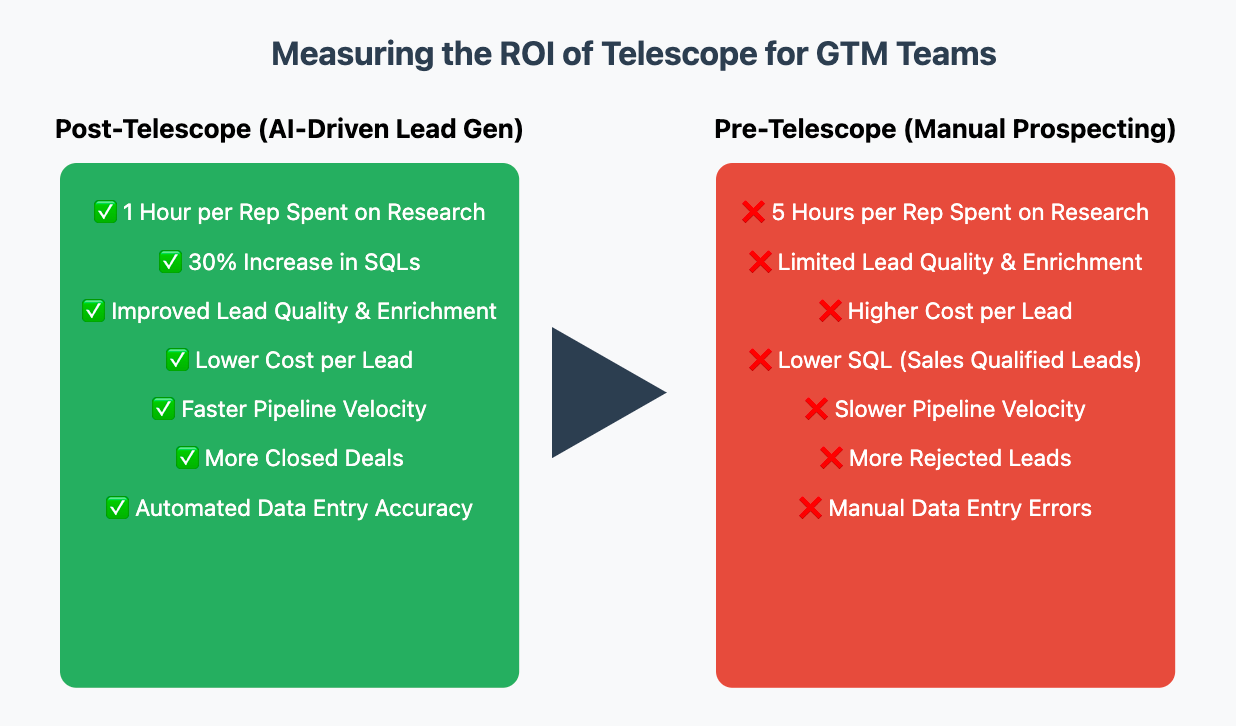
To measure the ROI of Telescope, a GTM team could track key sales efficiency and conversion metrics before and after implementation. By comparing manual prospecting efforts versus AI-driven lead discovery, teams could quantify time saved per rep (e.g., reducing research time from 5 hours per week to 1 hour), increase in qualified leads generated, and improvements in outreach response rates.
If Telescope helps increase SQLs (Sales Qualified Leads) by 30% while maintaining or improving close rates, teams can calculate the additional pipeline revenue generated per quarter. Additionally, by reducing spend on alternative data providers, companies could see a direct impact on cost per lead acquisition, ultimately showcasing Telescope’s value in streamlining prospecting, lowering acquisition costs, and increasing revenue potential.
Telescope has been instrumental in enhancing the operational efficiency of companies like Guidebook and ColdIQ through its AI-driven lead generation platform.
Guidebook:
Guidebook, renowned for its user-friendly mobile app platform tailored for events and educational purposes, faced challenges in expanding its market reach and identifying potential clients in niche sectors. By integrating Telescope into their sales strategy, Guidebook leveraged AI-powered lead generation to pinpoint and engage with high-quality prospects. This integration streamlined their outreach process, resulting in a more robust and targeted client acquisition pipeline.
ColdIQ:
ColdIQ specializes in enhancing B2B sales prospecting through AI and software solutions, offering services like email infrastructure setup, audience research, and campaign optimization. To accelerate their client onboarding and improve lead accuracy, ColdIQ adopted Telescope's platform. This collaboration led to a 50% reduction in client onboarding time and enabled the generation of 200 accurate leads per click, significantly boosting their operational efficiency and client satisfaction.
Telescope stands out as a robust solution for businesses aiming to enhance their lead generation capabilities through AI. Its blend of advanced features and user-centric design makes it a valuable asset for GTM teams striving for efficiency and effectiveness in their prospecting endeavors.
That is all for this week, let me know what you think!