

First we want to celebrate and tell you THANK YOU for the love and listen, we hit the #30 spot on the Spotify Top Business Podcasts lists. Means more than you know!
Also a few changes.. at the GTM AI Academy, we have grown a lot and have a HUGE announcement to make regarding how you can be involved.
In the past, people asked me to create courses to consume which I did and have had many people go through.
However, because AI changes literally so fast and all the time, it has become impossible to keep things up to date, so instead I am announcing a new way to get involved with the below options:
1-Buy a course: We offer full certification courses or small outcome-focused mini courses of 30 min or less. Prices vary from $15 up to $399. All courses you will have lifetime access to those courses and they will be updated as the need arises.
2-Bundles: You can buy multiple courses for a discount.
3-Membership Subscription: I have decided to offer FULL ACCESS to the GTM AI Academy for 2 pricing options depending on your interest level. They are:
$47 GTM AI 2025 All Access Pass gives you full access to the entire GTM AI Academy. I will be uploading a ton of mini courses on a ton of subjects in order to keep up with the speed of AI and the most logical way to do this was starting where we are now with AI and update new content as changes happen
$99 GTM AI Masters Pass gives you full access to the GTM AI Academy AND you can join a weekly workshop and live Q&A where you can ask any question you want to Coach and his team.
Part of this means I will be discontinuing the paid newsletter option here (will send an email to the subscribers there later today) and will only be focusing on content with the GTM AI Academy and in March the AI Business Network (which will give an update on soon)
This newsletter will stay free forever. To join in the GTM AI Academy (and a ton of content coming your way) you can join anytime www.gtmaiacademy.com
Now with that being said, ON TO THE NEWSLETTER!
Here is an Audio overview from our AI friends if you want to listen:
This week we have the following:
Season 2, Episode 7 with Victor Adefuye CEO and Sales coach at Dana Consulting
GTM AI Tool of the week: SundaySky AI Video creation at scale
And the features in the free newsletter this week are:
Forbes on $1 billion dollar 1 person company
AI Disrupts outsourced work
o1 Prompting (and maybe o3) and GPT 5 updates
10 AI Skills to Boost Salary
With that being said, lets get into the podcast!
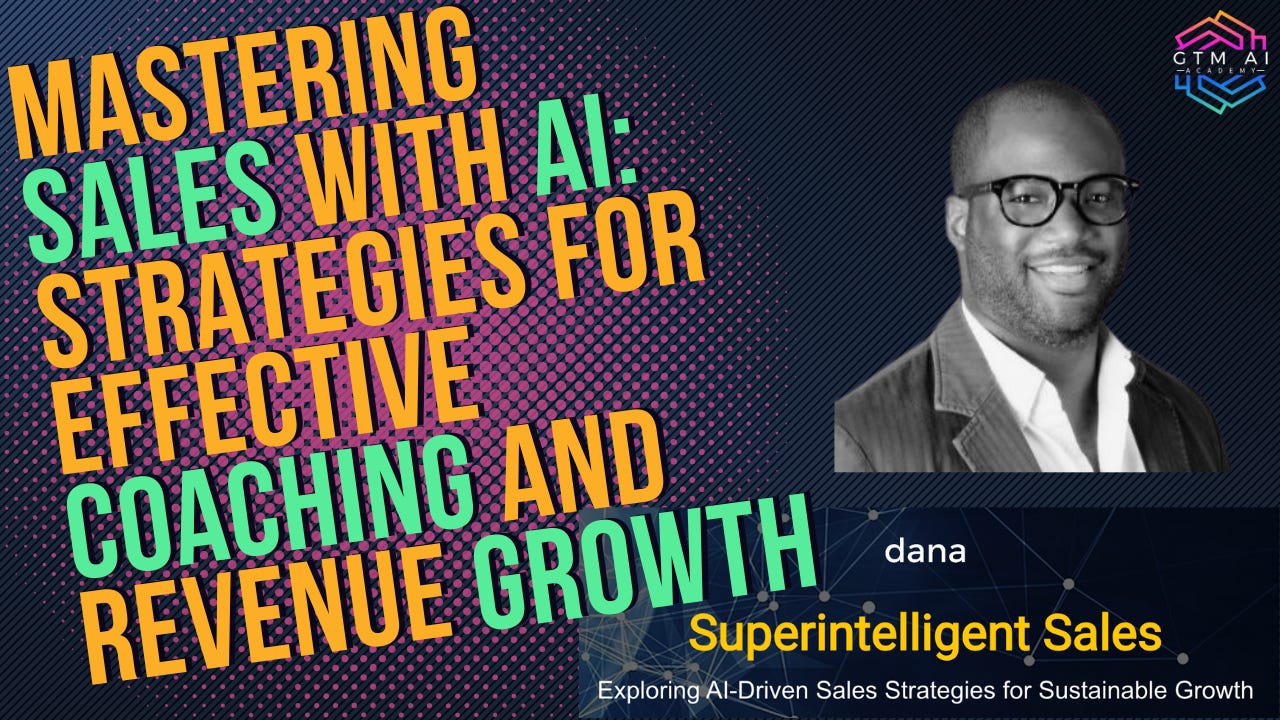
You can go to Youtube, Apple, Spotify as well as a whole other host of locations to hear the podcast or see the video interview.
Mastering Sales with AI: Strategies for Effective Coaching & Revenue Growth
In the ever-evolving landscape of sales, artificial intelligence (AI) has emerged as a pivotal tool for redefining how companies operate. Recently, on the GTMAI podcast, Jonathan interviewed Victor Adefuye, co-founder and CEO of Dana Consulting, to explore how AI is revolutionizing the sales industry. Below, we delve into the conversation, capturing Victor's insights on training, coaching, forecasting, and more.
AI: A Catalyst for Sales Efficiency
Victor opened the discussion by highlighting a key area of inefficiency in sales: the gap between training and actionable results. He stressed that despite tactical inefficiencies within sales teams, the disconnect between coaching and real-world outcomes is a deeper challenge. Victor pointed out that while market conditions and products can make any salesperson appear successful, true proficiency is tested when outcomes are lacking. AI, he argues, provides the clarity needed to reassess strategies, structure training, and sustain behavioral changes necessary for long-term success.
Training and Development: The Athlete's Mindset
Drawing a parallel between sales professionals and athletes, Victor emphasized the importance of preparation. Just as athletes prepare for game day, sales professionals must refine their skills continuously. Coaching, regular training, and reliable feedback form the cornerstone of sustained improvement. AI plays a significant role here, by providing data-driven insights that help identify precise skill gaps. Through this, organizations can develop tailored training and coaching strategies that ensure progress is tangible and accountable.
The Power of Personalized Coaching
AI enhances sales training by offering personalized insights, enabling meaningful, targeted interventions. Victor shared examples of how AI can analyze call data, provide constructive feedback, and monitor progress. This not only optimizes the coaching process but ensures that sales reps aren't practicing on customers. By establishing clear baselines and mapping sales processes, AI ensures organizations can define and track both individual and team growth effectively.
Revolutionizing Forecasting Through AI
On forecasting, Victor discussed leveraging AI to enhance accuracy. By incorporating standardized scoring systems, such as MEDDPICC, companies can objectively evaluate opportunities based on defined criteria. AI streamlines this process, offering managers a comprehensive view of deal status and potential, helping to avoid inflated forecasts. Such precision allows sales leaders to align closer with reality and provide more reliable, data-driven projections.
Implementing AI: Training and Workflow Integration
Victor cautioned against the misconception that simply acquiring AI tools is enough. Instead, he emphasized a focused implementation strategy, rooted in proper training and integration into existing workflows. Training sales teams for comfort and proficiency in using AI tools is essential. He underscored the importance of creating environments where AI use blends seamlessly into daily activities, ensuring the transition is smooth and sustainable.
Achieving Tangible ROI
Victor articulated a straightforward approach to measuring AI's ROI by mapping out the sales process and establishing baselines for key performance indicators. With AI-facilitated interventions, companies can track improvements in conversion rates, win rates, and sales cycles. This clearly defined measure of success underscores the impact AI can have, driving growth and efficiency across the organization.
Key Quotes:
"The disconnect between training and skill development and actual results has driven me the most in sales."
"Salespeople are performers. Just like athletes, you get judged on what happens when it's game time."
"AI allows us for the first time to address a lot of these gaps in insight and behavior change necessary to sustain growth."
"You can't just buy a piece of software or even build one and expect it to solve the problem. It's about skill development."
"Personalized coaching is key. AI gives us the ability to identify personalized skill gaps and develop targeted plans."
Victor Adefuye’s insights make it clear: AI is no longer optional but an essential component of a modern sales strategy. By addressing inefficiencies and fostering skills development through targeted training and transparent forecasting, AI can reshape how sales teams operate. As Victor aptly demonstrates, the future of sales lies in embracing AI to unlock new levels of performance and precision.
The Rise of Billion-Dollar One-Person Companies: AI Is Rewriting Entrepreneurship
For decades, the conventional wisdom has been that building a billion-dollar company requires massive teams, extensive funding, and years of scaling. However, the rise of AI-powered automation, no-code development, and decentralized workforces is disrupting this paradigm.
Lets dig in to the article from Michael Ashley from Forbes.
In Tim Cortinovis’ new book, Single-Handed Unicorn: How to Solo Build a Billion-Dollar Company, he argues that a solo entrepreneur leveraging AI can build a billion-dollar business without employees. Even OpenAI CEO Sam Altman has predicted that we will soon see billion-dollar companies with just 10 people—and eventually, a company of one.
This shift towards "solopreneurs" (or "silopreneurs")—entrepreneurs who use AI instead of employees—is a game-changing trend for Go-to-Market (GTM) professionals, startups, and business strategists.
Here’s how AI is making one-person billion-dollar companies possible, the key tools driving this revolution, and how GTM teams can adapt to this new reality.
1. How AI is Enabling Solo Entrepreneurs to Scale Like Enterprises
In the past, scaling a company required hiring large teams to handle marketing, operations, customer service, and product development. Today, AI can automate most of these functions, allowing a single founder to run a full-scale business with minimal overhead.
🔹 Key AI-Powered Advantages for Solo Entrepreneurs
✅ AI-Driven Product Development → No-code tools like Bubble allow non-technical founders to build complex web apps without writing code.
✅ AI-Powered Marketing & Advertising → Tools like AdCreative.ai automate ad copy, visuals, and audience targeting, reducing the need for marketing teams.
✅ AI as a Personal Assistant → ChatGPT and AI-powered tools help founders brainstorm, analyze data, and manage daily operations.
✅ AI-Enabled Customer Service → AI chatbots and virtual assistants can handle customer inquiries, support tickets, and onboarding.
✅ AI for Decision-Making → AI-driven analytics tools can predict trends, optimize pricing, and refine product strategies automatically.
🚀 The Impact:
One person can now do the work of an entire team.
AI allows businesses to scale faster without hiring employees.
Founders can focus on vision and strategy, while AI handles execution.
2. AI-Driven Business Models for Solopreneurs
The future of one-person billion-dollar companies will be built on AI-first business models. Here are some of the top scalable AI-driven business ideas that solopreneurs are leveraging today:
🔹 1. AI-Powered SaaS (Software-as-a-Service)
💡 Example: A solo founder builds a B2B SaaS tool using Bubble for development, AI for customer support, and automation for billing and analytics.
✅ No engineering team required—AI generates the code.
✅ No sales team required—AI personalizes marketing & outreach.
✅ No customer support team needed—AI chatbots handle queries.
📌 Real-World Example:
A solo entrepreneur launched a lead-generation AI tool that integrates with LinkedIn and HubSpot, generating $100k/month in revenue—without employees.
🔹 2. AI-Driven E-Commerce & Digital Products
💡 Example: A solopreneur sells AI-generated content, stock videos, digital art, or AI-powered productivity tools with no inventory, employees, or supply chain management.
✅ AdCreative.ai generates high-converting ad creatives and copy.
✅ AI chatbots automate customer engagement and support.
✅ AI-powered analytics optimize pricing and inventory decisions.
📌 Real-World Example:
A single founder built an AI-powered SEO tool, used AI-generated blog content for marketing, and scaled to $1M ARR in under 12 months.
🔹 3. AI Consulting & Automation Services
💡 Example: A solo entrepreneur sets up AI-powered automation workflows for businesses, helping them reduce costs and increase efficiency.
✅ Uses Zapier + OpenAI to build custom workflow automations for clients.
✅ Automates client acquisition with AI-driven prospecting tools.
✅ Uses AI-generated reports for insights and recommendations.
📌 Real-World Example:
A solopreneur offering AI automation consulting grew to six figures in monthly revenue by automating CRM workflows for businesses.
3. Overcoming the Challenges of Solopreneurship
While AI enables incredible scalability, running a one-person company still comes with challenges.
🔹 Challenge 1: Loneliness & Isolation
Solution: Join founder mastermind groups like YPO, Vistage, or online AI entrepreneur communities to share insights and stay motivated.
🔹 Challenge 2: Managing Complexity
Solution: Use AI-powered project management tools like Notion AI or ClickUp AI to organize tasks, automate workflows, and stay productive.
🔹 Challenge 3: AI Model Dependence & Vendor Lock-In
Solution: Use open-source AI models like DeepSeek and explore multi-AI model platforms like Magai to avoid reliance on a single provider.
🚀 The Key Takeaway: AI solopreneurs must optimize not just for automation, but also for personal resilience, adaptability, and strategic thinking.
4. The Future of One-Person Billion-Dollar Companies
Even though we haven’t yet seen a single-person unicorn ($1B+ company), the day is coming soon.
🔹 Key Predictions for AI-Driven Solopreneurs:
✅ By 2030, the first AI-powered solopreneur will build a billion-dollar company.
✅ AI-first companies will outcompete traditional startups with leaner, faster business models.
✅ Investors will start funding “AI-enabled solo founders” as a new startup category.
GTM Takeaways: How Businesses Should Adapt to the Solopreneur Revolution
For GTM teams, investors, and business leaders, the rise of AI-powered solopreneurs means:
1. AI-First Business Models Will Become the Norm
📌 Companies that don’t integrate AI automation will fall behind.
✅ GTM Strategy:
Offer AI-enhanced solutions that empower solopreneurs & lean startups.
Build PLG (product-led growth) strategies to help self-serve customers adopt AI-powered tools.
2. New B2B SaaS Opportunities Will Emerge
📌 Solo entrepreneurs will need AI tools for automation, marketing, and operations.
✅ GTM Strategy:
Develop no-code AI platforms that allow founders to launch and scale without engineering teams.
Offer AI-driven financial, HR, and operational services optimized for one-person companies.
3. Traditional Startups Will Need to Reevaluate Scaling Strategies
📌 Raising millions for a startup might no longer be necessary—AI-first businesses will scale faster, leaner, and cheaper.
✅ GTM Strategy:
Position AI not just as a tool for enterprises, but as an enabler of high-growth solopreneurs.
Invest in ecosystem partnerships that support AI-driven solo founders.
Final Thoughts: The Age of AI Solopreneurs Is Here
AI is not just automating work—it’s redefining entrepreneurship. The ability for one person to build and scale a high-growth company using AI is no longer science fiction.
🚀 For GTM teams, investors, and AI vendors, this means:
✅ AI tools must be designed for solopreneurs, not just enterprises.
✅ Self-service, no-code, and automation-first GTM strategies will win.
✅ The companies that embrace this shift will be the ones that lead in the 2030s.
👤 The billion-dollar, one-person company is no longer a question of "if"—it’s a question of "who" will do it first. Maybe it’s you. 🚀
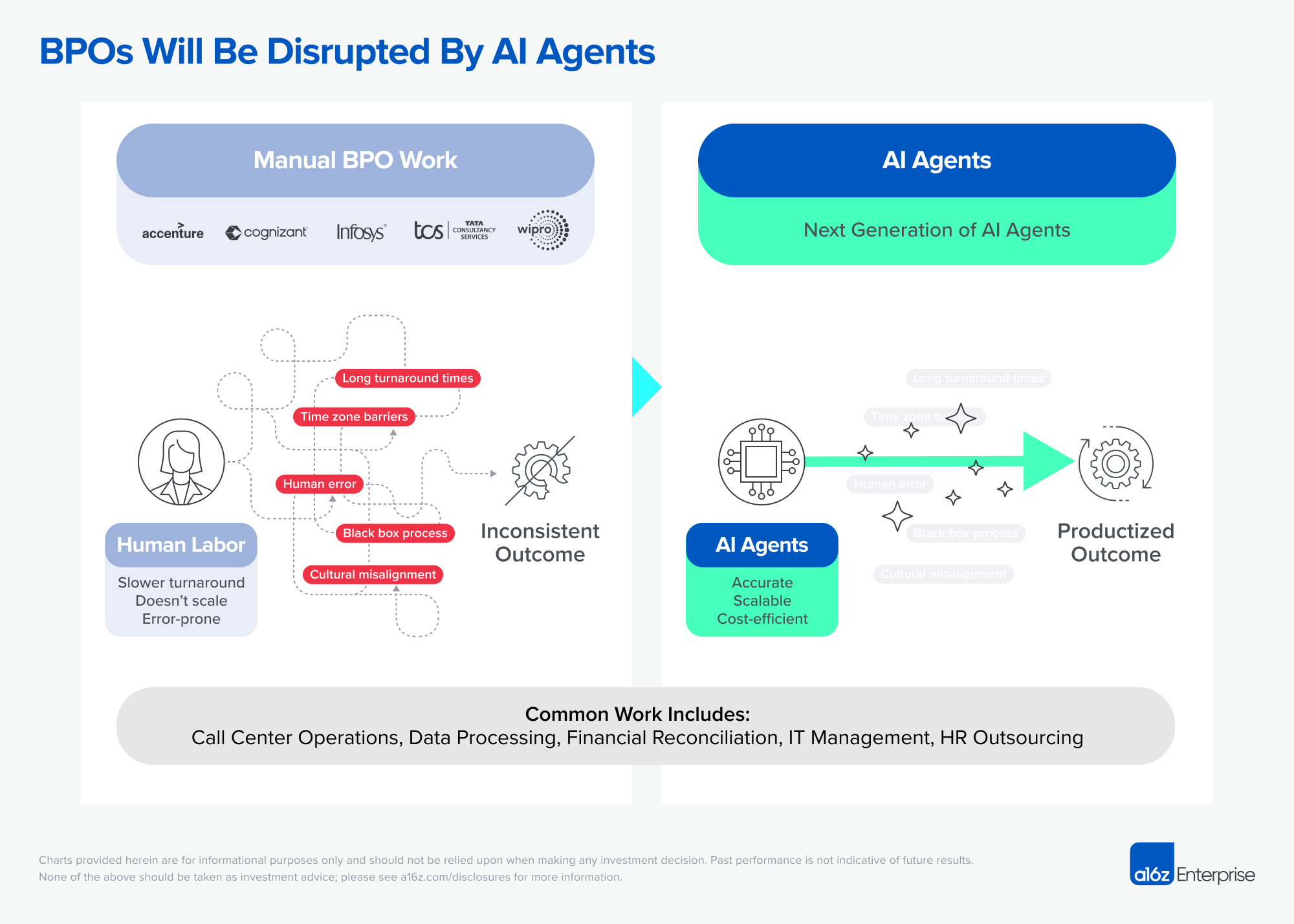
AI is Unbundling the BPO Industry: How Startups Are Disrupting Outsourced Work
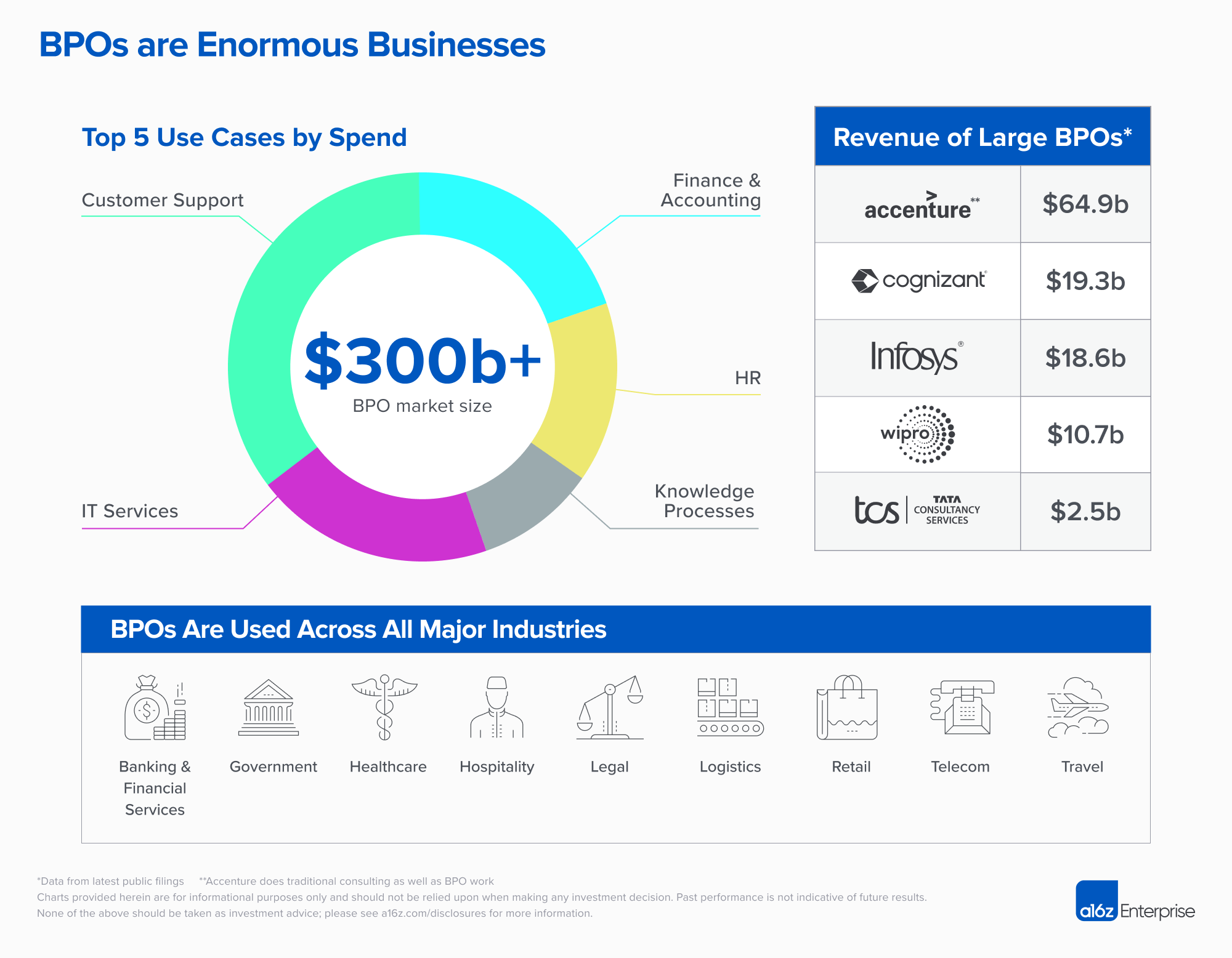
Kimberly Tran wrote about how the Business Process Outsourcing (BPO) industry, valued at over $300 billion in 2024 and projected to surpass $525 billion by 2030, has long been a staple for enterprises looking to offload repetitive, labor-intensive work like customer support, IT services, payroll processing, and financial claims management.
But AI is changing everything.
Instead of outsourcing to large BPO firms, enterprises are now in-housing customer experience and back-office operations by deploying AI-powered agents that work faster, cheaper, and more efficiently than humans.
This "unbundling of the BPO" represents one of the biggest business opportunities for AI startups, allowing them to disrupt legacy BPO incumbents like Cognizant, Infosys, and Wipro by productizing traditionally outsourced services.
For GTM teams, investors, and AI founders, this shift means:
✅ AI-native solutions will replace traditional outsourced labor models.
✅ Industry-specific AI agents will drive adoption by integrating with existing workflows.
✅ Startups that productize BPO workflows will capture billions in market share.
Here’s a deep dive into how AI is disrupting the BPO industry, the key AI advancements making it possible, and where GTM teams should focus next.
1. Why Enterprises Are Moving Away from BPOs
🔹 The Problems with Traditional BPOs
BPOs have historically provided companies with an outsourced workforce for back-office operations and customer service, but they come with significant drawbacks:
❌ Slow Turnaround Times → Work must pass through multiple layers of outsourcing, delaying execution.
❌ High Human Error Rates → BPO employees lack individual accountability and make costly mistakes.
❌ Lack of Business Context → BPO workers lack deep knowledge of a company’s operations, leading to inconsistent service.
❌ Seasonal Hiring Challenges → Enterprises face scalability issues, requiring BPOs to ramp up and down hiring unpredictably.
🔹 How AI Solves These Problems
AI-powered solutions allow businesses to replace BPO services with automation, offering:
✅ 24/7 AI agents that process tasks instantly (no turnaround time).
✅ Automated workflows that eliminate human error.
✅ AI-powered customer support that understands business context.
✅ Scalability without hiring seasonal or offshore workers.
🚀 GTM Impact:
BPO alternatives will gain massive traction in enterprise AI adoption.
AI-first startups will challenge incumbents by offering cost-effective, in-house automation.
Sales and marketing teams must shift messaging from “outsourcing efficiency” to “AI-native automation.”
2. AI Advancements Driving BPO Disruption
🔹 1. LLMs Are Becoming Specialized for Back-Office Work
AI models are rapidly improving at unstructured document processing, data reconciliation, knowledge search, reasoning, and tool usage—the core functions of BPO services.
📌 Example:
Anthropic, DeepSeek, and OpenAI have all released LLMs optimized for reasoning, math, and data extraction, directly competing with BPO manual processes.
🚀 GTM Impact:
AI solutions can now automate finance, HR, and operations workflows.
Enterprises will shift from outsourcing to deploying AI-powered in-house automation tools.
🔹 2. AI Voice Agents Can Now Handle Customer Support Calls
Voice AI technology has dramatically improved, allowing companies to replace human call center agents with AI-driven phone and chat support.
📌 Example:
Companies like Decagon have built AI-powered customer service agents that deliver 80% resolution rates and higher CSAT scores than human agents.
Salient’s AI voice agents handle high-volume auto-lending and collections calls, improving efficiency while staying compliant with regulations.
🚀 GTM Impact:
Sales teams should position AI call agents as a direct replacement for BPO-run customer service teams.
Enterprises will prioritize in-house AI call center deployments over outsourcing.
🔹 3. AI Agents Can Now Operate Across Browser & Desktop Apps
Until recently, AI agents were limited to working within specific applications. Now, they can perform tasks across entire desktop environments and web browsers, thanks to advancements in AI-powered workflow automation.
📌 Example:
Anthropic’s computer use model, OpenAI’s Operator, and Google DeepMind’s Project Mariner all showcase AI agents navigating digital environments autonomously.
🚀 GTM Impact:
Back-office tasks that required BPO employees can now be fully automated using AI agents.
Industry-specific AI solutions will integrate with existing enterprise workflows, making adoption easier.
3. The Biggest Opportunities for AI Startups in BPO Disruption
🔹 1. AI-Powered Customer Support
📌 $100 billion+ market opportunity
❌ The Problem: Traditional customer service BPOs offer slow response times, high costs, and inconsistent quality.
✅ The Solution: AI-powered agents handle real-time chat, email, and voice support, improving customer experience while reducing costs.
🔹 Real-World Example:
Avoca’s AI-powered support agents handle overflow and off-hours calls that BPOs previously managed, improving efficiency and availability.
🚀 GTM Strategy:
AI-powered customer support solutions should be marketed as an alternative to call center outsourcing.
Focus on enterprise clients with high customer service volumes (e.g., telecom, healthcare, e-commerce).
🔹 2. AI for Back-Office Workflows (Finance, HR, and Logistics)
📌 $200+ billion market opportunity
❌ The Problem: Companies rely on BPOs for invoice reconciliation, claims management, payroll processing, and compliance reporting—all slow and error-prone.
✅ The Solution: AI can automate and streamline these back-office workflows, improving accuracy and efficiency.
🔹 Real-World Example:
Loop is automating invoice reconciliation for the transportation industry, reducing errors and fraud.
Juniper is applying AI to healthcare revenue cycle management, improving billing efficiency.
🚀 GTM Strategy:
Target industries with heavy reliance on back-office BPOs (banking, healthcare, logistics).
Highlight cost savings and automation benefits over traditional outsourcing models.
🔹 3. AI for Software Development & Low-Code Application Building
📌 $50+ billion market opportunity
❌ The Problem: Enterprises outsource software development to BPOs due to a shortage of in-house engineers.
✅ The Solution: No-code AI platforms allow enterprises to build apps without outsourcing development.
🔹 Real-World Example:
Cursor AI helps engineers write code faster, reducing the need for outsourced dev teams.
No-code AI web app builders enable non-technical employees to create internal tools without developers.
🚀 GTM Strategy:
Position AI-powered coding assistants and no-code platforms as a BPO alternative for software development.
Target industries that frequently outsource application development.
4. BPOs vs. AI Startups: Who Will Win?
🔹 Why AI Startups Have the Edge Over BPOs
✅ AI-powered automation scales infinitely—BPOs require human labor.
✅ BPOs rely on outdated pricing models that AI disrupts.
✅ AI agents integrate with modern tech stacks, while BPOs rely on legacy systems.
🚀 Key GTM Takeaways for AI Vendors & Startups:
1️⃣ Market AI-powered automation as a direct BPO replacement.
2️⃣ Target industries with high outsourcing costs and compliance requirements.
3️⃣ Leverage integrations with enterprise platforms to ease adoption.
Final Thought: The Future of AI in BPO Disruption
AI is not just improving outsourced work—it’s eliminating the need for it altogether. By 2030, AI-first startups will replace traditional BPOs in customer support, back-office operations, and software development.
🚀 GTM teams, investors, and AI founders must position their offerings now to capture this $500 billion market shift.
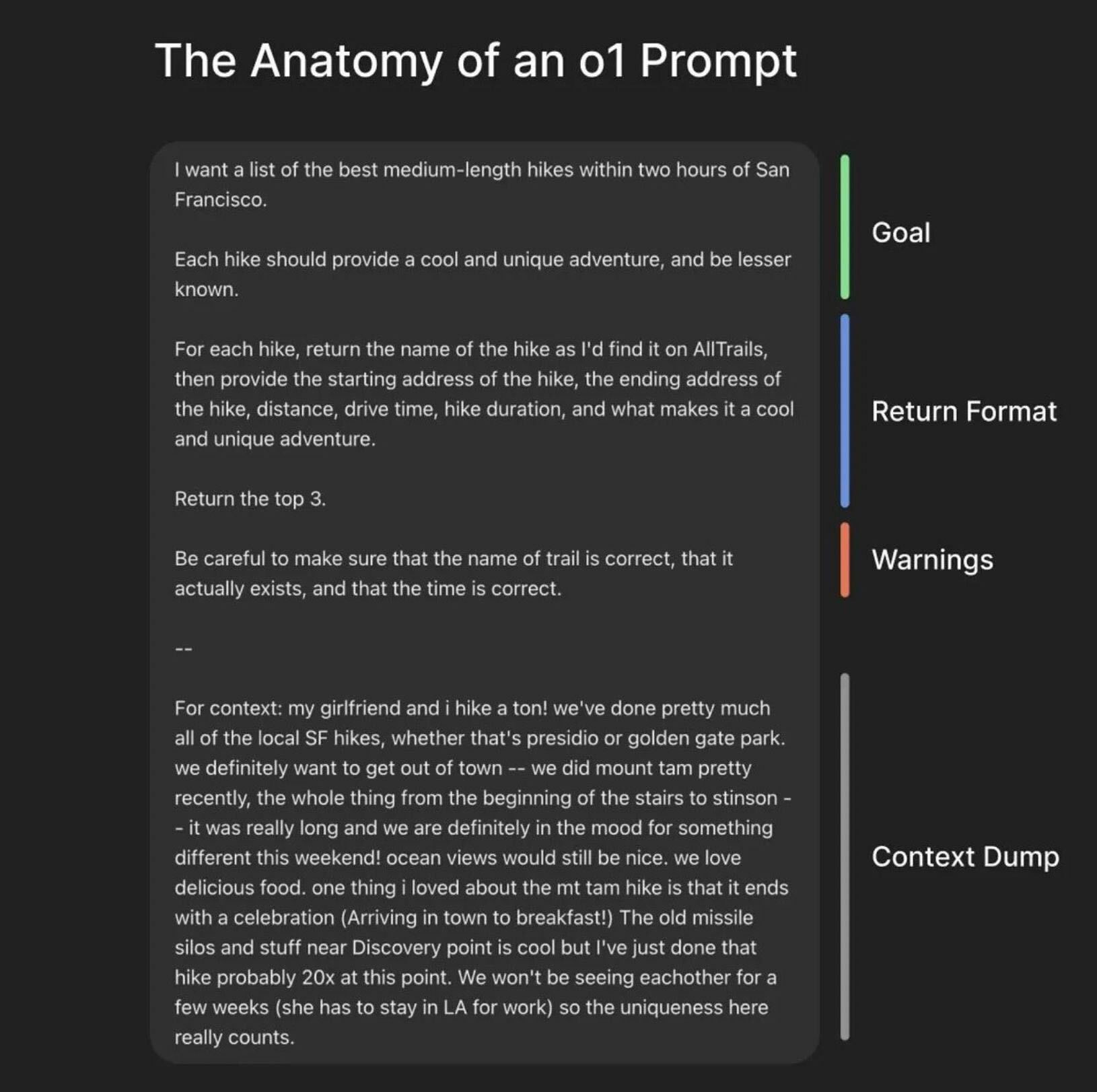
Reasoning Models: The Next Leap in AI Problem-Solving and Decision-Making
AI is evolving beyond simple pattern matching and moving toward advanced reasoning models that can analyze, plan, and solve complex problems with a structured thought process. OpenAI’s o1 and o3-mini reasoning models represent a new wave of AI that can “think before they respond”, making them particularly well-suited for coding, scientific research, multi-step planning, and decision-making tasks.
For Go-to-Market (GTM) teams, developers, and enterprises, these models offer a new level of AI sophistication—delivering more accurate, reliable, and efficient automation across industries. This article explores how reasoning models work, how they differ from traditional AI, and how businesses can leverage them effectively.
1. What Are Reasoning Models?
Traditional AI models, such as GPT-4, predict the next word in a sentence using statistical probabilities based on vast amounts of training data. However, they do not truly reason—they simply generate responses based on learned patterns.
🔹 How Reasoning Models Are Different:
✅ They "think" before responding → These models generate "reasoning tokens" that help them process and analyze a question before answering.
✅ They use multi-step problem solving → Instead of immediately outputting a response, reasoning models break down a problem into steps, analyze different approaches, and then select the most logical solution.
✅ They are ideal for complex tasks → This approach makes them especially powerful for coding, math, research, and structured decision-making.
🚀 GTM Impact:
Enterprises can use reasoning models for better AI-driven decision-making.
AI automation will become more accurate, reducing hallucinations and errors.
Businesses can deploy AI in complex workflows requiring multi-step problem solving.
2. OpenAI’s o-Series: o1 vs. o3-Mini
OpenAI provides two reasoning models, optimized for different use cases:
ModelBest ForSpeed vs. ComplexityCosto1Deep reasoning & multi-step planningMore thorough but slowerHigher cost per tokeno3-miniFaster responses for problem-solvingBalances speed & accuracyMore cost-efficient
📌 Key Use Cases:
o1: Complex research, AI-assisted decision-making, coding assistance, legal/financial analysis.
o3-mini: Faster problem-solving, customer support, automation, general reasoning tasks.
🚀 GTM Impact:
AI-first companies must choose models based on speed vs. reasoning depth.
Businesses can optimize AI costs by using o3-mini for efficiency-focused applications.
3. How Reasoning Models Work: Step-by-Step Thinking Process
Unlike traditional AI models that generate instant responses, reasoning models:
1️⃣ Process the question and break it down into multiple steps.
2️⃣ Generate internal reasoning tokens (not visible to the user).
3️⃣ Evaluate multiple approaches before selecting the best response.
4️⃣ Discard the reasoning tokens and provide the final answer.
🔹 Example: Coding Problem Solving
Task: Write a Bash script that transposes a matrix stored as a string.
Traditional AI Response:
Generates code immediately, often without validating accuracy.
Reasoning Model Response:
✅ Breaks down the problem step by step.
✅ Evaluates different ways to process string-based matrices.
✅ Writes a structured and logically verified Bash script.
📌 Code Example Using OpenAI’s API:
javascriptCopyEdit
import OpenAI from "openai"; const openai = new OpenAI(); const prompt = ` Write a bash script that takes a matrix represented as a string with format '[1,2],[3,4],[5,6]' and prints the transpose in the same format. `; const completion = await openai.chat.completions.create({ model: "o3-mini", reasoning_effort: "medium", messages: [ { role: "user", content: prompt } ], store: true, }); console.log(completion.choices[0].message.content);
🚀 GTM Impact:
Developers and enterprises can use AI for reliable, high-accuracy coding automation.
AI-powered engineering teams can accelerate debugging and optimization.
4. The "Reasoning Effort" Parameter: Controlling AI’s Thought Process
Unlike traditional AI models, reasoning models allow users to control how much reasoning effort is applied before responding.
Reasoning EffortBehaviorBest ForLowFast response, minimal thinkingSimple Q&A, real-time AI chatMedium (default)Balanced reasoning & speedCoding, structured decision-makingHighDeep analysis, long thought chainsScientific research, financial/legal analysis
📌 Example:
"Low" effort → Good for quick customer support responses.
"High" effort → Best for multi-step financial modeling.
🚀 GTM Impact:
Companies can optimize AI performance by adjusting reasoning depth per task.
Enterprises can control AI costs by choosing the right reasoning effort for different workflows.
5. Cost Management: Allocating Space for Reasoning Tokens
Unlike traditional AI models, reasoning models require "invisible reasoning tokens" that take up space in the AI’s context window.
📌 Key Considerations:
Reasoning tokens are billed as output tokens (even though users don’t see them).
Companies must allocate enough tokens to allow for complex reasoning (typically reserving 25,000+ tokens for high-effort reasoning tasks).
🔹 How to Manage Costs Efficiently:
✅ Use max_completion_tokens to cap total token usage.
✅ Adjust reasoning effort based on task complexity.
✅ Track completion_tokens_details in API responses to monitor AI’s internal processing costs.
🚀 GTM Impact:
Businesses must factor in reasoning token costs when scaling AI implementations.
Companies can optimize costs by adjusting reasoning effort per use case.
6. Reasoning Models vs. Traditional GPT Models
FeatureReasoning Models (o1, o3-mini)Traditional GPT ModelsThinking ProcessMulti-step reasoning before answeringPredicts next token based on probabilityBest forCoding, research, problem-solvingConversational AI, content generationResponse SpeedSlower due to deep reasoningFaster, but less structuredOutput AccuracyHigher for complex tasksGood, but can hallucinate moreUse Case ExamplesScientific research, debugging, financial modelingBlogging, chatbot conversations
🚀 GTM Impact:
Enterprises must choose between speed (GPT models) and accuracy (reasoning models).
AI-first companies can use both models strategically, depending on business needs.
Final Thoughts: How GTM Teams Can Leverage Reasoning Models
Reasoning models like o1 and o3-mini mark a significant evolution in AI problem-solving, offering deeper analysis, better decision-making, and more structured responses.
🔹 Key Takeaways for GTM Teams:
✅ AI-powered coding and automation tools will see major improvements with reasoning models.
✅ Companies must optimize reasoning effort levels to balance speed, accuracy, and cost.
✅ AI-driven enterprise applications will become more sophisticated in financial, legal, and research fields.
✅ Businesses must integrate reasoning models strategically to enhance decision-making.
🚀 The future of AI is reasoning-based problem-solving—companies that leverage it will gain a massive competitive advantage in automation, analytics, and AI-driven decision-making.
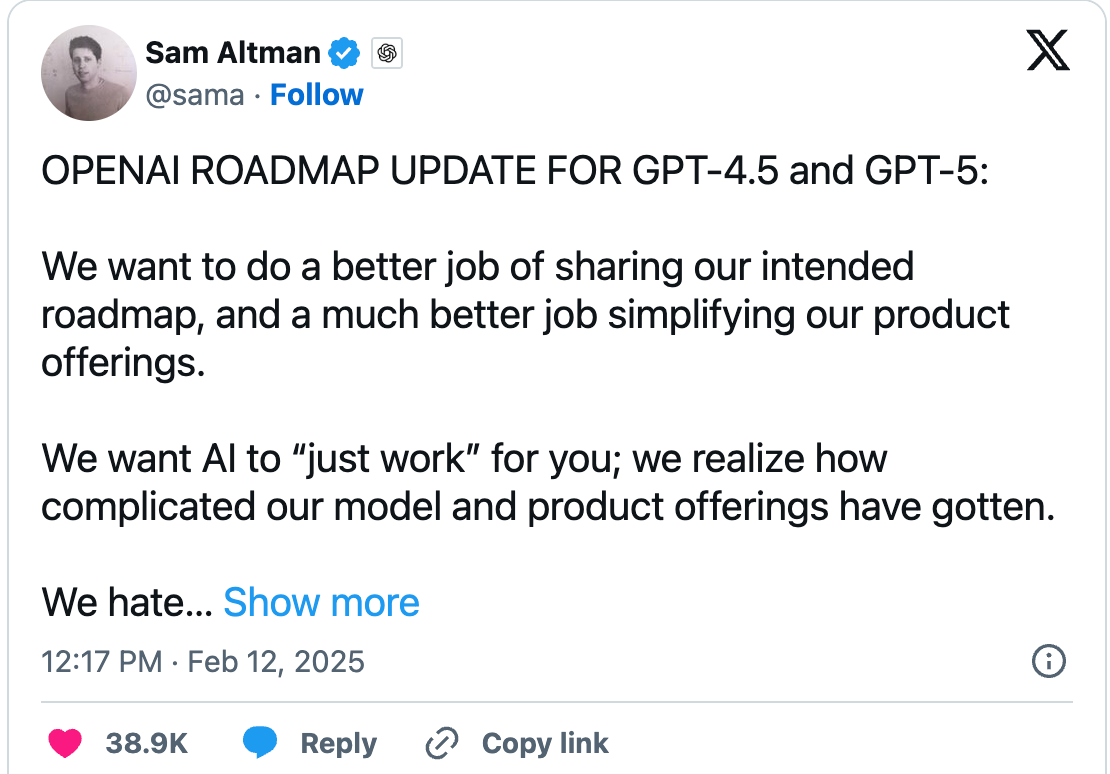
GPT-4.5 and GPT-5 Are Coming: OpenAI’s Next Leap in AI Intelligence
OpenAI CEO Sam Altman has confirmed that GPT-4.5 (Orion) will launch in weeks, with GPT-5 following within months. These upcoming releases represent a significant shift in OpenAI’s AI strategy, as the company plans to unify its GPT and o-series models, offering a more streamlined and integrated AI experience.
For Go-to-Market (GTM) teams, developers, and AI-driven businesses, these changes signal a new era of AI capabilities—improving reasoning, automation, and user experience while reshaping how companies leverage AI across products and services.
Here’s an in-depth look at GPT-4.5, GPT-5, and what this evolution means for AI users, businesses, and GTM professionals.
1. GPT-4.5 (Orion): The Final Non-Reasoning Model
🔹 What is GPT-4.5 (Orion)?
The last "non-chain-of-thought" model before OpenAI fully commits to reasoning-based AI.
Expected to be a cost-effective, high-speed model optimized for chat, content generation, and general knowledge tasks.
A bridge between GPT-4 and GPT-5, offering incremental improvements in accuracy, coherence, and efficiency.
🚀 GTM Impact:
✅ GPT-4.5 will be an ideal model for AI-powered customer service, content creation, and automation.
✅ Businesses can expect faster response times compared to reasoning models like o3-mini.
✅ GTM teams can use GPT-4.5 for real-time applications while preparing for more advanced reasoning AI.
2. GPT-5: OpenAI’s Next Evolution in Unified AI
🔹 What Makes GPT-5 Different?
Integration of reasoning models (o-series) and language models (GPT-series) into a single unified AI system.
Offers “magic unified intelligence”, removing the need for users to pick between different models.
Includes multi-modal capabilities, better context retention, and deeper problem-solving skills.
🔹 GPT-5 Access & Subscription Tiers
💡 How OpenAI is structuring access to GPT-5:
Free Users → Unlimited access at standard intelligence.
Plus Subscribers → Access to higher intelligence settings.
Pro Subscribers → Even higher intelligence, optimized for complex tasks and reasoning-heavy applications.
🚀 GTM Impact:
✅ Businesses can now integrate advanced reasoning AI (o3) into ChatGPT and APIs without separate model selection.
✅ Enterprises using AI for analytics, research, and decision-making will benefit from better reasoning capabilities.
✅ Subscription tiers allow businesses to scale AI intelligence levels based on their needs and budget.
3. OpenAI’s Shift: Moving from Multiple Models to “Magic Unified Intelligence”
🔹 Why OpenAI is Unifying Its Models
Altman acknowledged that OpenAI’s product offerings had become too complicated, leading to the decision to simplify AI model selection.
Key takeaways from OpenAI’s new approach:
✅ No more manual model selection → AI will "just work" without users needing to choose between GPT and o-series models.
✅ Unified intelligence means AI will optimize responses dynamically based on the task, balancing speed and reasoning effort.
✅ A smoother user experience for businesses and end-users—making AI more intuitive and accessible.
🚀 GTM Impact:
✅ AI-powered applications will be easier to build, as developers won’t need to manually pick models.
✅ Sales and marketing teams can position AI as an all-in-one, plug-and-play solution rather than a complex technical tool.
✅ Product teams can focus on integrating AI instead of managing multiple versions.
4. Challenges and Delays in GPT-5 Development
While OpenAI has ambitious plans for GPT-5, development has faced significant hurdles:
🔸 Over budget and behind schedule → GPT-5 has been in development for over 18 months, with unexpected problems in training.
🔸 Large-scale compute requirements → The training process required massive data processing power, leading to delays.
🔸 Performance shortfalls → Early training runs did not meet OpenAI’s internal benchmarks, prompting refinements.
🔹 What This Means for Businesses
✅ AI development is still constrained by infrastructure and cost—companies should expect pricing adjustments for high-end AI models.
✅ GPT-5’s full release may be iterative, rolling out improvements over time rather than all at once.
✅ GTM teams should prepare for gradual AI evolution rather than a sudden transformation.
5. How GPT-4.5 & GPT-5 Will Reshape AI-Driven Businesses
🔹 Key GTM Takeaways for AI Integration
1️⃣ Businesses must prepare for the shift from traditional AI to reasoning AI.
2️⃣ Subscription-based AI models will change how companies budget for AI tools.
3️⃣ AI-powered apps and workflows will become more automated and require less human oversight.
4️⃣ The need for structured, high-quality data will increase as AI models improve reasoning capabilities.
5️⃣ Developers will have access to more robust APIs, reducing AI deployment complexity.
🚀 The Future of AI is Intelligent, Automated, and Seamless
OpenAI’s upcoming GPT-4.5 and GPT-5 launches represent a major step toward fully autonomous AI workflows. Businesses that embrace this shift early will gain a competitive advantage in automation, content generation, decision-making, and AI-powered services.
👉 The key question now is not whether AI will transform business—but how quickly your organization can adapt to the new AI era. 🚀
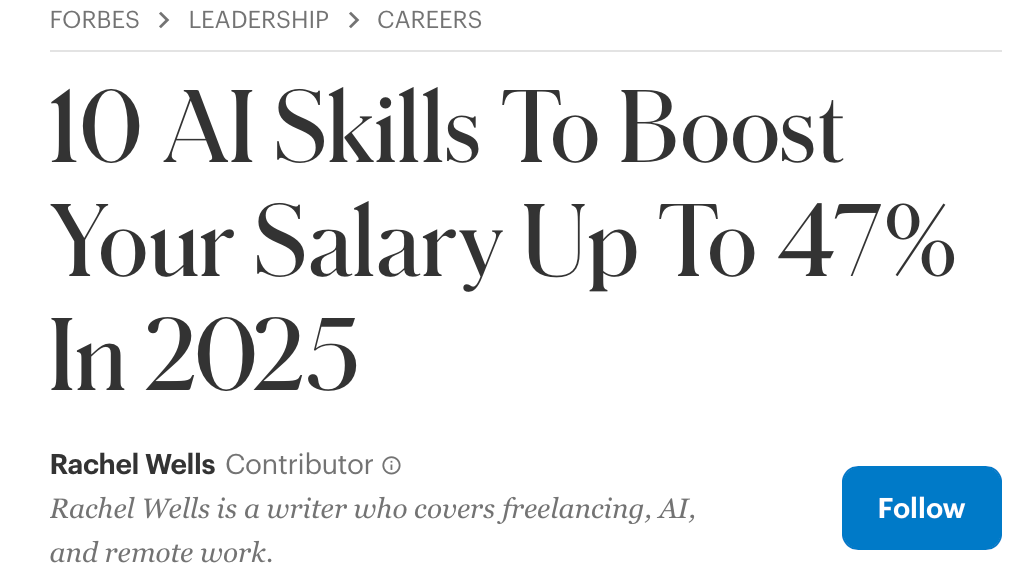
10 AI Skills That Can Boost Your Salary by 47% in 2025
The AI skills gap is widening, and professionals who upskill in artificial intelligence stand to earn significantly higher salaries and access better career opportunities. According to recent data from Coursera, AWS, and Indeed, AI expertise can increase salaries by up to 47%, particularly in fields like sales, marketing, finance, business operations, legal, and HR.
For GTM professionals, entrepreneurs, and AI-driven businesses, these AI skills are becoming essential for career advancement and competitive differentiation. With 73% of employers prioritizing AI talent but struggling to find qualified professionals, the demand for AI expertise has never been higher.
Here’s a deep dive into why learning AI skills is crucial in 2025, the top 10 AI skills you should focus on, and where to learn them.
1. Why Learning AI Skills in 2025 Is a Game-Changer
AI is rapidly transforming every industry—from automating marketing analytics to enhancing decision-making in finance and operations.
🔹 Key Reasons to Upskill in AI Now:
✅ 73% of employers are actively hiring AI-skilled professionals but struggle to find talent.
✅ 92% of companies plan to implement AI-powered solutions by 2028—meaning AI fluency will be required across job roles.
✅ 22% of recruiters have already updated job descriptions to reflect AI expectations.
✅ Companies using AI are seeing productivity and efficiency gains, leading to higher salaries for AI-literate employees.
🚀 GTM Impact:
Sales and marketing professionals who master AI will command higher salaries.
AI-powered automation will reshape hiring, making AI fluency a career advantage.
Understanding AI-driven insights will be essential for leadership and strategic decision-making.
2. The 10 AI Skills That Will Boost Your Salary in 2025
1️⃣ Generative AI (GenAI)
📌 What It Is:
Using AI models to generate text, images, videos, and code.
Powers tools like ChatGPT, Midjourney, and DALL·E.
🚀 GTM Impact:
✅ Marketing teams use GenAI to create high-converting content automatically.
✅ Sales teams use AI-generated insights to craft personalized outreach messages.
✅ Product teams leverage AI-generated UX/UI designs for rapid prototyping.
📚 Where to Learn:
IBM SkillsBuild (Free)
Coursera’s Generative AI Specialization
2️⃣ Artificial Neural Networks
📌 What It Is:
A machine learning model designed to simulate how the human brain processes information.
Used in AI-powered automation, decision-making, and predictive analytics.
🚀 GTM Impact:
✅ AI-powered lead scoring and recommendation engines improve sales efficiency.
✅ Marketing analytics platforms use neural networks for customer segmentation.
📚 Where to Learn:
Deep Learning Specialization by Andrew Ng (Coursera)
Codeacademy’s AI Foundations Course
3️⃣ Computer Vision
📌 What It Is:
AI that enables computers to analyze and interpret images, videos, and visual data.
Used in security, e-commerce, social media, and healthcare.
🚀 GTM Impact:
✅ E-commerce brands use AI to analyze product images and optimize visual search.
✅ Retailers leverage AI for automated checkout systems and inventory management.
📚 Where to Learn:
Fast.ai’s Practical Deep Learning for Coders
Udacity’s AI for Computer Vision Nanodegree
4️⃣ PyTorch (Machine Learning Library)
📌 What It Is:
An open-source deep learning framework used for building AI applications.
Essential for AI engineers, data scientists, and software developers.
🚀 GTM Impact:
✅ AI-driven SaaS platforms rely on PyTorch for predictive analytics.
✅ Startups use PyTorch to fine-tune AI models for business intelligence.
📚 Where to Learn:
PyTorch’s Official Tutorials
Deep Learning with PyTorch (Coursera)
5️⃣ Machine Learning
📌 What It Is:
Teaching AI to learn from data and make predictions or decisions.
The foundation of AI automation, forecasting, and personalization.
🚀 GTM Impact:
✅ AI-driven lead qualification improves sales pipeline efficiency.
✅ Marketing teams use ML for customer segmentation and trend forecasting.
📚 Where to Learn:
Machine Learning by Stanford University (Coursera)
Google’s Machine Learning Crash Course
6️⃣ Applied Machine Learning
📌 What It Is:
Applying ML techniques to solve real-world business problems.
🚀 GTM Impact:
✅ AI-powered chatbots automate customer support interactions.
✅ Finance teams use ML algorithms for fraud detection.
📚 Where to Learn:
DataCamp’s Applied Machine Learning Track
Kaggle’s Machine Learning Courses
7️⃣ Deep Learning
📌 What It Is:
A subset of ML focused on training AI to process complex patterns.
🚀 GTM Impact:
✅ AI-driven automation handles complex back-office operations.
✅ Deep learning is used in AI-powered content moderation.
📚 Where to Learn:
Deep Learning Specialization by Andrew Ng
MIT’s Deep Learning Course (OpenCourseWare)
8️⃣ Supervised Learning
📌 What It Is:
Training AI using labeled datasets for accurate predictions.
🚀 GTM Impact:
✅ Personalized marketing campaigns based on customer behavior.
✅ AI-powered product recommendations for e-commerce.
📚 Where to Learn:
Fast.ai’s Machine Learning Course
Google’s AI Hub for Supervised Learning
9️⃣ Reinforcement Learning
📌 What It Is:
AI learns through trial and error, improving over time.
🚀 GTM Impact:
✅ AI-powered ad bidding for PPC campaigns.
✅ Automated trading strategies in finance.
📚 Where to Learn:
Udacity’s Reinforcement Learning Nanodegree
DeepMind’s RL Course
🔟 Machine Learning Operations (MLOps)
📌 What It Is:
The process of managing, deploying, and scaling AI models.
🚀 GTM Impact:
✅ Businesses can deploy AI solutions faster and more efficiently.
✅ Scalability ensures AI models stay cost-effective.
📚 Where to Learn:
Google’s MLOps Specialization (Coursera)
AWS Machine Learning Engineer Certification
3. How Learning AI Skills Will Transform Your Career
🔹 The Career Benefits of AI Fluency
✅ AI-trained professionals earn 35-47% more than non-AI professionals.
✅ AI fluency makes employees indispensable across industries.
✅ Understanding AI enables professionals to transition into leadership roles.
🔹 Where to Learn AI for Free or Cheap
🎓 IBM SkillsBuild → 100% Free AI courses.
🎓 Coursera (Financial Aid Available) → AI professional certificates.
🎓 Codeacademy (Affordable Subscription) → AI and ML courses.
🚀 GTM Takeaway:
Investing in AI skills now ensures long-term job security and career growth.
AI-trained professionals will drive the next wave of business innovation.
The best time to upskill in AI is now—before the job market becomes saturated.
💡 Final Thought: AI isn’t just a trend—it’s the future of work. Those who embrace AI fluency will gain the biggest salary increases, job opportunities, and career advancements in the coming years. 🚀
https://sundaysky.com/
SundaySky's Enterprise Video Platform is a comprehensive solution designed to revolutionize how businesses create, personalize, and distribute video content at scale. By integrating advanced AI capabilities, the platform streamlines video production, enhances audience engagement through personalization, and provides robust tools for seamless distribution and performance analytics.
Key Features and Functionalities
AI-Powered Video Creation
Generative AI Assistance: The platform's AI Copilot automates initial stages of video production, offering automated recommendations for storyboarding and scriptwriting. This reduces the time and expertise required to develop compelling video briefs.
Advanced Editing Tools: Users have access to features such as automatic video trimming, rotating, cropping, and background removal, allowing for precise content customization without the need for specialized skills.
In-App Screen Recording: The integrated screen recording feature enables the capture of on-screen activities directly within the platform, facilitating the creation of tutorials, demonstrations, and other instructional content.
Personalization at Scale
Data-Driven Content Customization: By leveraging existing customer data, the platform personalizes various elements of videos—including narration, on-screen text, and visuals—to resonate with individual viewers, thereby enhancing engagement and relevance.
AI Avatars and Voiceovers: The introduction of AI-generated avatars and a diverse library of text-to-speech voices allows businesses to maintain brand consistency and add a human touch to videos without incurring significant production costs.
Seamless Distribution and Integration
Omnichannel Deployment: SundaySky supports distribution across multiple channels, including email, SMS, social media platforms, and websites, ensuring a consistent and widespread reach.
Integration Capabilities: The platform offers seamless integration with existing systems and marketing tools, enabling businesses to incorporate personalized videos into their current workflows and digital experiences effortlessly.
Analytics and Optimization
Real-Time Performance Tracking: Built-in analytics provide insights into viewer behavior and video effectiveness, allowing for data-driven decisions to optimize content and distribution strategies.
Continuous Improvement: The platform's feedback mechanisms enable businesses to refine their video content based on performance metrics, ensuring that messaging remains impactful and aligned with audience preferences.
Advantages
Efficiency and Scalability: The AI-driven tools significantly reduce production time and costs, enabling the rapid creation of high-quality videos suitable for large-scale campaigns.
Enhanced Engagement: Personalized content fosters deeper connections with viewers, leading to improved customer experiences and higher conversion rates.
Comprehensive Solution: By consolidating various video creation and distribution tools into a single platform, SundaySky simplifies workflows and reduces the need for multiple disparate tools.
Considerations
Learning Curve: While designed for user-friendliness, new users may require time to fully explore and utilize the platform's extensive features effectively.
Data Integration: The effectiveness of personalization relies on the quality and accessibility of existing customer data, necessitating robust data management practices.
Cost Structure: Potential users should assess the platform's pricing in the context of their specific needs and budget constraints.
In summary, SundaySky's Enterprise Video Platform offers a powerful suite of tools that empower businesses to efficiently create personalized video content, streamline distribution, and gain actionable insights through analytics. Its integration of advanced AI technologies positions it as a valuable asset for enterprises aiming to enhance their customer engagement strategies through dynamic video content.
That is all for this week, thank you!
This was an awesome piece Coach K! I’ve been super interested to see how AI affects sales. I’ve been behind the scenes in the marketing field before and AI has really changed the game and redefined what roles are needed. Nice to know it can also be used to help people improve at sales too!💪❤️